

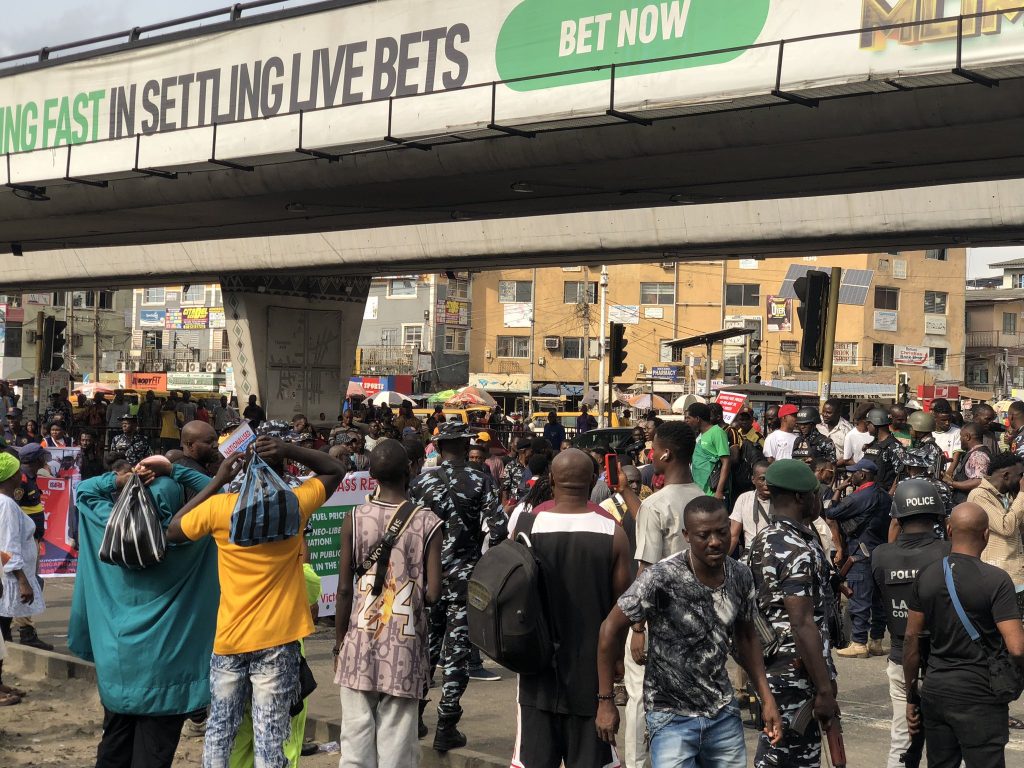
As the protest kicked off this morning, hundreds of protesters marched in Ikeja, the Lagos State capital. The protesters who marched through Obafemi Awolowo Road carried placards with the bold message “Enough is Enough” for hunger and hardship.
When they arrived Alausa Secretariat, the seat of government, they met the Divisional Police Officer, DPO, of the Alausa Police Station at the scene. She requested the protesters to relocate to Gani Fawehinmi Park, Ojota which was the authorised venue for protests.
The demonstrators who repeatedly chanted “End Bad Government,” vowed to continue their march to Ojota in their determination to make their voices heard.
It would be recalled that a Lagos High Court presided over by Justice Emmanuel Ogundare on Tuesday July 30 had given a judgement in a preemptive ex parte application filed by the state Attorney -General and Commissioner for Justice, Lawal Pedro, seeking to maintain and secure public safety and prevent irreparable loss of lives and damage to property in the state during the period of the protests.
The ruling mandated that the organisers and other residents of Lagos aiming to participate in the demonstration to converge and remain inside the Gani Fawehinmi Freedom Park in Ojota and Peace Park, Ketu area of the state.
Notwithstanding, the restriction, banks, eateries, fuel stations and other business concerns remained under lock and key throughout the day. The roads were virtually empty while few commercial buses, popularly called Danfo, operated.
Armed security personnel took strategic positions across the metropolis. A special security team tagged: CP Tactical Squad, Lagos State Police Command, was stationed at Egbeda Bus Stop, to monitor development.
Armoured Personnel Carriers, APC, and vans were seen stationed at strategic points at Gani Fawenhimi Freedom Park as well as Peace Park, Ojota area.
In Ibadan, the protesters commenced early in the morning at the Iwo Road Interchange and thereafter occupied major roads to drive home their demands.
The protesters, armed with placards various inscriptions vowed not to back down in their agitations until their demands are met.
Security personnel were also on full alert to avert any possible violence.
Commercial and business activities were crippled in the political capital of the defunct Western Region as residents stayed indoors for fear of civil unrest by the protesters.
Some of the popular markets and business stores in the ancient city such as Bodija, Oje, Ojoo, Adelabu, Orita Challenge were closed for business activities.
Similarly, few workers reported for duties at the Oyo State Government Secretariat, Agodi with heavily armed security agent on standby.
In Osun State, the protesters hit the major streets of Osogbo, the state capital, despite an early morning rain.
They started their march from Freedom Park, Osogbo, and moved through the popular MDS Road to Olaiya Junction where the protesters, accompanied by armed security operatives, addressed journalists.
The protesters armed with a large banner with the inscription ‘End bad governance in Nigeria,’ sang songs to express their frustrations over the poor state of the economy.
Speaking on behalf of the protesters, the Osun State Coordinator, Coalition of Concerned Nigeria Citizens, Adetunji Ajala, demanded a return of the pump price to N180 per litre.
“Pump price is N800 per litre today. It is not a question of either APC or PDP. What we are going through in this country is affecting everybody and it was caused by bad governance.
“Tinubu should review the policies. We are hungry. The protest is going to last for ten days. We want the pump price to return to N180 per litre,” Ajala said.
“Hunger, poverty and bad policy of this administration are affecting all of us. We are here not because of any political affiliation, not because anybody has given us money. What we have here is a reflection that people are displeased.
“The youth population is the largest and they are the ones suffering most.
We are not afraid of anybody. What we have come to do is to exercise our rights.”
Due to the protest, banks and commercial shops were shut in the state capital.
The ever-bubbling Osun Mall was also shut, while there was a heavy presence of security personnel, comprising the army, police, and NSCDC within the mall premises.
Security personnel were also seen at some strategic locations within the state capital, while others were patrolling the major roads.
However, there were vehicular movements, while the environment was relatively peaceful.
In Ondo State, there were no protests even as markets and shops remained shut. Traders at the Oja-Oba market in Akure were seen playing football along the busy Oba Adesida Road.
Even so, there was heavy security presence at strategic locations around Akure and environs.
Protest did not hold in Ondo State because various stakeholders were approached and talked out of the agitation. Governor Lucky Aiyedatiwa had met with students of Ondo State origin in tertiary institutions.
The students under the auspices of National Association of Nigerian Students, NANS, National Association of University Students, NAUS, National Association of Ondo State Students, NAOSS, National Female Students Association and indigenous student associations in the State, reasoned with the governor and refused to join the protest.
But top government officials resumed for work at the state Secretariat while the junior workers stayed away.
Security personnel manned strategic locations in the metropolis especially the CBN office, Federal Secretariat and other government structures in the state capital.
Police patrol vehicles went round major streets in the state capital while few vehicle owners, commercial taxi drivers and motorcycles operators were plied their trade within the roads in Akure metropolis.
In Ekiti State, the #EndBadGovernance failed as there was no protest. Banks, markets and traders opened for business.
The relative peace was due to the state government’s earlier meetings with various interest groups including monarchs, student leaders, market women, artisans, drivers’ unions and the security agencies on why they should not take part in the planned protest.
Although there was no threat to peace, armed security men were stationed in strategic places to ensure free movement of persons.
Consequently, banks along the popular Bank Road, opened for business, while traders on the corridor transacted businesses in their shops peacefully.



