

BY MYKE UZENDU
The Independent National Electoral Commission, (INEC), has re stated that the commission does not receive direct funds from its external partners , including the European Union
This is as it clarifies that INEC does not also have any designated account into which donor funds are warehoused.T
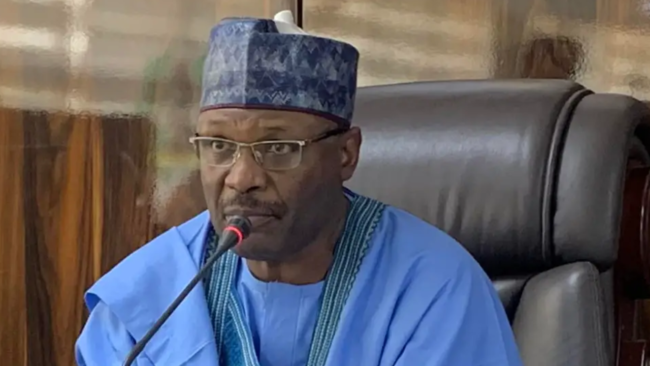
INEC chairman, Professor Mahmoud Yakubu made the clarification when he received the new European Union Ambassador to Nigeria and ECOWAS, Gauntier Mignut, at the commission’s headquarters on Tuesday in Abuja
Yakubu however explained that the European Union, EU, and other development partners have remained supportive to INEC’s quest for delivering transparent election and nurturing the nation’s democratic process by providing indirect support in areas such as the publication of reports, retreats, engagement with stakeholders, as well as consultancy and technical support services in various areas, through the implementing partners selected and appointed by them.
Professor Yakubu noted further that the support by EU and other development partners does not involve any direct funding of core electoral activities of the Commission such as voter registration, production of PVCs, training and renumeration of ad hoc staff, electoral logistics, and the procurement of sensitive materials, including election technologyT
Tthese activities, he pointed out, remain the sovereign responsibility of the Federal Government of Nigeria.
According to the INEC Chairman, “I would like to seize this opportunity to clarify a matter over which there is some misunderstanding in certain quarters. “For the record, the Commission does not receive direct funding and we do not have an account into which donor funds are warehoused.
“The EU and other development partners provide indirect support in areas such as the publication of reports, retreats, engagement with stakeholders, as well as consultancy and technical support services in various areas, through the implementing partners selected and appointed by them.
“Their support does not involve any direct funding of core electoral activities of the Commission such as voter registration, production of PVCs, training and renumeration of ad hoc staff, electoral logistics, and the procurement of sensitive materials, including election technology.
“These activities remain the sovereign responsibility of the Federal Government of Nigeria”, he explainedC
Continuing, Yakubu said, “I wish to reiterate our commitment to sustaining our regular consultative engagements with stakeholders.
“We are aware that election is a multi-stakeholder responsibility.
“Only last week, the Commission met with political parties in the first of our regular quarterly meetings this year. “Similar engagements with civil society, the media and security agencies will soon follow.
“We have also been interfacing with our lawmakers at the National Assembly to facilitate the necessary review of the electoral legal framework ahead of the next General Election.
“Furthermore, the Commission has already commenced work on the review of our planning tools such as the Strategic Plan and the Election Project Plan for future elections.
“Series of meetings have already taken place over the last couple of weeks involving our staff across the States of the Federation”, he explained.
Yakubu stated that for several years, particularly since the restoration of democracy in Nigeria in 1999, EU’s partnership with the Commission and other stakeholders has helped to consolidate the electoral and democratic process in Nigeriae
He added that there has been incremental improvement in Nigeria’s electoral process over the last six electoral cycles.
He added, “however, we also appreciate that a lot of work lies ahead. Since the 2023 General Election, the Commission has received reports from many of the 206 national and foreign groups and international organisations accredited to observe the elections, including the European Union Election Observation Mission (EU-EOM) which made a total of 23 recommendations of which eight require action by the Commission and 15 by the executive, judiciary and legislative arms of government as well as other stakeholders such as civil society organisations, the media, faith-based organisations and political parties.
“The eight specific recommendations for INEC relate to the dissemination of the Commission’s regulations and guidelines for election, training of election duty staff, deployment of electoral technology, result management process, continuous registration of voters, the cleaning up of the voters’ register, the participation of marginalised groups in the electoral process and voting by Internally Displaced Persons (IDPs)”, he said.



