

BY JOY ODOR
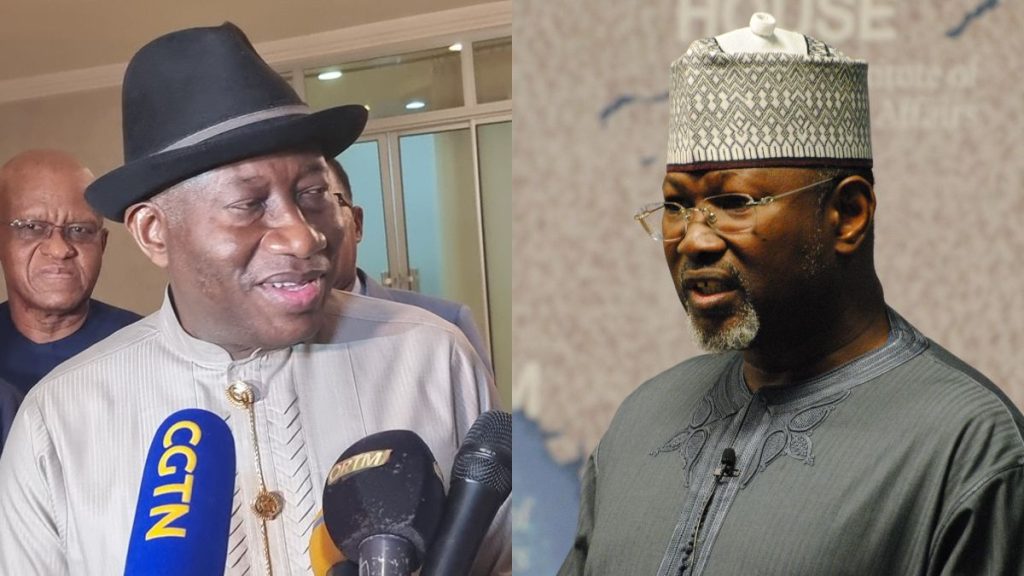
Former President Goodluck Jonathan has reflected on how the introduction of Card reader during the 2015 general election could have led the country into crisis
The former president, who lost the 2015 presidential election to the candidate of the then opposition All Progressives Congress (APC), ex-President Muhammadu Buhari, said the card reader rejected him, his wife and mother and almost sent Nigeria ablaze.
Jonathan, who was the candidate of the then ruling People’s Democratic Party (PDP), made the remarks on Tuesday in Abuja at the YIAGA Africa’s Reflection Conference on Democratic Elections in West Africa.
He emphasized that the success of every election depends on the conduct of electoral management body and the security
The event with the theme ‘Strengthening Democratic Processes in West Africa: Lessons from the 2024 Elections and Prospects for Future Elections’ was supported by the European Commission, ECOWAS, and GIZ.
According to the former president, “Strengthen Electoral Institutions: Independent and impartial electoral commissions as well as non-partisan security operatives are the cornerstone of credible elections. We must invest in building the capacity of these institutions and safeguarding their independence from political interference.
“I always hold the view that the success or failure of any election lies in the hand of two critical agencies which are the the electoral management body and the police.
“It goes without saying that the stability of a democracy is strongly tied to the way its elections are conducted and policed. If elections are not properly managed by security personnel who, must be fair and just, the credibility of the electoral process and, by extension, the legitimacy of governance, could be undermined,” Jonathan said.
He also commended the increasing role of youth in the electoral process, describing their participation as one of the most crucial developments in recent electoral reforms.
Narrating his experience , he said, “When Jega was there, he introduced the card reader, but during the election, the card reader rejected me and almost set the country ablaze. Because the card reader rejected me, rejected my wife, rejected my mother,” he said.
He however emphasized the importance of technological advancement in the electoral process across the West African sub region despite the challenges, while calling on other African nations emulate the significant progress in electoral processes in countries like Liberia, Senegal, and Ghana, noting how these improvements had fostered greater democratic participation.
He said, “It must be stated that high voter turnout in Liberia, Senegal, and Ghana, as well as the official transition of power in these countries, demonstrated public enthusiasm for democratic participation and consolidation.
“And I must commend the elections in Senegal. To me, it was one of the best elections I have observed in Africa and a few outside Africa.”
Delivering the keynote address, former INEC chairman, Prof. Jega, acknowledged concerns over democratic backsliding in the region but stressed that citizens still strongly desire accountable and representative governance.
“In spite of the worrisome evidence of backsliding of democratic progress in the West African region, there remains a substantial appetite among citizens for representative and accountable democratic government,” Jega said.
He noted the need for citizens, civil society organizations, and democratic political actors to mobilize effectively for credible and sustainable democratic development.
He said, “Electing good representatives in governance and holding them to account would make government more responsible and responsive to the needs and aspirations of citizens for societal progress and socio-economic development.”
Jega also noted progress in strengthening independent election management bodies (EMBs) across West Africa but acknowledged that significant work remains to be done.
Executive Director of Yiaga Africa, Samson Itodo, said that the conference was as a platform for key stakeholders to reflect on the challenges and progress of electoral reforms in the West African region, and the need for sustained efforts towards credible and transparent elections.
He said that the discussions was to provide a comprehensive analysis of the 2024 elections, shedding light on key challenges and opportunities for improvement.



