

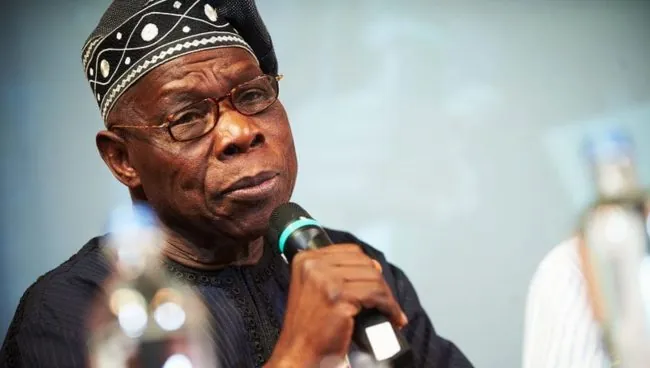
Olusegun Obasanjo, the former president of Nigeria, has expressed concern about the drilling of water boreholes in residential areas, suggesting that the consequences could be disastrous.
He bemoaned that the ongoing drilling of boreholes, especially in the capital of Ogun State, Abeokuta, was caused by the inability of succeeding administrations to maintain the Oyan Dam project that his military government had started in 1977.
Obasanjo pointed out that drilling boreholes everywhere to obtain water had potentially disastrous consequences.
When the management and employees of the Ogun-Osun River Basin Development Authority (O-ORDA), led by Managing Director Adedeji Ashiru, paid him a visit over the weekend in honor of World Water Day, the former president issued the warning.
The Oyan Dam was built to provide water and electricity to the people of Ogun and Lagos State, but regrettably, 48 years later, it has failed to live up to the expectations, Obasanjo said.
“Oyan Dam was constructed to supply water to Abeokuta and Lagos, but like the turbine for the power supply, it has been neglected and ignored,” he stated.
I don’t know how long we will have it, but the geologist can do their job and tell us how quickly the consequences will materialize. “The water supply is not there for Abeokuta and we have instead continued to dig holes everywhere causing the water level to go down and down.
The significance of water for human life cannot be overstated, which is why we say that it has no enemies.
As Military Head of State in 1977, I realized that strategic water management was essential to our efforts to provide food security and sufficiency. As a result, we established 11 River Basins, including Lake Chad.
And what are we attempting to accomplish? If we are forced to rely solely on rain-fed agriculture, we will undoubtedly fail. Droughts, floods, and too-early or too-late rains can all have a significant impact on food production and security.
Effective water management for agriculture is therefore the first step in any action intended to promote food security. In order to guarantee year-round agricultural, irrigation infrastructure are present in every river basin, the former president continued.
The management of O-ORBDA chose to visit the former president and honor him for his vision in creating the 11 river basins 48 years ago, according to Ashiru, MD of O-ORBDA, who spoke earlier.
He revealed that the Sustainable Development Goal 6 of the UN, which focuses on sanitation and clean water, encapsulated Obasanjo’s vision for sustainable development and efficient water management that dates back to 1977.



