

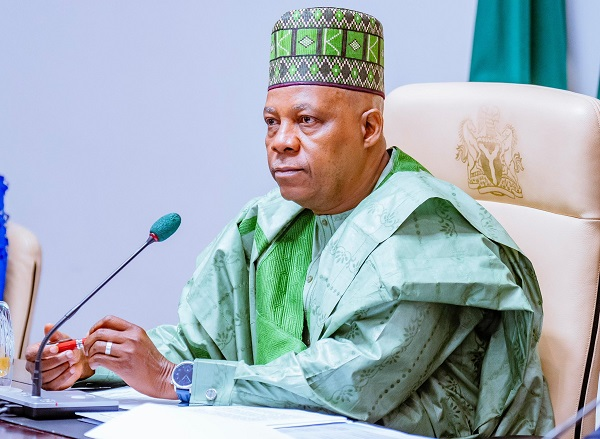
Citing time restrictions, the National Economic Council (NEC) postponed its talks on the proposed state police formation Thursday during its lengthy meeting in the State House’s Council Chambers in Abuja.
The idea for state police, a subject of growing public interest, was supposed to be discussed but was not reached before the meeting concluded, according to information obtained.
Douye Diri, the governor of Bayelsa State, acknowledged that the state police issue was on the agenda for Thursday’s meeting; however, the debate was postponed because of the lengthy presentations on other subjects.
Our schedule for today included state police, but regrettably, due to time constraints, the presentations took a long time. We couldn’t reach that portion of it. Governor Diri assured reporters during the post-NEC media briefing that the matter would be thoroughly reviewed at our next meeting.
The postponement of the state police idea coincides with growing demands for more state-level protection.
The plan was last considered by NEC in December 2024, at which time it was said that all states had endorsed it.
The council held a minute of silence to honor the victims of recent violent assaults in Plateau and Benue states, underscoring the mounting worries over national security and highlighting the gravity of the problem throughout the meeting.
The Agriculture Sector Takes the Lead
Due to the postponement of the state police discussion, the briefing swiftly turned its attention to other urgent agenda issues, especially those pertaining to agriculture.
Along with his counterparts from Imo, Ekiti, and Bayelsa states, Abdullahi Sule, the governor of Nasarawa, gave updates on important agricultural projects.
Governor Sule addressed persistent reservations about the National Livestock Transformation Plan (NLTP), a program aimed at reducing conflicts between farmers and herders by implementing contemporary ranching practices.
Sule, whose state hosted the NLTP’s most successful trial, admitted that the program’s wider deployment was impeded by major difficulties, especially with regard to funding.
Sule clarified that the NLTP, a collaboration between the Dutch government and the Federal Ministry of Agriculture, had difficulties when it first started, particularly with regard to funding.
He pointed out that these problems were not entirely fixed prior to the 2023 elections, which hindered the plan’s nationwide expansion.
Sule, however, was upbeat about a fresh program run by the Ministry of Livestock Development that aims to get past the previous challenges.
“I’m pleased to report that this was communicated to the ministers. It wasn’t considered a waste. Many of the trainees are now training others after moving on to other programs, such as the RUGA initiatives, Sule explained.
In response to complaints about land invasion at the Nasarawa pilot ranching site, Sule clarified that the villagers were permitted to temporarily restart farming in order to save the area from becoming unusable.
In the strictest sense, it was not an incursion. The communities that once farmed the land were permitted to return to agricultural use because it would be difficult to cultivate it again if left idle.
Contemporary Remedies for Farmer-Herder Conflicts
Governor Diri also discussed the necessity of contemporary approaches to resolve the persistent problem of disputes between farmers and herders. As part of the ministry’s endeavors to improve the agricultural sector, he underlined the significance of peacebuilding projects and cattle ranching.
The ministry’s equally disclosed follow-up to the NLTP today demonstrates the modernization of the sector. More significantly, peacebuilding and cattle ranching are being prioritized,” Diri stated.
The conference on Thursday reiterated the NEC’s commitment to addressing the twin concerns of food security and national security, even if it was unable to cover all of the scheduled agenda items.
All eyes will be on whether the long-awaited discussion about state police will finally take center stage as the next NEC session approaches, especially because the matter is still a hot topic among Americans.



