

BY SAM OTUONYE
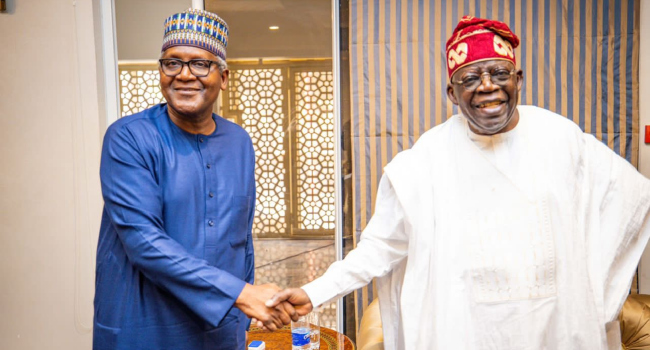
President of the Dangote Group and Africa’s richest man, Alhaji Aliko Dangote recently made a high-profile visit to President Bola Tinubu at the Villa, and to the new Nigerian National Petroleum Company Limited (NNPCL) helmsman, Mr. Bashir Bayo Ojulari. His mission? To show support for the new leadership and signal his readiness for battle in Nigeria’s oil sector, a war that’s already heating up.
In his meeting with Tinubu, Dangote commended the President for assembling what he called “a formidable and professionally competent team” to lead the NNPC into a new era. He praised Tinubu’s vision for reform and innovation, and didn’t mince words about the stakes.
According to Dangote, entrenched forces in the oil sector who are the major marketers and traders are actively working to frustrate his $20 billion refinery. He reiterated a statement he made earlier: he is ready to “fight to a standstill” the cabals resisting his efforts. But he clarified that his war is not with the new NNPCL leadership, which he described as cooperative and committed to progress.
Meeting with GCEO Ojulari, Dangote doubled down on his support, saying the new management “brings a wealth of technical expertise and managerial experience essential for revitalising Nigeria’s most strategic public enterprise.”
He expressed confidence that Ojulari and his team would tackle systemic challenges, align with the President’s vision for a $1 trillion economy, and reposition the NNPCL for excellence and sustainability. “We are confident that this team will address systemic challenges… and reposition NNPC Limited for operational excellence and long-term sustainability,” Dangote declared.
Both men pledged to maintain a collaborative and competitive relationship between their organisations, promising productive engagement for the good of the country.
But beneath the handshakes and high-level courtesies, Dangote’s public comments reveal a man under siege. At a recent investor forum in Lagos, he admitted his refinery is still “fighting for survival” in the face of sabotage. He pointed fingers at unnamed oil cabals, people who, for years, profited from subsidised imports who now see his refinery as a threat to their monopoly.
“We are fighting, and the fight is not yet finished,” Dangote said. “But I have been fighting all my life, and I’m 100% sure I will win at the end of the day.”
On Friday, May 9, the Depot and Petroleum Products Marketers Association of Nigeria (DAPPMAN) fired back. The group dismissed the cabal narrative, warning instead of a looming monopoly in the downstream sector and is Dangote’s monopoly.
Olufemi Adewole, DAPPMAN’s Executive Secretary, argued that the real danger lies in one player—Dangote’s dominating supply, pricing, and distribution. “You can’t stop importation today,” Adewole warned. “That would create chaos and a monopoly… It can be stopped only when we have adequate local production from multiple sources, not just one.”
He admitted the existence of “vested interests” among depot owners but rejected the label of cabals. “These are people who have invested billions over the years to keep fuel flowing when no one else did,” he said.
The Petroleum Refineries Owners Association of Nigeria (PETROAN) echoed similar concerns. Its National President, Dr. Billy Gillis Harry, urged caution over a blanket ban on petroleum imports, warning that Nigeria’s domestic refining capacity remains “fragile.”
Harry argued that banning fuel imports while relying solely on Dangote’s refinery could lead to “severe market distortions,” particularly in essential sectors like petroleum and pharmaceuticals.
The rift between the NNPCL and Dangote didn’t start overnight. Prior to the new leadership, both parties had locked horns over pricing, blending, product quality, and crude supply. At one point, Dangote even suggested the NNPC should buy him out.
“They have labelled me a monopolist. That’s an incorrect and unfair allegation,” Dangote said. “But it’s okay. If they buy me out, at least their so-called monopolist would be out of the way.”
Dangote also accused some NNPC officials of operating a secret blending plant in Malta to sabotage his operations, a claim the former GCEO Mele Kyari strongly denied, calling it a serious allegation with national security implications.
Kyari, it’s worth noting, was once one of Dangote’s biggest backers. In 2021, the NNPC agreed to acquire a 20% stake in the refinery. That figure eventually dropped to 7.2%, with NNPC citing a pivot toward cleaner energy like compressed natural gas (CNG).
Dangote, however, believes the NNPC made a strategic blunder. “We gave them a good deal,” he said. “But they changed their minds and decided to stick with 7.2%. That’s fine. But there’s no negotiation anymore. That agreement is dead and buried.”
Despite the fallout, Dangote confirmed that the NNPC had pledged to supply 390,000 barrels of crude per day starting in October, with payments to be made in naira—a move that could ease pressure on the local currency by as much as 40%.
Dangote’s refinery is the most ambitious industrial project in Nigeria’s history, and he has every right to defend his investment. But other players in the sector also have a right to compete and survive. The spectre of monopoly, whether real or perceived, cannot be ignored.
Now that the NNPCL has a new leadership team and Dangote is extending a hand of cooperation, it’s time for the federal government and regulators to broker a new kind of oil diplomacy, one rooted in transparency, fairness, and national interest.
If the Tinubu administration can balance these forces by protecting legitimate private investment and preventing market distortion, it might just write a new chapter in Nigeria’s oil story which is one of shared prosperity and not perpetual conflict.



