

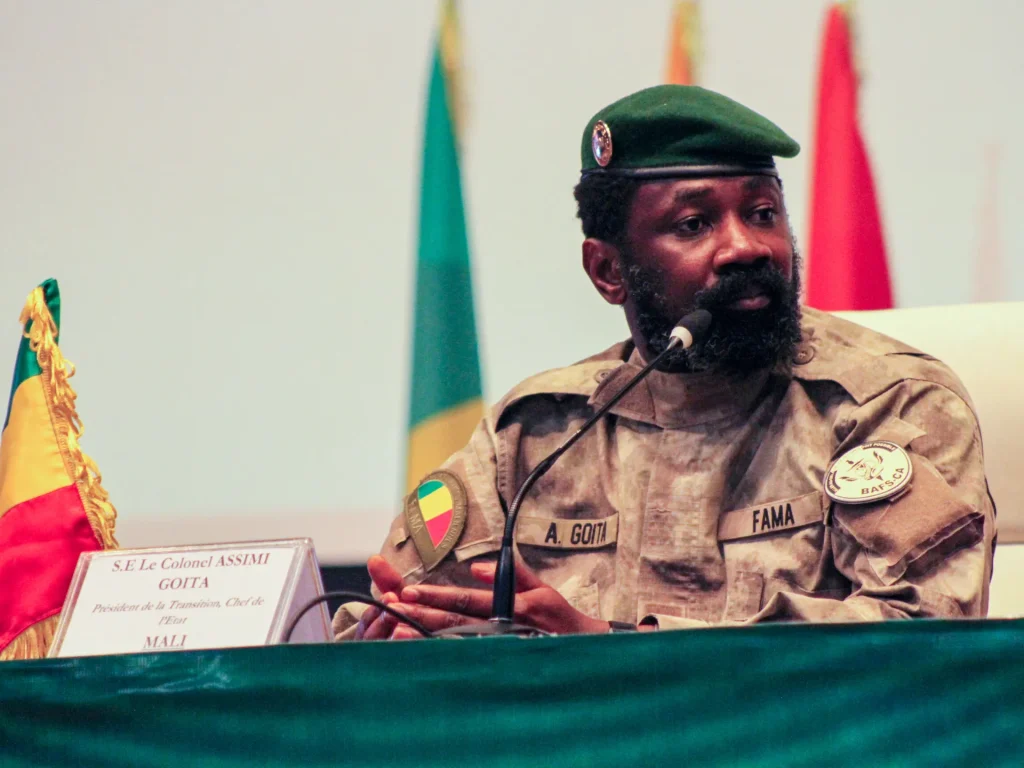
The political class in the Republic of Mali have risen to protest the military regime’s ban and dissolution of the political parties in the now Sahel region country
The military government on Tuesday, announced the scrapping and dissolution of all political parties in the West African country
The scrapping, which was contained in a presidency decree, is the latest attempt by the military leaders to clamp down on the opposition since the junta seized power.
Opposition parties had envisaged the move for weeks, leading to their banding together into a hundred-party coalition to demonstrate in a rare act of open defiance since back-to-back coups in 2020 and 2021 brought the army to power.
Hours after the head of the military regime, General Assimi Goita approved the suspension of a political party’s charter, a step on the road to dissolution, the authorities announced the dissolution of “political parties and political organisations”.
The military decree, which was announced on national television bans “all meetings of members of political parties and organisations of a political character”.
Yet, junta officials working for the Malian state’s political and administrative institutions “may pursue their mission without having to identify themselves as representatives of political parties”, the decree added.
The latest act of repression comes on the recommendation of a national assembly organised in late April, which was all but boycotted by the opposition.
Besides the suspension of the political parties’ charter approved by Goita earlier on Tuesday, which allowed for the parties’ dissolution, the April assembly also proposed handing the junta chief a five-year renewable presidential term without a vote.
Citing the risk of disturbances to public order, the junta had already suspended all political party activities on May 7, a ban which drew fire from the opposition and calls for repeal from UN experts.
That squeeze on civic space comes against a backdrop of demands by the authorities for the country to unite behind the military, which had originally committed to hand power back to civilians by March 2024 but has since reneged on that promise.
Since 2012, Mali has been mired in violence carried out by jihadist groups affiliated with Al-Qaeda and the Islamic State group, as well as other criminal organisations.
Fearing dissolution, a coalition of roughly 100 parties recently formed to demand an end to junta rule by December 2025, calling for “the establishment of a timetable for a rapid return to constitutional order”.
In a rare act of protest against the junta, the movement drew several hundred people for a demonstration in the capital, Bamako, in early May.
Malian Director General of Territorial Administration Abdou Salam Diepkile, however disagreed.
“The repeal of this law does not call into question the existence of political parties,” Diepkile told public broadcaster ORTM.
He said the decision was in line with the desire to “stop the proliferation of political parties” in the country.
Some Malians seem to agree with him, as many went onto the street recently to declare their support for the government’s actions.
Experts and opposition figures are expressing deep concern over the military government’s decision to dissolve all political parties. The move, announced today, is seen as a significant blow to democratic institutions and opposition voices in the country.
Former justice minister Mamadou Ismaila Konate described the dissolution as an attempt to “systematically demolish political countervailing powers” in Mali.
Human rights organisations and UN experts have criticised the junta’s increasing restrictions on political activity, warning that the suppression of opposition parties could further destabilise Mali, which has been grappling with jihadist violence and political turmoil since 2022.
The journalists who wouldn’t want their names in print for fear of attack said the regime was planning to stifle all opposition to its hold on power.
“The news broke just two hours ago. For the moment, there has been no reaction from political parties or politicians. Now we can say that we are officially in a dictatorship,” one of them said.
The junta had suspended French television channel TV5 Monde for a reportage on the May 3 demonstration, which the authorities argued “lacked a commitment to impartiality”, according to a ruling from Mali’s communications regulator.



