

BY DAVID ADUGE-ANI
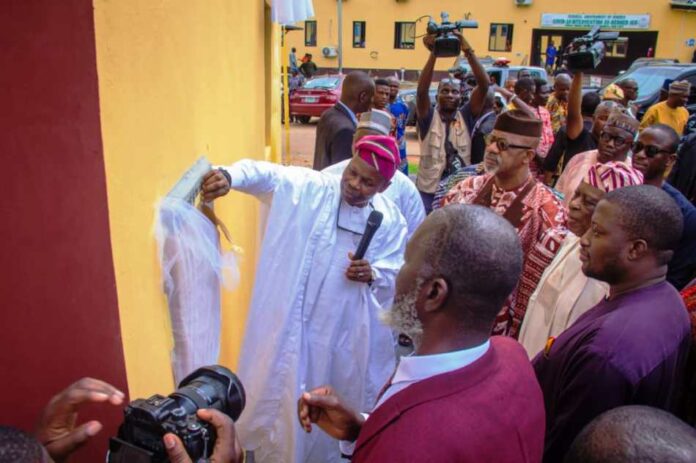
The Federal Government, through the Federal Ministry of Health and Social Welfare, has commissioned five major infrastructure projects at the Federal Medical Centre (FMC), Abeokuta, Ogun state.
Our reporter gathered that the projects, executed under President Bola Tinubu, were designed to enhance service delivery, improve population health outcomes, and working conditions.
Speaking at the event, the governor of Ogun state, Prince Dapo Abiodun, emphasised the importance of collaboration among healthcare stakeholders and pledged continued state government support for health innovation.
According to him: “The Federal Medical Centre (FMC), Abeokuta, and other medical institutions across the state played a crucial role in delivering efficient and effective medical care”.
“We extend this assurance to other sectors as well, recognising that collaborative partnerships among stakeholders are essential for inclusive and sustainable development.”
He called on all health institutions within Ogun state, regardless of ownership, to strengthen partnerships among themselves and with the state government.
“What matters to the people is not who delivers the care, but that the care is delivered effectively,” Governor Abiodun noted, quoting former UN Secretary-General Kofi Annan: “Health will finally be seen not as a blessing to be wished for, but as a human right to be fought for.”
In a significant gesture, Governor Abiodun announced the donation of the Ogun State Model College building at Onijogbon-Jongon in Abeokuta, to serve as the take-off infrastructure for the newly approved Federal University of Medicine and Medical Sciences, Abeokuta.
“Following the request of the Minister of Education, Dr. Tunji Alausa, and in appreciation of the Federal Government’s approval of the university, we have decided to donate yet another existing facility,” the governor declared. “This marks the second time we are making such a contribution for the benefit of federal health education.”
He expressed gratitude for the naming of the newly commissioned Works and Maintenance Department building after him, saying, “I feel deeply honoured as this is the first public building to bear my name.”
In his remarks, the Minister of State for Health and Social Welfare, Dr. Iziaq Adekunle Salako, praised the projects as a key milestone in the ongoing transformation of Nigeria’s healthcare landscape.
In a statement by the deputy director, information and public relations, Alaba Balogun, Dr. Salako commended recent economic reforms by President Tinubu that have granted autonomy to Nigeria’s 774 local government areas, unlocking fresh opportunities for grassroots-level healthcare funding.
“The Basic Health Care Provision Fund (BHCPF), which draws 1% from the Consolidated Revenue Fund, has been reorganised for greater transparency and timeliness in disbursement,” Dr. Salako said.
To ensure efficient utilisation of resources, Nigeria is adopting a bottom-up budgeting approach, strengthening program integration, leveraging digital health technologies, and improving tracking of expenditures through the National Health Accounts and resource mapping systems.
“Nigeria is not only focused on mobilising more funds but also on spending smarter,” he emphasised.


