

…As external reserves increase significantly
BY PETER USMAN
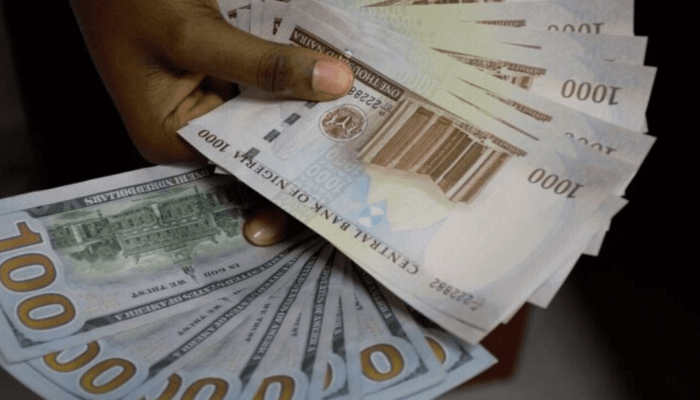
In a move that coincided with an uptick in Nigeria’s external reserves, the naira concluded trading for the month of May, 2025 on a positive note in the official foreign exchange (FX) market, appreciating by N16.03 against US dollar.
The official data released by the Central Bank of Nigeria (CBN), revealed that the local currency closed on Friday, May 30, at N1,586.15 to the dollar. This marks a slight appreciation of 1.01 percent compared to the rate of N1,602.18 per dollar recorded at the beginning of the month on May 2, at the Nigerian Foreign Exchange Market (NFEM).
While the naira gained value in the official FX segment, the situation was quite different in the parallel market. Consequently, the currency experienced a decline of 0.9 percent, ending the month weaker as the dollar was exchanged for N1,620 on Friday, May 30. This marks a N15 depreciation compared to the exchange rate of N1,605 that was quoted at the beginning of the month.
The divergence in performance between the official and parallel market segments highlights the ongoing volatility and segmentation within Nigeria’s FX landscape.
In a development that adds some optimism to the broader macroeconomic outlook, Nigeria’s external reserves showed a modest improvement over the course of the month.
The CBN figures revealed that the reserves increased by $460 million or 1.2 percent, climbing from $38.00 billion at the beginning of May to $38.46 billion as of May 29, 2025. This increment signals improved dollar inflows and may provide the CBN with more leverage to sustain its market interventions aimed at stabilising the naira.
Commenting on the currency’s near-term outlook, analysts at Afrinvest Securities Limited projected that the naira could maintain its current trajectory in the coming month.
“Next month, we anticipate the naira will maintain similar performance across FX segments, supported by CBN’s continued intervention,” the analysts stated, suggesting that ongoing efforts by the apex bank could help manage the volatility and reinforce confidence in the market.
With the recent signs of relative stability, some experts believe the naira remains significantly undervalued.
The Chief Executive Officer (CEO) of CFG Advisory, Tilewa Adebajo, said that based on the country’s current economic fundamentals, the local currency should be trading well below N1,000 to the dollar.
In a detailed analysis titled “Shouldn’t the Naira Be Trading Below 1,000/$?”, Adebajo pointed to improvements in several key areas of the economy that, in his view, justify a stronger naira.
He identified three major factors contributing to this perspective: the emergence of a more transparent FX market, enhanced external reserves, and increased oil production.
He also underscored the narrowing gap between the official and parallel FX markets, which he attributed to structural reforms introduced in the last two years.
Adebayo said, “The spread between the official and parallel FX rates has narrowed from over 50 percent in 2022 to under 5 percent in 2025.”
He credited this achievement to the adoption of a Bloomberg-driven bid and offer platform, which has improved transparency and price discovery in the FX market.
In December 2024 the CBN issued a directive mandating all banks in the interbank FX market to use the Bloomberg BMatch system for foreign exchange transactions.
He emphasized that FX flows have improved significantly, with inflows consistently surpassing outflows since January 2024.
“In 2025, average monthly FX turnovers have grown to $8.1 billion, compared to $5.5 billion in 2024,” he added, pointing to a clear upward trend in market activity.
Adebajo further stressed that Nigeria’s external financial buffers have strengthened considerably over the past year. External reserves surged from $30 billion in March 2024 to $40 billion by September of the same year, before stabilising at about $38 billion in early 2025.
He also cited a dramatic recovery in the net reserve position, which had plunged to just $4 billion in 2023 but rebounded to $23.1 billion by the end of 2024, a more than fivefold increase that reflects improved fiscal and external sector management.
The month of May also saw the CBN take a significant step in engaging with the Nigerians in the diaspora, through the formal launch of the Non-Resident Diaspora Bank Verification Number in partnership with the Nigeria Inter-Bank Settlement System (NIBSS).
The initiative aims to deepen the financial integration of Nigerians living abroad, thereby strengthening the country’s FX inflow base through remittances and other diaspora-linked financial activities.
The CBN Governor, Olayemi Cardoso, reaffirmed the Bank’s commitment to attracting as much as $1 billion in monthly diaspora remittances.
He highlighted the importance of strict adherence to the FX Code and compliance with regulatory frameworks as essential steps toward fostering trust and ensuring long-term market stability.
“These measures are crucial in anchoring expectations, improving market confidence, and supporting a more stable and efficient FX regime,” Cardoso said.



