

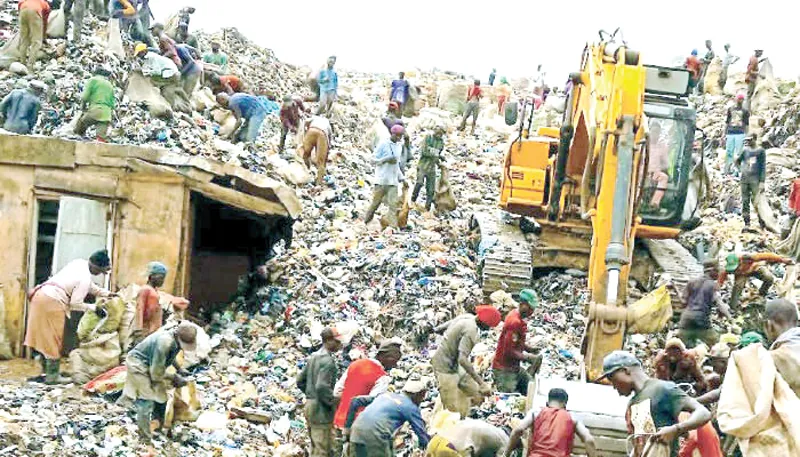
In major towns across the country, scavengers have become a source of terror and security threat. Nowhere is safe from their antics. They not only cart away people’s valuables but also kill unsuspecting residents who try to block them in their nefarious activities.
Early this year, the problem posed by scavengers was so much that members of the Lagos State House of Assembly, on January 21, 2025, resolved to curb the illegal activities of scavengers in the state.
The lawmakers made the resolution during plenary while debating the motion titled, “Motion to Curb the Activities of Scavengers and Manhole Theft in Lagos”, moved by Hon. Gbolahan Yishawu (Eti-Osa 2).
According to the lawmakers, if the menace of scavenging and manhole theft was not checked, it would bring about an increase in accidents and blockage in drainage systems.
This House called on the State Governor, Mr. Babajide Sanwo-Olu, and the Commissioner for the Environment to sanction scavengers and cart pushers to curb their nefarious activities.
In Oyo State, residents of Ibadan last March lamented the menace of scavengers in the city’s neighbourhoods where they often vandalise private and other public property in their aggressive search for disused items and in the process engaged in other crimes.
In their aggressive search for scraps, they have become a pain in the neck of residents.
Residents of Katsina State have not been left out in their condemnation of the activities of scrap metal scavengers, who are allegedly damaging public and private property in their quest for valuable materials.
The worried residents described how scavengers, some as young as school-age children, were roaming the streets as early as 6a.m. in search of scrap metals, iron rods, rubber, armoured cables, and aluminum objects.
“Sometimes these children even jump into uncompleted buildings to destroy lintels and steal iron rods,” lamented Dr. Habibu Kamilu, a Katsina resident.
The issue of scavenging and scavengers has reverberated in many other states, communities and towns.
Now, it is the turn of the FCT to voice out its disenchantment with the almajiris who wander around the towns looking for disused iron, condemned automotive batteries, copper, aluminum, disposable plastics, etc. to sell to recycling plants or steel rolling companies.
And attempts to curb their activities have been resisted vehemently. For example, aggrieved residents of the FCT, through a lawyer, Abba Hikima, had sued the FCT Minister, Nyesom Wike and the Inspector-General of Police (I-GP) as 1st and 2nd respondents.
Hikima, who is the applicant, also joined the Director-General of the Department of State Services (DSS), the Nigeria Security and Civil Defence Corps (NSCDC), Attorney-General of the Federation (AGF), and the Federal Government of Nigeria as 3rd to 6th respondents respectively.
The litigants demanded N500 million in damages over an alleged breach of their fundamental rights.
An exasperated Wike on June 2 told the Federal High Court in Abuja that the increasing rate of scavengers, beggars, and homeless people in FCT was posing serious security threat to residents.
Wike, in a counter-affidavit filed in opposition to the case instituted on behalf of the alleged vulnerable FCT residents, told Justice James Omotosho, the trial judge, to dismiss the N500 million suit in its entirety.
The minister, who made this known in the counter affidavit deposed to by Saidu Abdulkadir, an officer in the Legal Services Secretariat, Federal Capital Territory Administration, FCTA, said that many of the “purported scavengers” have been arrested in various acts of vandalising private and public property, and in most cases serve as spies to kidnappers, criminals, and terrorist organisations.
Addressing the situation demands a more radical approach by all levels of government. For scavengers to be able to afford a lawyer in order to legitimize an inglorious trade by youths who ought to be in schools calls for concern.
We call on all state governments to begin to take urgent measures and implement effective solutions such as vocational skills training for youths, to eradicate or curb the dangerous phenomenon.
“For scavengers to be able to afford a lawyer in order to legitimize an inglorious trade by youths who ought to be in schools calls for concern.”



