

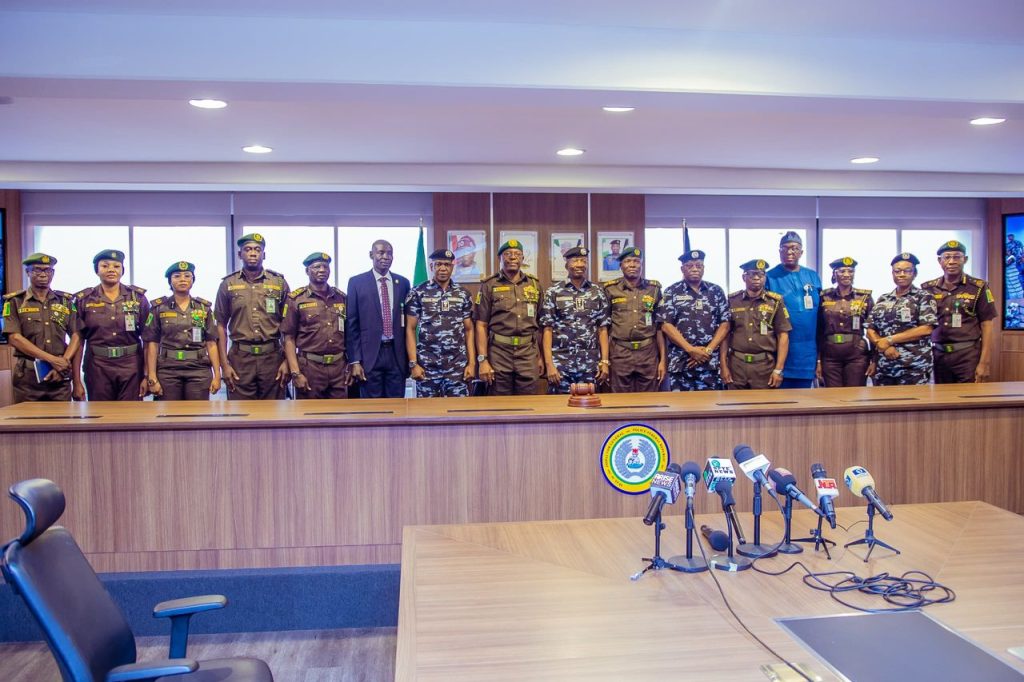
Building on previous bilateral agreements and joint efforts to address trade-related issues, Nigeria and India have reaffirmed their commitment to strengthening customs cooperation. Nigeria’s Comptroller-General of Customs, Bashir Adewale Adeniyi, met with Surjit Bhujbal of India’s Central Board of Indirect Taxes and Customs (CBIC) on June 25, 2025, at the 92nd Session of the World Customs Organization (WCO) Policy Commission in Brussels to further ongoing discussions on trade facilitation and customs reform.
The main focus of the meeting was the Customs Mutual Administrative Agreement (CMAA), which was signed by both nations during the Indian Prime Minister’s state visit to Nigeria on November 16, 2024. Officials claim that since then, the agreement has established a strong basis for collaboration in crucial areas like transfer pricing, customs valuation, and the fusion of the tax and customs systems.
A major point of discussion was the rise in international trade involving substandard pharmaceutical products. Both sides acknowledged recent joint successes, including seizures in Nigeria made possible through improved intelligence sharing and operational coordination.
CGC Adeniyi summed up the meeting: “Today’s dialogue is a continuation of the strong foundations laid during the signing of the CMAA in November 2024. We are intensifying efforts to tackle undervaluation, abusive transfer pricing, and to improve system integration between customs and tax authorities. Additionally, our joint actions in curbing the importation of substandard pharmaceuticals yield results and protect public health.”
Adeniyi also expressed Nigeria’s interest in broadening the partnership through joint technical missions, data sharing, and training programmes. These efforts, he said, would enhance revenue assurance, strengthen trade enforcement, and boost risk management capabilities.
India, on its part, reaffirmed its commitment to working closely with Nigeria.
“India regards Nigeria as a crucial partner in Africa. The CMAA has opened a structured channel for mutual assistance, information exchange, and capacity building. We are keen to deepen technical cooperation on valuation, combat revenue leakage through transfer pricing schemes, and share our experience integrating customs with tax systems,” Bhujbal stated.



