

……As upper chamber passes N1.48trn Rivers’ budget
BY JOHN DANJUMA
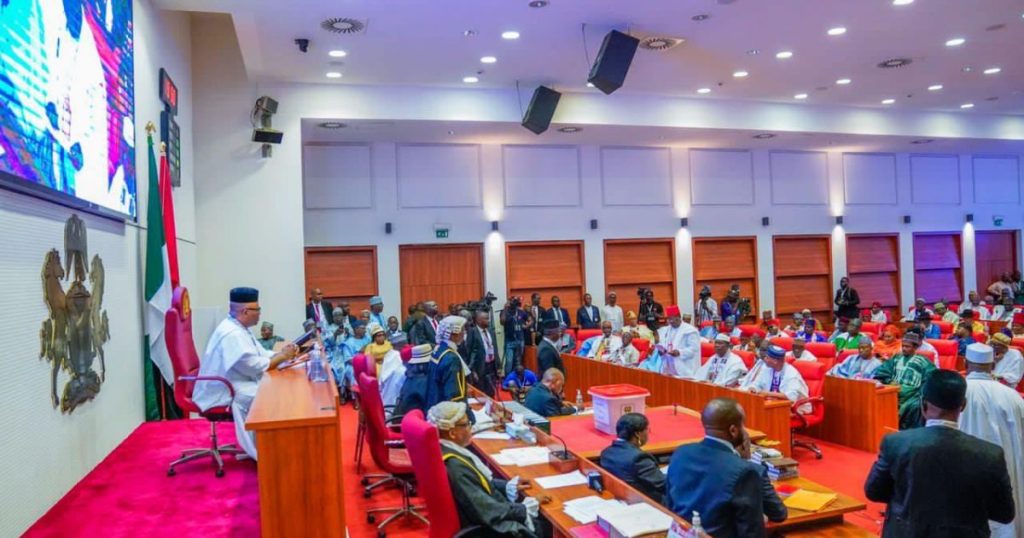
The 10th Senate was again in the news, as members turned Wednesday’s plenary into a heated political showdown, following the confirmation of President Bola Tinubu’s appointment of Dr. Michael Ekpali Odeh, a native of Cross River State, as Chairman of the Rivers State Independent Electoral Commission (RIVSIEC).
The confirmation drew fierce opposition from lawmakers who accused the federal government of sidelining indigenes and deepening political tensions in the crisis-ridden state.
Recall that tempers similarly flared at the red chambers on Tuesday, following the decision of its leadership to block plans to probe the near poor implementation of the 2024 appropriation bill, as well as the extension for another six months for the federal government to continue to implement the budget after the initial six months expired in June without any visible actions.
Odeh’s nomination, made under emergency rule in Rivers, was one of several appointments approved by the Senate, including members of the state’s Civil Service Commission and Primary Healthcare Management Board.
However, it was his origin and the broader implications for democracy in Rivers that lit the fuse in the chamber.
“Let it be on record that I, Senator Abdul Ningi, oppose this decision. It may not stop the confirmation, but the people of Rivers deserve better,” said the Bauchi Central lawmaker.
Ningi, Senator Ali Ndume (APC, Borno South), and Senator Abba Moro (PDP, Benue South) led the charge against the nomination, warning that the decision could further destabilise Rivers, where governance is currently under a federally-imposed administrator, Vice Admiral Ibok-Ete Ibas, also from Cross River.
Despite objections, the Senate Ad-Hoc Committee on Rivers, chaired by Senate Leader Opeyemi Bamidele, defended the appointment. The committee said Odeh met all legal requirements and cited court precedents affirming that public officers need not be indigenous to the states where they serve.
Deputy Senate President, Barau Jibrin, who presided over the session, supported the committee’s recommendation and cited examples such as the current Head of Service in Abia State, an Edo State indigene as evidence that such appointments are not unusual.
“Any Nigerian can be appointed to any office in any part of the country, so long as they meet the constitutional requirements,” argued Senator Mohammed Monguno (APC, Borno).
“We are not just lawmakers. We are custodians of conscience and fairness,” Ndume said. “This appointment may follow the law, but it violates the spirit of equity.”
The debate tapped into deeper anxieties about perceived federal overreach and political interference in Rivers, a state traditionally controlled by the opposition.
Senator Moro warned that pushing through such a controversial appointment in a state already under emergency rule could send the wrong message.
“We must be sensitive to the dynamics in Rivers. Imposing outsiders in critical roles may provoke more instability,” he cautioned.
Some lawmakers also questioned the optics of appointing a non-Rivers indigene, especially one from the same state as the administrator overseeing Rivers.
“It creates the impression of an inner circle controlling Rivers from the outside,” one senator said off the record. “That’s politically dangerous.”
Despite the objections, the Senate voted to confirm Odeh and other nominees. The chamber also approved the 2025 Rivers State budget, amounting to N1.48 trillion, which had earlier been defended by Admiral Ibas before the Bamidele Committee.
Senators Ningi, Ndume, and Moro formally requested that their dissent be recorded in the Senate’s official proceedings.
“We may not have won the vote, but we stood for principle,” one senator told reporters after the session. “This moment will be remembered.”
The confirmation of a non-indigene to lead a state electoral body, especially in a state under direct federal control has set a contentious precedent.
While the ruling party insists the appointment is legal, the opposition warns that it threatens democratic credibility and risks inflaming an already volatile political environment.
As Rivers braces for local elections under an outsider-led commission, the question remains: Will legality be enough to guarantee legitimacy?
The Senate, on Wednesday, passed the Rivers 2025 Appropriation Bill of N1.48 trillion.
The budget approval followed a presentation and consideration of the report of the Senate Ad hoc Committee on Oversight of Emergency Rule in Rivers.
Senate Leader, and appropriation committee chairman, Sen. Opeyemi Bamidele said that for the record, emergency rule is not a substitute for democratic governance in any political climate.
“Rather, it is an extraordinary constitutional measure intended to restore order in times of disorder, promote peace in periods of conflict and ensure stability where there is instability.
“As you are all aware, these provisions legitimately empower both the President and the National Assembly to act in the interest of national stability and constitutional governance.
“Neither the President nor the National Assembly has violated any constitutional provision in the maintenance of national security.
“With respect to the former or specifically in the exercise of our oversight powers guided by the 1999 Constitution to prevent executive absolutism.
“It is upon this premise that the Senate, under the leadership of Sen. Godswill Akpabio deemed it necessary to constitute this ad hoc committee.
“To oversee the implementation of the State of emergency rule in Rivers.
“In line with Section 11(4) of the 1999 Constitution of the Federal Republic of Nigeria (as amended), the National Assembly is constitutionally empowered to make laws necessary for the peace order and good governance of any state.
“This is where the House of Assembly is unable to perform its legislative functions due to prevailing circumstances. This provision directly applies to Rivers”, he said.
Bamidele explained that the committee observed that the 2025 Rivers Appropriation Bill is consistent with the objectives of the emergency rule, adding that 72 percent of the budget was allocated to capital projects which is aimed at driving economic recovery and enhancing public sector efficiency.



