

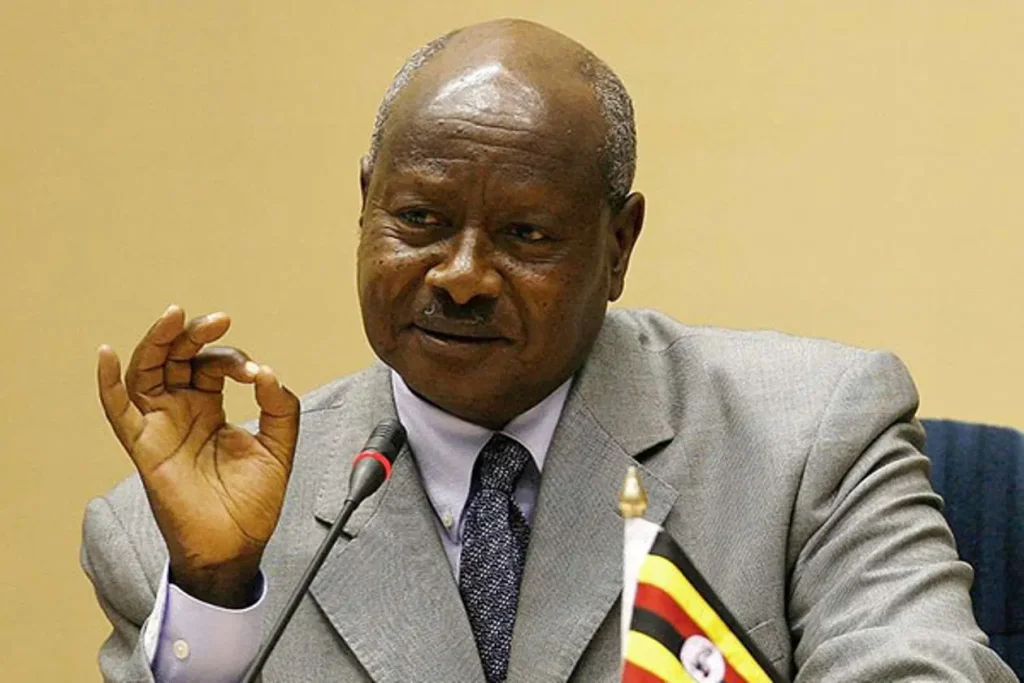
The news filtering out of Uganda must be unpalatable to many watchers of events in that East African country.
Again, the country’s President Yoweri Museveni, will seek reelection for another term of four years in polls due early next year.
When Museveni ran again in 2021, his major opponent, Bobi Wine, whose real name is Robert Kyagulanyi, rejected the results, saying his victory had been stolen through ballot stuffing, intimidation by security forces and other irregularities.
General elections will hold in Uganda in January 2026, and Museveni, 80, who has been in power since 1986 and is Africa’s fourth longest-ruling leader, will contest.
If he wins, and definitely he will, Museveni’s 39 years of rule would have been extended by four more years. Confirmation of the next move of one of Africa’s sit-tight presidents came from a senior official from the ruling National Resistance Movement, NRM, party.
To perpetuate Museveni in power, his party has changed the constitution twice in the past to allow him to extend his rule.
Reports quoted the chairperson of the ruling party’s electoral body, Tanga Odoi, to have declared that the 80-year-old Museveni would pick up forms on June 28 to represent the party in the polls.
“The president … will pick (up) expression-of-interest forms for two positions, one for chairperson of the party and the other to contest if he is given a chance for presidential flag bearer,” Odoi said.
NRM and other political parties are currently vetting and clearing their candidate for the polls.
Museveni’s latest antics have brought to the fore, for the umpteenth time, the opprobrious situation Africa has faced over the years about many heads of state who have held power for extended periods, often referred to as “sit-tight” leaders, and do not see the need to leave the stage.
These leaders have often consolidated their power during independence movements and remained in office for decades.
Among the sit-tight leaders on the continent are Paul Biya in Cameroon, Denis Sassou Nguesso in the Republic of Congo, Yoweri Museveni in Uganda, Isaias Afwerki in Eritrea, Teodoro Obiang Nguema Mbasogo in Equatorial Guinea and Paul Kagame of Rwanda.
Biya has been in power since 1982; Museveni, 1986 while Nguesso has ruled for at least 39 years now.
Afwerki of Eritrea has been in power since the country’s independence in 1993 while the longest power monger, Theodore Obiang Nguema Mbasogo of Equatorial Guinea, has held on to power since 1979, a record 46 years now.
In spite of initial acclaim when they assumed power, and initial success in nation-building, the sit-tight leaders have since fallen into self-glorification rather than public service.
To further entrench themselves in office, many of them have had to brutally suppress opposition and kill alleged enemies of the governments.
The sit-tight syndrome has not and will not augur well for Africa. Rather, it has stagnated meaningful political reform and national development.
As Ugandans brace up for Museveni’s participation in next year’s election, we call on the continent’s leaders in the Africa Union, AU, to exert pressure on the octogenarian to see reason and step down for the country’s younger elements who are poised to take the East African nation to the next level.
We believe that without breaking free from the vice-like grip of these sit-tight leaders, democracy as symbolised by dynamic and accountable governance will continue to be a mirage on the continent.
“As Ugandans brace up for Museveni’s participation in next year’s election, we call on the continent’s leaders in the Africa Union, AU, to exert pressure on the octogenarian to see reason and step down for the country’s younger elements who are poised to take the East African nation to the next level.”



