

BY OSINACHI OZOEMENA
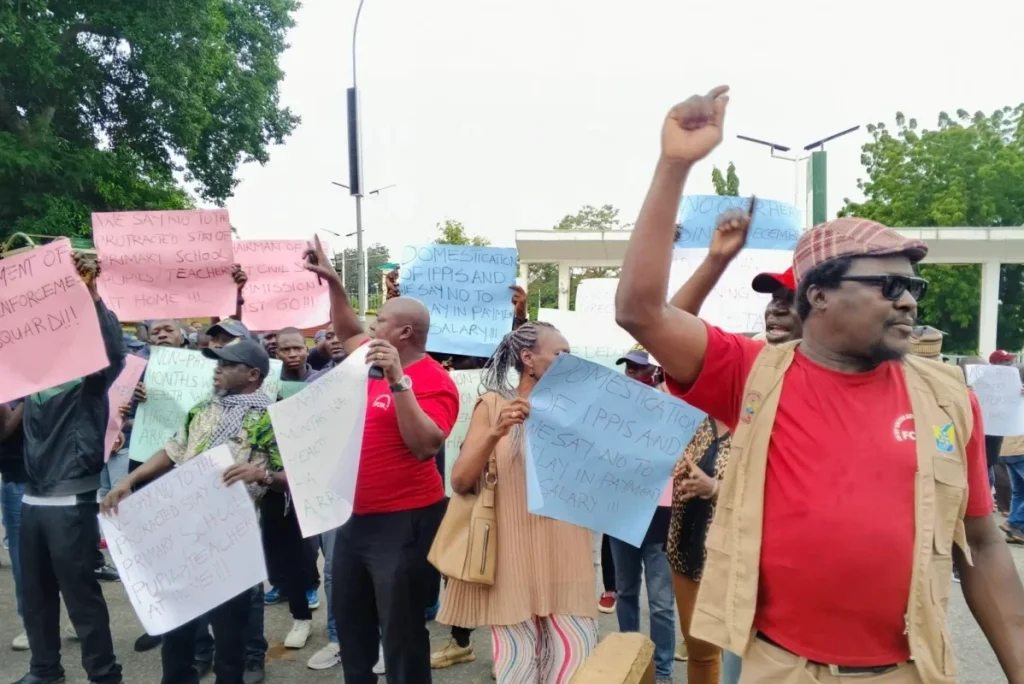
Federal Capital Development Authority (FCDA) workers, under the aegis of the Joint Union Action Committee (JUAC), commenced their earlier threatened three-day protest on Monday, as they shut the gate of the Federal Capital Territory Administration (FCTA) secretariat in protest over poor welfare conditions.
JUAC President, Rifkatu Iortyer, who led the protesting workers, accused the FCTA administration of non-payment of overheads since December 2024, adding that they have been left at a point of stagnation in their career progression, with no staff training.
She listed irregular salary payments, unresolved strikes by primary healthcare workers and teachers, and unpaid casual staff as additional grievances.
The JUAC President, who acknowledged Nyesom Wike, Minister of the FCT, for initiating far-reaching reforms aimed at repositioning the administration, noted, however, that workers’ welfare had deteriorated despite the reforms.
“We are protesting for so many things and we are not happy over a lot of things,” NAN quoted Iortyer as saying.
“We no longer go on training anymore; from December last year, there was no overhead to run the offices. We go from office to office to borrow paper to work.
“No promotion since clearing of the backlog the Wike-led administration met in August 2023. Since that time, there’s been no promotion, only appointments of permanent secretaries.”
The JUAC President also said casual workers in agencies like the Abuja Environmental Protection Board (AEPB) have not been paid since December 2024.
“They may not be career civil servants, but they are the ones that sweep the streets; they are the ones that attend to the cemetery; and they are the ones that attend to the mortuary,” she said.
“Yes, we don’t have casual workers in career civil service, but we already have them, and then you say you will not pay them?
“If the FCTA doesn’t want casual workers, then it should absorb them because they are humans and have families to feed.”
She warned that the protest would continue for three days, after which workers would reconvene to decide on their next steps if no action is taken.



