

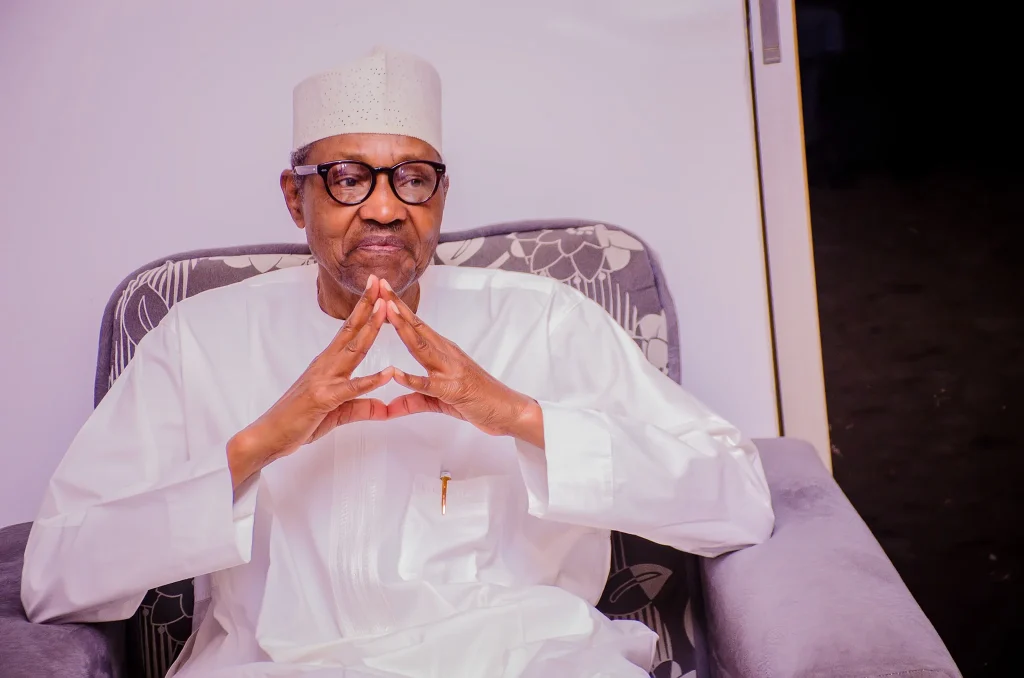
BY OBINNA F NWACHUKWU
Nigerians across the globe yesterday received the shocking news of the death of immediate past President, General Muhammadu Buhari, GCFR, which happened at about 4.30pm in a London Hospital. The news of his death followed earlier reports of his illness in an undisclosed hospital in the United Kingdom.
The former president, who left office on 29 May 2023 after serving two terms, had been abroad since April. According to sources close to his family, Buhari initially travelled to the United Kingdom for what was described as a routine medical check-up, but subsequently took ill.
“There are conflicting reports about when exactly he became unwell. Some say he fell ill in Nigeria and was flown out. Others insist he only took ill after arriving in London for regular medical checks,” Premium Times, a popular online Nigerian medium reported recently.
The nature of Buhari’s ailment and the identity of the hospital where he died remained undisclosed. However, given his history of prolonged medical stays abroad during his presidency, many people weren’t taken aback by the news of his eventual death.
Confirming his death, Buhari’s media aide, Garba Shehu, said he died on Sunday at a London hospital. He was 82.
“The family of the former president has announced the passing of Muhammadu Buhari, GCFR, this afternoon in a clinic in London. May Allah accept him in Aljannatul Firdaus, Amin,” Shehu wrote in a message posted on X (formerly Twitter).
Late General Muhammadu Buhari served as Nigeria’s democratically elected president from 2015 to 2023, having previously ruled the country as a military head of state from January 1984 to August 1985. He stepped down from office on 29 May 2023 after completing the constitutionally allowed two terms.
Throughout his presidency, Buhari was known for frequently seeking medical treatment in the United Kingdom — a trend that drew public criticism and sparked debates about the quality of healthcare in Nigeria. Some notable instances include:
* February 5-10, 2016: Buhari took a six-day vacation in the United Kingdom, saying that his doctors lived in England.
* June 6-19, 2016: Buhari went on a 10-day medical trip to England for an ear infection surgery.
He extended his trip by three days to rest.
* January 19, 2017: Buhari went to London again on a medical vacation.
* February 5, 2017: Buhari wrote to the National Assembly, seeking extension of his London medical leave.
* March 10, 2017: Buhari returned to Nigeria, but didn’t resume work immediately at Aso Villa. The Presidency said “he’s working from home.”
* May 7, 2017: Buhari embarked on a trip to London for another medical vacation. He returned after 104 days.
* August 19, 2017: Buhari returned to Nigeria and it took him a while to resume work because rats had reportedly damaged furniture in his office. The President announced he’ll be working from home.
* May 8, 2018: Buhari went to London for a four-day “medical review.”
In 2022, he made two more medical trips abroad. One in March, the other in October.
However, his health was said to have improved post-presidency but deteriorated again in April 2025, prompting an extended medical stay abroad.
For the eight years he ruled Nigeria (May 29, 2015 to May 29, 2023) former President Muhammadu Buhari embarked on medical trips abroad more than seven times, covering a period of no fewer than 242 days. He also visited over 40 countries.
At the height of his treatment regime, an apartment was reportedly secured for him near his hospital in central London to facilitate easier and discreet access to the facility.
His frequent trips abroad drew the ire of federal lawmakers, especially, the Senate which issued a warning to State House officials that, henceforth, President Muhammadu Buhari should stop embarking on foreign trips for medical attention.
According to the Senate, rather than allow President Buhari to jet out on medical tourism, the Federal Government and State House officials should put the State House Clinic in order for such purposes.
The warning was given when the then State House Permanent Secretary, Tijani Umar, appeared before the panel to defend his 2021 budget estimates.
Profile
Muhammadu Buhari was born on 17 December 1942 in Daura, Katsina State. He was the 23rd child of his father, Adamu, and was raised by his mother, Zulaiha, following his father’s death when he was about four years old.
He began his education in Daura and Maiduguri (1948–1952), proceeded to Katsina Middle School in 1953, and later attended the Katsina Provincial Secondary School (now Government College, Katsina) between 1956 and 1961, earning the West African School Certificate.
He married Safinatu Yusuf in 1971; the couple separated in 1988. In 1989, he married Aisha Halilu. He had ten children from both marriages.
Military Career
The late president Buhari enlisted in the Nigerian Army in 1961 and trained at the Nigerian Military Training College, Kaduna. Between 1962 and 1963, he attended the Mons Officer Cadet School in Aldershot, England, and was commissioned as a Second Lieutenant in January 1963.
He took the Platoon Commanders’ Course in Kaduna (1963–1964) and was appointed Platoon Commander, Second Infantry Battalion in Abeokuta. His subsequent military training included:
· Mechanical Transport Officers’ Course, Borden, UK (1965)
· Defence Services Staff College, Wellington, India (1973)
· United States Army War College (1979–1980)
During his career, Buhari held several key command and political positions: Military Governor of the North Eastern State, Federal Commissioner for Petroleum Resources, Chairman of the Nigerian National Petroleum Corporation (NNPC), Military Secretary, and General Officer Commanding two key Army divisions.
He rose to national leadership through the military coup of December 1983, becoming Head of State and Commander-in-Chief. He was removed from office in a counter-coup in August 1985.
Buhari’s Political Journey
Following Nigeria’s return to democracy in 1999, Buhari joined partisan politics and emerged as a leading opposition figure. He first contested for the presidency in 2003 under the All Nigeria People’s Party (ANPP) but lost to then-incumbent Olusegun Obasanjo of the Peoples Democratic Party (PDP).
Undeterred, he ran again in 2007 and 2011. In 2013, Buhari helped form the All Progressives Congress (APC) through a merger of his party, the Congress for Progressive Change (CPC), with the Action Congress of Nigeria (ACN), ANPP, and members of the All Progressives Grand Alliance (APGA).
The then newly formed APC presented a more formidable and nationally viable platform. He contested the 2015 election under the APC banner, campaigning on an anti-corruption and reformist message that resonated with Nigerians disillusioned with 16 years of PDP rule. His image as an austere and incorruptible leader helped him secure a decisive victory on 28 March 2015.
He was sworn in as President on 29 May 2015 and re-elected for a second term in 2019. His eight-year tenure was marked by efforts to combat corruption, insurgency, and infrastructural decay, although his administration faced criticism over rising insecurity, economic hardship, and human rights concerns.
The truth remains that Buhari left the government with a legacy very different to the one voters had hoped for when they elected him eight years ago.
His 2015 victory over Goodluck Jonathan, the first defeat of an incumbent president in Nigerian history, was his second time in power after an August 1985 palace coup ended his 18-month stint as military ruler.
His success at the polls came after three consecutive failed attempts to return to the presidency as the electorate turned to a man from its past out of frustration with Jonathan, a meek leader who critics said was better suited to his previous life as a zoology lecturer than as president of Africa’s largest democracy.
Buhari’s winning campaign had emphasized three key promises: to tackle insecurity, stem corruption and fix economic troubles. But as he left office after two terms, not many rate his scorecard as being better than the man he succeeded despite embarking on a vast infrastructure drive.
Under Buhari, Nigeria became the world’s poverty capital – 133 million of his compatriots now live in abject poverty. When his staunch ally, former Kano state governor, Umar Ganduje, was seen stuffing dollar notes believed to be contract kickbacks into his robe in a viral video, Buhari defended him, claiming the videos were doctored.
As Frank Kokori, an APC leader said in 2022, “It is only a person who is deaf and dumb that will say Nigeria is doing well … and it is disappointing that the president is not seeing it the way we are seeing it, “People were ready to die for Buhari in 2014 to 2015, but unfortunately, Buhari has squandered all his goodwill,” he stated.
Indeed, Buhari’s death marks the end of an era in Nigerian political and military history. Revered by supporters and criticized by detractors, his lega
cy remains one of the most controversial in Nigeria’s post-independence history.


