

…Speaker raises alarm over ₦149.39trn debt burden
…Insists loans driven by consumption, corruption must be rejected
..As FG seeks fresh $500m World Bank facility
BY SAM OTUONYE
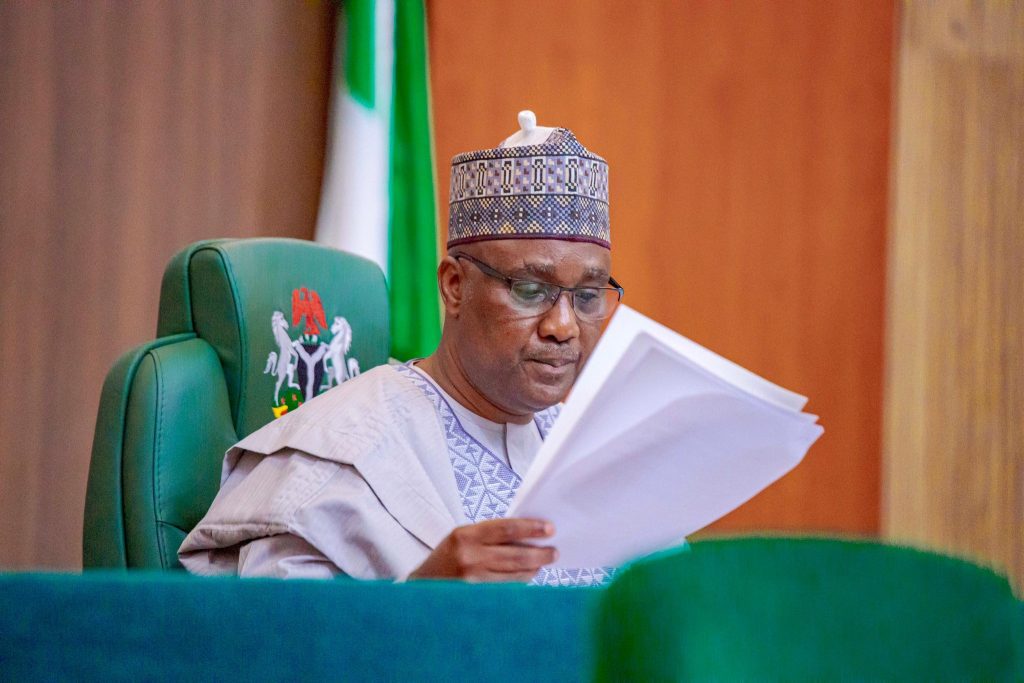
The skyrocketing debt profile of the President Bola Tinubu-led federal government has received a parliamentary knock, as Speaker of the House of Representatives, Rt. Hon. Tajudeen Abbas, raised the alarm over Nigeria’s N149.39 trillion debt, warning that it poses a major threat to fiscal sustainability.
The Speaker stated that the rising debt profile has exceeded the country’s legal threshold and endangers fiscal stability.
Abbas, represented by the House Leader, Prof. Julius Ihonvbere, spoke on Monday at the opening of the 11th Annual Conference and General Assembly of the West Africa Association of Public Accounts Committees (WAAPAC) in Abuja.
The Speaker said Nigeria’s total public debt rose to N149.39 trillion (about US$97 billion) in the first quarter of 2025, up from N121.7 trillion the previous year.
He noted that the country’s debt-to-GDP ratio has climbed to 52 percent, surpassing the statutory ceiling of 40 percent.
“As at the first quarter of 2025, Nigeria’s total public debt stood at N149.39 trillion, equivalent to about US$97 billion. This represents a sharp rise from N121.7 trillion the previous year, underscoring how quickly the burden has grown. Even more concerning is the debt-to-GDP ratio, which now stands at roughly 52 percent, well above the statutory ceiling of 40 percent set by our own laws,” he said.
This comes as the federal government pushes for a fresh $500m World Bank loan to address the poor performance of the power sector.
The Federal Government disclosed on Monday that it is working with the World Bank to assess a loan facility of $500 million to reset the distribution companies (DisCos).
Abbas described the breach as a signal of strain on fiscal stability and called for stronger oversight, transparent borrowing practices, and reforms to ensure loans deliver tangible economic and social benefits.
He cautioned that many African countries are already spending more on debt servicing than on healthcare and other essential services, adding that Nigeria must avoid a similar situation.
To address fiscal risks, the Speaker announced plans to establish a West African Parliamentary Debt Oversight Framework under WAAPAC.
The initiative will harmonise debt reporting across the sub-region, set transparency standards, and equip parliaments with data to scrutinise borrowing, he explained.
He also disclosed plans for a regional capacity-building programme to strengthen debt sustainability analysis and fiscal risk assessment.
Abbas stressed that borrowing should be targeted at infrastructure, health, education, and industries that create jobs and reduce poverty, warning that reckless debt driven by consumption or corruption must be rejected.
He reaffirmed the 10th House’s commitment to accountability, saying that under its Open Parliament policy, major borrowing proposals will undergo public hearings, while simplified debt reports will be made available to citizens.
In a sharp contrast, the Minister of Finance and Coordinating Minister of the Economy, Wale Edun, who also spoke at the event, painted a more reassuring picture, declaring that Nigeria was turning the corner under President Bola Tinubu’s reforms, noting that revenues rose by 34.7 percent in the first half of 2025.
He said the country’s debt service-to-revenue ratio dropped to about 60 per cent in 2024, while the debt-to-GDP ratio stood at 38.8 per cent, a level he described as comfortable compared to global benchmarks.
The minister, however, acknowledged that Nigeria, like many countries in West Africa, faces significant fiscal challenges, including elevated debt service costs, constrained revenues, and rising demands for public spending.
“Nigeria is turning the corner. The reforms are delivering measurable impact in terms of investor confidence, reduced spending on fuel imports, greater energy self-sufficiency, and value addition in our economy,” Edun said.
Experts, however, argue that the rising debt levels are placing increased pressure on Nigeria’s fiscal resources, potentially impacting future generations and economic stability. They note that while the debt-to-GDP ratio may appear to improve due to GDP rebasing, the underlying debt burden continues to grow significantly.
Former presidential candidate of the Labour Party, Peter Obi, had recently expressed concern over Nigeria’s growing debt burden, describing the current borrowing trend as unsustainable and lacking accountability.
Obi noted that with Nigeria’s public debt already standing at N149.39 trillion in the first quarter of 2025, the newly approved loans, estimated at about N37.2 trillion, would raise the total debt to approximately N187 trillion. He warned that the figure could exceed N200 trillion by year-end.
Meanwhile, the Presidency last week said Nigeria generated N20.59 trillion from the non-oil sector of the economy in eight months, from January to August 2025, surpassing the Federal Government’s revenue target for the year.
In a statement titled ‘Nigeria’s Non-oil Revenues Power Strongest Fiscal Performance in Recent History’, the government disclosed that the Nigeria Customs Service (NCS) generated N3.68 trillion in the first quarter of the year, N390 billion above target, and 56 per cent of the full-year goal.
Confirming the fresh $500m loan request to newsmen in Abuja, Director General of the Bureau of Public Enterprises (BPE), Ayodeji Ariyo Gbeleyi, revealed that the transaction has two components.
According to him, “there is the investment project financing (IPF), and then there is a second component called a programme for results.
“Under the IPF investment project financing, there will be a total of 3.2 million meters to be distributed to customers across the country. About 330 of those meters have been shipped. One hundred and sixty thousand, three hundred meters have been delivered, and 160,700 are currently nearing completion.
“Additional shipments are expected before the end of the year. So, under the Phase One of what we refer to as the international competitive bidding, we have received 330 additional consignments to come in between now and the middle of next year. There is the national competitive bill which is also the local content component of this programme to deliver 217,000 meters from local manufacturing. We expect that the project will also be ready. There is a second phase of the international competitive bidding that expects about 1.5 million meters to be procured from equipment manufacturers.
“Where we stand today, over the next few weeks, we will be launching that international competitive input process,” he said.
Gbeleyi also said that the second component is the programme for results, adding that the bureau would disburse, by way of shareholder loan to the 11 distribution companies (DisCos), a total sum of $50 million. This, he said, will enable the DisCos to implement management information systems.



