

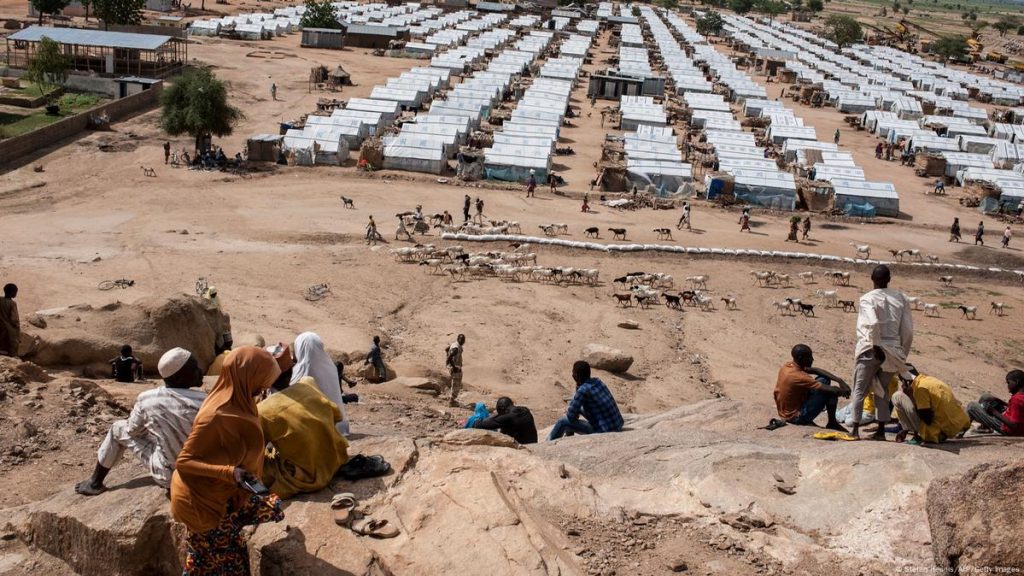
….Concerned Borno citizens want over 91,000 displaced persons returned
…Urge Tinubu to release funds for repatriation, resettlement
BY TEDDY NWANUNOBI
Since 2013, residents of Gwoza Local Government Area of Borno State have suffered serial neglect, humiliation, and abuse as Internally Displaced Persons (IDPs) in different camps across the country, following a series of Boko Haram attacks that led to the loss of several lives, destruction, and the takeover of their homes and farmlands.
The displaced persons are scattered across IDP camps in Gwoza, Kuchigoro (FCT), Adamawa, Taraba, and Edo states, as well as the neighbouring Republic of Cameroon.
This is even as the Concerned Citizens of Gwoza Local Government Area of Borno State have petitioned President Bola Tinubu to “restore the right of return, dignity, and safety to all displaced people from Gwoza.”
New National Star reports that a total of 91,007 Gwoza indigenes have been displaced by the Boko Haram insurgents since 2013.
The group also called on the Federal Government to promptly release funds for their repatriation and resettlement.
They particularly urged Tinubu to release the funds for repatriation and resettlement as approved in the 2025 Appropriation Act, and ensure prompt and transparent disbursement.
Their demands were presented by their spokesperson, Dr. Ayuba John Bassa, who added that over 50,000 of these IDPs are living with relatives nationwide, where prolonged displacement has become a source of vulnerability and a heavy burden.
“Mr President, please release the funds for repatriation and settlement approved in this year’s budget, and ensure prompt and transparent disbursement.
“Direct the Federal Ministry of Humanitarian Affairs and Poverty Alleviation, the National Commission for Refugees, Migrants, and Internally Displaced Persons (NCFRMI), the Ministry of Foreign Affairs, the International Organisation for Migration (IOM) and other stakeholders to coordinate and execute comprehensive repatriation, resettlement, and recovery programmes with all due diligence.
“Ensure that displaced persons are active participants in planning and implementation to promote transparency, ownership, and sustainable reintegration.
“Establish an independent panel of inquiry to investigate unlawful detentions, abductions, and related human rights violations affecting Gwoza citizens, including the cases of the parents of the 17 children and other detained persons, and to recommend accountability and reparations where appropriate,” Bassa said.
Bassa recalled that since 2013, many people from Gwoza were forced to flee by Boko Haram insurgents and are currently displaced across Nigeria and in Cameroon.
Giving the breakdown, he noted that Minawao Refugee Camp in Cameroon has 58,327 refugees; Abuja – Wasa; Area 1; Waru; and New Kuchigoro camps have 5,100 IDPs; Jalingo camps in Taraba State have 2,119 IDPs.
He added that Adamawa State camps have 8,447 IDPs, while Nasarawa State camps have 7,206 IDPs.
Bassa noted that the camps in Borno State including Wulari, Jerusalem, and Shuwari camps have 4,168 IDPs, whereas Edo State’s Uhogua Benin-City camp has 3,600 IDPs, and the Jos camp in Plateau State has 2,040 IDPs.
“Over 50,000 displaced persons are living with relatives across the country, where prolonged displacement has become a burden and source of vulnerability. Some 550 refugees in the Cameroonian camp are now abandoned; while many who tried to return on foot to Nigeria have died or suffered extreme hardship en route,” he stated.
Bassa, on behalf of the group, made other urgent requests:
“The president and the Federal Government should act swiftly to restore the right of return, dignity, and safety to all displaced people from Gwoza. Repatriation and resettlement should be carried out with full participation of beneficiaries, and with the provision of shelter, livelihood support, healthcare, education, and psychosocial services.
“A credible, independent inquiry should be set up without delay to investigate abductions and unlawful detentions, to return the missing to their families, and to secure justice for victims and survivors. Policies and reforms should be enacted to prevent recurrence of such violence, protect civilian populations, and ensure that local and national officials who failed in their duties are held accountable.
“Humanitarian and development partners should coordinate closely with government agencies and Gwoza community representatives to deliver lasting solutions. Provision of a military battalion and barracks in Gwoza East to discourage the regrouping and growth of insurgents is very necessary,” they demanded.
The Gwoza IDPs’ spokesperson regretted that the displaced persons have been abandoned by the Borno State government and its representatives at various levels of the parliament, adding that no legislator representing the area has shown interest in addressing the plight of the IDPs.
“It’s horrible when one thinks of it. Yes, you can’t go to farm in Gwoza. In my area, all the Mandara Mountain, you can’t farm. Anybody you see farming there is a Boko Haram member. There’s no normal person living there as it were before 2013, only Boko Haram. They also farm because they have slaves who farm for them, get water for them to drink, to bathe. They behave like kings at the detriment of other lives.
“As Internally Displaced Persons (IDPs), coping has been very hard since 2013. There’s no month we do not record up to five to six deaths. In a particular month, even though that was an accident that happened when they were trekking from Cameroon to Mubi, and in Mubi, they were able to take a bus coming to Abuja, they had an accident and 18 of them died. So that one was the most tragic, but living in the camps, even here, we buried more than 10 in Abuja some time ago. These were those who could not take the suffering anymore. Some widows who lost their husbands to Boko Haram couldn’t cope. They had nothing to do, their children were there, nobody to take care of them, frustration set in. One day, it could just be a small headache, they were gone out of frustration. All these we have been handling.
“In most of the camps, the aged ones are still there. They can’t do anything; they became a burden, a nuisance. The younger ones have to go and fend for them and come back to feed them. They are there; they don’t know how to live a city life. What will they do apart from farming, but they don’t have their farms any longer? And then, age is not on their side, and the strength is not there. If you go to one of our camps in New Kuchigoro, you will weep at the type of shelter they live in. It’s very terrible. It’s typical of all the IDP camps.”
He further accused the federal and state governments of abandoning the IDPs and exposing them to further menace of Boko Haram members who, he said, storm the camps at will and carry out rapes and killings without consequence.



