

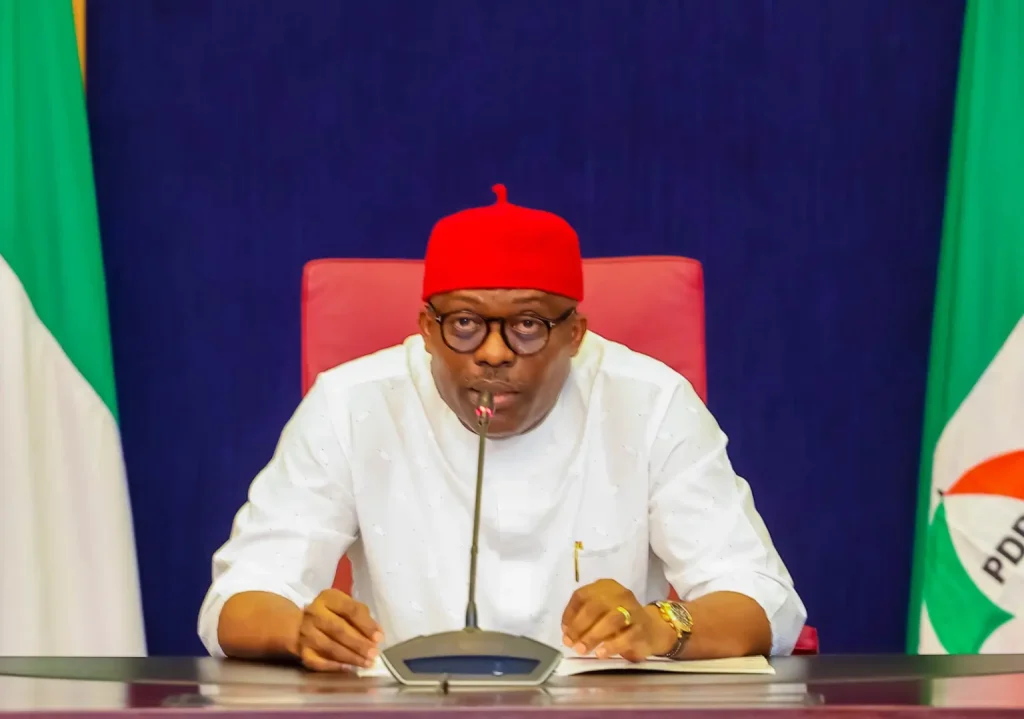
Cautious optimism and skepticism are the appropriate words to describe the return of full democratic governance in Rivers State after a six-month emergency rule which President Bola Ahmed Tinubu imposed on March 18, 2025.
In the declaration of a state of emergency, President Tinubu had suspended the governor, his deputy, and the 31-member House of Assembly and placed executive and legislative functions under federal control.
The temporary arrangement was headed by Admiral Ibok-Ete Ibas (rtd.) who was named Sole Administrator for six months.
On Wednesday September 17, 2025, President Tinubu who had cut short his working vacation to France lifted the emergency rule via a national broadcast. He reinstated Governor Siminalayi Fubara and other officials, after he had noted that the constitutional crisis that paralysed governance in the state had been resolved.
President Tinubu said intelligence reports showed a “groundswell of a new spirit of understanding” among political stakeholders, thus paving the way for a return to democratic governance.
The emergency declaration, however, triggered more than 40 suits in courts across Abuja, Port Harcourt and Yenagoa.
In a farewell broadcast on September 17, Admiral Ibas handed over authority and urged political stakeholders in Rivers to embrace dialogue, peace, and mutual respect.
During his tenure, Admiral Ibas inaugurated the Rivers State Independent Electoral Commission, RSIEC, chaired by Michael Odey, which conducted local government elections in all 23 councils on 30 August.
The All Progressives Congress, APC, won in 20 councils, while the People’s Democratic Party, PDP, won three.
With the lifting of the emergency, the governor, his deputy, and the 31-member House of Assembly were expected to resume duties on September 18. But only the House of Assembly reconvened immediately while Governor Fubara who was out of the state returned to the Government House two days after President Tinubu lifted the state of emergency and ordered his reinstatement.
Now that the six-month emergency rule has ended, will there be a return to democratic governance? Is the political turbulence that led to the suspension and emergency measures over?
We believe that the gladiators must have weighed in on the various issues and pondered on what mechanisms need to be put in place to ensure the stability of the restored government.
Fubara’s return has restored legitimacy and healed divisions but we enjoin the combatants not to reopen old wounds and reignite instability.
Both sides must henceforth embrace mutual respect and dialogue and must ensure that the interest of the people of Rivers State prevail at all times.
We enjoin the gladiators in the oil-rich state to be mindful of the fact that the emergency rule had altered the political structure of the state, so much so that the opposition APC has taken control of the local governments. It won 20 councils, while the People’s Democratic Party (PDP) won in three local government areas.
Against this backdrop, we envisage mass defection to the APC in the months ahead. This in turn might engender Fubara’s defection even as the People’s Democratic Party on which platform he came to power has issued a warning against such a move.
While the public was kept in the dark about the terms of the settlement of the rift between the embattled governor and Nyesom Wike, his predecessor, we believe neither side should play the winner takes all game.
“While the public was kept in the dark about the terms of the settlement of the rift between the embattled governor and Nyesom Wike, his predecessor, we believe neither side should play the winner takes all game.”



