

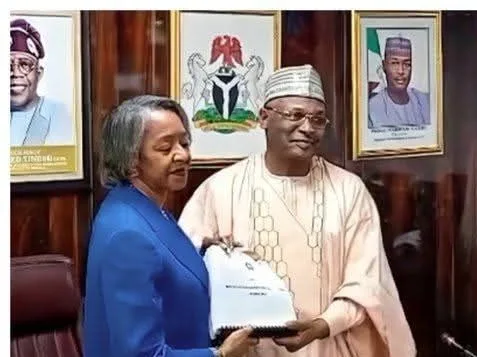
….Hands over to Agbamuche-Mbu
….Rolls out progress made in 10 years of service
…..As Tinubu accepts exit, honours him with CON
BY TONY EZIMAKOR
The Chairman of the Independent National Electoral Commission (INEC), Prof. Mahmood Yakubu, on Tuesday stepped down as chairman of the commission in a manner that left staff, national commissioners, and Resident Electoral Commissioners aghast and lost for words at his sudden exit.
The tenure of Prof. Yakubu, who recently proceeded on terminal leave, was expected to end on November 15, but events appear to suggest that his departure was hastened by internal pressures within the commission.
In a brief speech, the outgoing chairman expressed profound gratitude, thanking the staff and Resident Electoral Commissioners for their dedication, commitment, and hard work throughout his tenure.
Nothing suggested that the transition was due, at least not to INEC staff, national commissioners, and Resident Electoral Commissioners (RECs), who had gathered in Abuja for their routine quarterly consultative meeting ahead of several off-cycle governorship elections, starting with the Anambra poll scheduled for November 8.
Reporters were also caught off guard. However, suspicion that something was amiss at the commission began when the time for the event, initially slated for 10:00 a.m. on Tuesday, was shifted first to 1:00 p.m. and eventually did not commence until 3:45 p.m.
Addressing the RECs in what seemed a valedictory message, Prof. Mahmood said the commission had advanced preparations for the off-cycle elections in Anambra, Osun, and Ekiti, noting that the Continuous Voter Registration (CVR) exercise had also recorded progress, with 6.8 million registrants pre-registering online.
He said the amendment to the electoral laws had also reached advanced stages in both chambers of the National Assembly.
“There are a number of forthcoming elections. The preparations for some of them are either at advanced or concluding stages. The Anambra State governorship election is holding next month, followed by the Area Council election in the Federal Capital Territory (FCT) in February 2026, the Ekiti State governorship election in June 2026, and the Osun State governorship election in August 2026.
“In addition to these off-cycle elections, we have already commenced preparations for some of the major activities for the 2027 General Election, while awaiting the enactment of a new Electoral Act. The Bill is currently before the National Assembly. It is expected that the electoral reforms contained in the new Act will necessitate further review of our Regulations and Guidelines as well as the Manuals for Elections. Beyond these reviews, the Commission needs to further clean up the voters’ register, review the locations of some polling units, and the allotment of voters to them.”
Prof. Mahmood noted that much progress had been made in the use of technology and other innovative measures to improve the process, including the nomination of candidates, electoral inclusivity, and management of party primaries. He warned that going into the 2027 election cycle, much work and dedication would be required to meet the challenges of delivering credible elections.
“Over the years, we achieved a lot in responding to challenges and introducing many innovations. We have consolidated the biometric register of voters and replaced many of our manual processes with digital platforms and applications. These include the nomination of candidates, submission of polling and collation agents by political parties, accreditation of national and international observers and the media, voter accreditation, and result management.
“In addition, with the support of development partners, we have introduced various technologies to improve diverse aspects of election management, such as the easy location of election facilities, management of collation and returning officers, virtual training of electoral staff, management of political party finances and audits, as well as overall monitoring of elections using our Election Monitoring and Support Centre (EMSC). Indeed, we have made tremendous progress, but a lot more needs to be done.
“Accordingly, and knowing the enormity of the challenges ahead, having been privileged to serve the Commission for ten years with only a few more weeks to go, I have taken a decision and conveyed same as provided by Section 306 (1) and (2) of the Constitution of the Federal Republic of Nigeria 1999 (as amended).”
Prof. Mahmood, who said he decided to bow out weeks before his tenure formally ends, explained that his exit would allow the appointing authorities time to carry out the necessary transition and enable the incoming INEC boss to settle into the job of midwifing Africa’s most demographically vast electoral process.
“Following consultation with other National Commissioners, Mrs. May Agbamuche-Mbu will serve in an acting capacity pending the appointment of a substantive Chairman of the Commission. I hope that this will afford the appointing authorities adequate time to appoint a new Chairman. It will also enable the new Chairman to settle down quickly to the task of conducting elections and electoral activities in Africa’s most demographically and logistically complex environment,” he said.
Despite the alibi he offered, the outgoing INEC chairman was reportedly pressured to step aside just a few weeks before the end of his term. Recall that the Presidency was alleged to have directed him weeks ago to proceed on terminal leave—a position not backed by the constitution.
It appears, as some stakeholders have contended, that the government is determined to forestall the growing agitation for a quick amendment of the law granting the President powers to appoint the INEC chairman.
In recent weeks, stakeholders have renewed calls for constitutional amendments to remove the sole appointing power from the President. Some even urged that such reforms be enacted before the appointment of Mahmood’s successor, sparking controversy ahead of 2027.
A source in the commission, equally shocked at Mahmood’s sudden departure, suggested that he may have been hastened out to enable the President to exercise his constitutional role before public agitation gained further traction.
While his exit this time is due to constitutional term limits, his re-nomination for a second term by former President Muhammadu Buhari in November 2020 was also controversial. His reappointment then was rumoured to have had the blessing of the then APC national leader, Asiwaju Bola Ahmed Tinubu.
Born in Bauchi State, Prof. Yakubu completed his primary and secondary education at Kobi Primary School and Government Teachers College, Toro, respectively. He proceeded to the University of Sokoto (now Usmanu Danfodiyo University), where he obtained a First-Class degree in History. He earned a Master’s degree in International Relations from Wolfson College, Cambridge, in 1987 and a Doctorate in Nigerian History from the University of Oxford in 1991.
He made history as the first electoral commission chairman to serve two successful terms. His tenure brought numerous innovations and reforms. While some of the reforms failed to deliver the expected outcomes—particularly in restoring public confidence in the electoral process—many innovations marked significant progress and have been widely adopted by electoral bodies across Africa. These include local production of ballot papers and result sheets, creation of additional polling units, regularisation of election dates, digitisation of candidate nomination, media and observer accreditation, online pre-registration, deployment of the Bimodal Voter Accreditation System (BVAS), and the INEC Results Viewing Portal (IReV).
Sadly, his glowing legacy was severely tainted in 2023 following the glitches that marred the electronic release of the presidential results but not the National Assembly results, which were conducted the same day.
Nevertheless, Mahmood’s achievements over his ten-year journey were not lost on the commission’s staff, who lamented his sudden departure. In an emotional tribute, the Secretary of the Commission, Rose Oriaran-Anthony, said his drive for excellence had greatly impacted the commission.
Meanwhile, President Bola Tinubu has formally conferred the national honour of Commander of the Order of the Niger (CON) on Prof. Mahmood Yakubu.
The President, while accepting Yakubu’s resignation following the expiration of his second and final tenure, said the conferment was in recognition of his service to the country.
The statement reads:
“President Tinubu thanked Professor Yakubu for his services to the nation and his efforts to sustain Nigeria’s democracy, particularly through the organisation of free and fair elections throughout his two-term tenure.
“In recognition of Yakubu’s dedicated service to the nation, President Tinubu has bestowed on him the honour of Commander of the Order of the Niger.
“President Tinubu also directed that Professor Yakubu should hand over to the most senior national commissioner, May Agbamuche-Mbu, who will direct the affairs of the commission until the completion of the process to appoint a successor.”
Yakubu was first appointed in November 2015 as INEC’s 14th chairman for a five-year term. Following Senate confirmation, he was reappointed in 2020 for another five years, now concluded.
Over the decade, Yakubu oversaw the 2019 and 2023 general elections and introduced technology-driven innovations such as the INEC Result Viewing Portal.
In a letter dated October 3, 2025, Yakubu expressed gratitude to President Tinubu for the privilege of overseeing the commission for two terms.



