

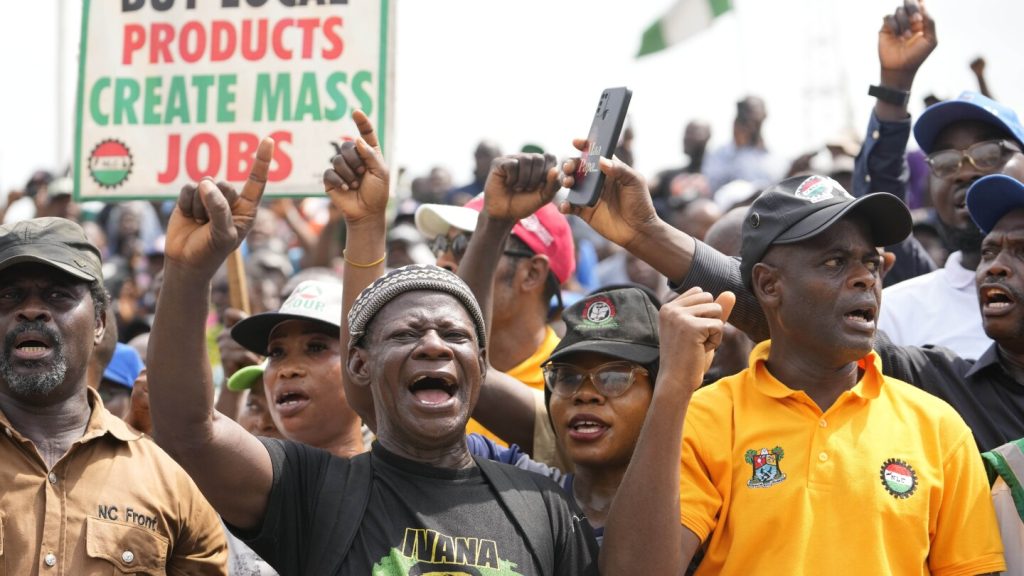
…NUPENG, NMA, MHWUN, NARD, ARD-FCT, NLC, TUC, NUT, ASUU, SSANU, ASUP, PENGASSAN, JOHESU, PASAN, JUSUN lead 2025 industrial actions
By TONY EZIMAKOR, TONY UDOKA, SAM OTUONYE, GLORIA AKUDORO, ODIGIE OKPATAKU, and NGOZI N. NWANKWO
Nigeria seems caught in a recurring nightmare, one in which the voices of labour unions, once the conscience of the working class, have become the alarm bell for a nation perpetually negotiating peace in the workplace. The latest two-week warning strike by the Academic Staff Union of Universities (ASUU) has crippled academic activities across public universities once again, adding to a long list of industrial actions that have haunted the All Progressives Congress (APC)-led government.
In the last thirty months alone, there have been more than fifty recorded strikes by various trade unions, a level of unrest observers describe as unprecedented in Nigeria’s democratic history.
From classrooms to hospital wards, oil rigs to courtrooms, the refrain is the same: unmet promises, unpaid allowances, and an ever-widening gulf of distrust between government and the governed.
Since coming into office, President Bola Ahmed Tinubu’s administration has struggled to maintain industrial harmony. While some of the grievances predate his tenure, the inability to resolve disputes amicably has taken a toll on governance. Each strike further fractures public confidence and sends the economy into fresh convulsions.
For decades, strikes have been the traditional instrument of last resort, the workers’ ultimate weapon when dialogue fails. But in Nigeria, that “last resort” has become a routine tool, deployed almost reflexively.
The irony is sharp: while strikes are meant to strengthen accountability, their frequency has instead weakened the system, eroding productivity and public trust. “Must the government always wait for agitation to fester before doing the right thing?” has become the question on every observer’s lips.
The National Bureau of Statistics (NBS) rarely quantifies the full economic cost of strikes, but the impact is visible everywhere. The oil sector slows down, classrooms go dark, hospitals operate skeletal services, and government offices grind to a halt.
In 2012, the Nigerian Labour Congress (NLC) shut down the country over the removal of fuel subsidy under then-President Goodluck Jonathan. Eleven years later, in June 2023, history repeated itself under President Tinubu, when the same unions — NLC, TUC, PENGASSAN, and NUPENG, protested the same policy.
The pattern is painfully familiar: threats, walkouts, negotiations, and temporary truces, only for the same issues to resurface months later.
No sector illustrates this vicious cycle better than education. The two-week warning strike declared by ASUU is only the latest in a string of actions that have scarred the nation’s academic calendar.
Since 1999, ASUU alone has gone on strike over 17 times, disrupting careers and crushing the dreams of millions of students. Other unions, the Non-Academic Staff Union (NASU), Senior Staff Association of Nigerian Universities (SSANU), Academic Staff Union of Polytechnics (ASUP), and the Colleges of Education Academic Staff Union (COEASU), have followed suit, making Nigeria’s tertiary education one of the most unstable in the world.
The human cost is staggering. Students who should graduate in four years spend six or seven. Parents lose money; institutions lose relevance; and the country loses an entire generation of productive youth.
In 2025 alone, there have been as many as nine strikes and warnings of strikes. Several labour unions have had bitter experiences with the government. The Nigerian Medical Association (NMA) in Lagos State protested illegal salary deductions. The Medical Guild, also in Lagos, embarked on a three-day warning strike over unresolved issues with the state government. Similarly, the Medical and Health Workers’ Union of Nigeria (MHWUN) threatened nationwide industrial action due to the exclusion of non-clinical staff from the proposed retirement age extension for medical personnel.
Other medical bodies also took industrial action. The National Association of Resident Doctors (NARD) went on a five-day warning strike in September. The Association of Resident Doctors in the Federal Capital Territory (FCT) began an indefinite strike, which was suspended on September 19, 2025.
Beyond the medical sector, the Nigeria Labour Congress (NLC) threatened strike over several issues, including the non-implementation of palliatives meant to cushion the effects of the government’s harsh economic policies. The Nigeria Union of Teachers (NUT) in the FCT was on strike from March to July 2025 due to the non-payment of the new minimum wage and five months of salary arrears. The strike was suspended in July after the FCT Administration began paying the national minimum wage with devastating effect on the education of thousands of primary school pupils.
“Since 2009 till date, ASUU has embarked on over sixteen strike actions,” lamented a retired director from the Federal Ministry of Education, who requested anonymity. “The leadership gap and political insincerity have crippled both education and the economy.”
At the heart of ASUU’s grievances are issues that have lingered for decades: funding for the revitalisation of public universities, payment of earned academic allowances, renegotiation of the 2009 FGN/ASUU Agreement, and implementation of the University Transparency and Accountability Solution (UTAS).
The union also demands the release of White Papers from university visitation panels, stoppage of the proliferation of state universities, and payment of withheld salaries.
ASUU President, Dr. Sylvanus Ugoh, has accused the Federal Government of insincerity. “If the government claims to have met our demands, let it open the draft agreement to the public and show Nigerians what has been implemented,” he said.
To Ugoh, the strike is not an act of rebellion but of necessity. “We want a university system we can proudly hand over to the next generation. When dialogue fails, letters fail, and meetings fail, strike becomes inevitable.”
The Federal Government insists it is not indifferent. Minister of Education, Dr. Maruf Tunji Alausa, recently inaugurated the Mahmud Yayale Ahmed Federal Government Tertiary Institutions Expanded Negotiation Committee to harmonize ongoing talks with academic and non-academic unions across universities, polytechnics, and colleges of education.
According to him, the new framework aims to “deliver a fair, realistic, and lasting agreement that reflects sector-wide inclusiveness.”
“President Tinubu has directed that our children must remain in school. We must do everything humanly possible to avert strikes,” Alausa said, assuring that the administration was finalizing a comprehensive counteroffer to ASUU’s demands.
While these assurances sound familiar, many Nigerians remain skeptical. They have heard similar promises from past governments, promises that dissolved in the fog of bureaucracy and broken trust.
The education sector is not alone in turmoil. In July 2025, the Nigerian Medical Association (NMA) threatened to embark on a nationwide strike after rejecting a circular from the National Salaries, Incomes and Wages Commission revising allowances for medical officers. The association said the circular “violated prior agreements” and issued a 21-day ultimatum to the government.
Barely a month later, the National Association of Nigerian Nurses and Midwives (NANNM) suspended a four-day nationwide strike over poor welfare and staffing shortages after fresh negotiations with the Federal Ministry of Health and other agencies.
Even so, nurses under the Federal Health Institutions Sector began their own seven-day warning strike soon after, joined by the Association of Resident Doctors, FCT, who cited unpaid salaries, manpower shortages, and burnout caused by the Japa syndrome.
“The FCT health system has become a long-standing systemic failure requiring comprehensive reform,” the doctors declared, capturing the growing frustration within the health sector.
No sector bears more economic consequence from strikes than oil and gas. In June 2024, the Nigeria Union of Petroleum and Natural Gas Workers (NUPENG) joined the NLC and TUC in a nationwide strike over minimum wage.
Three months later, in September 2025, NUPENG threatened another strike after Dangote Refinery barred new drivers from joining unions — a move the union likened to “slavery in modern Nigeria.” The strike was called off after last-minute government intervention.
But PENGASSAN (Petroleum and Natural Gas Senior Staff Association of Nigeria) wasn’t so patient. In the same month, it embarked on a three-day strike after over 800 of its members were reportedly sacked by the refinery. The action led to a 3% drop in national oil output, according to data from the Nigerian Upstream Petroleum Regulatory Commission (NUPRC).
Nigeria’s crude oil and condensate production fell to an average of 1.58 million barrels per day in September 2025, one of the lowest in the year.
These repeated disruptions have made Nigeria’s economy one of the most volatile in Africa. Productivity is stifled, investor confidence wanes, and national morale takes a hit. The cost goes beyond naira and kobo, it seeps into the psyche of citizens.
Students lose time and motivation. Patients die waiting for care. Workers grow disillusioned. And the government, scrambling for palliatives, ends up spending more to repair relationships than it would have cost to prevent the crisis in the first place.
The country’s industrial relations system appears built on distrust. For unions, dialogue is seen as a government tactic for delay; for the government, strikes are seen as political blackmail. This cycle of suspicion ensures that even when agreements are signed, their implementation is half-hearted.
Experts argue that a new approach is needed — one anchored on predictive engagement, where early warning systems and transparent timelines replace confrontation. “Industrial harmony is not a gift; it’s a process,” says a labour relations expert at the University of Lagos. “Until government learns to honour agreements and unions learn to balance activism with pragmatism, the cycle will continue.”
To its credit, the Tinubu administration has shown more willingness to engage labour early. But goodwill alone won’t stop strikes. The challenge lies in consistency, ensuring that every signed agreement translates to action, not rhetoric.
Industrial disputes are not inherently evil; they are symptoms of a deeper malaise, a failure of governance and communication. The longer that failure persists, the more Nigeria’s institutions weaken.



