

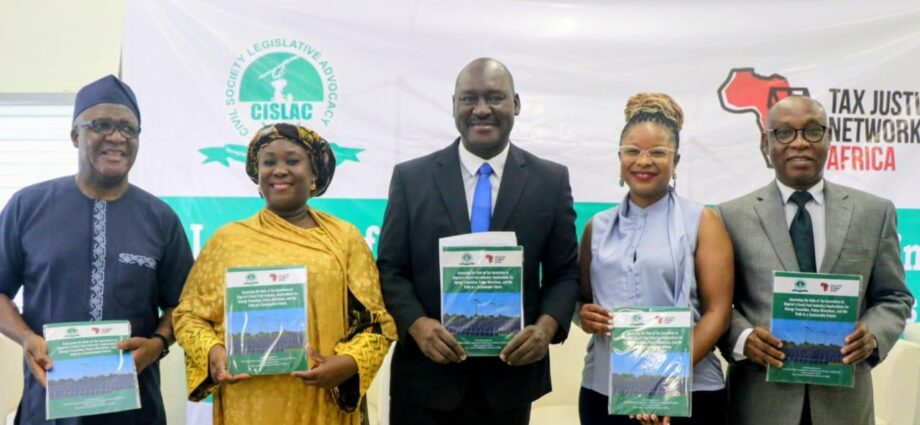
BY SAM OTUONYE
Civil Society Legislative Advocacy Centre (CISLAC) has called for a review of tax incentive policies in the fossil fuel industry.
Executive Director of CISLAC, Auwal Rafsanjani, who made the call at the launch of a new report on fossil fuel industry in Abuja, warned that continued fiscal support contradicts the nation’s energy transition goals.
The executive director commended Nigeria’s recent climate initiatives, including the establishment of Nigerian Council for Climate Change, Energy Transition Office and the adoption of Energy Transition Plan.
He, however, cautioned that fiscal regimes must not entrench fossil’s dependence but promote renewable energy and sustainable growth.
The CISLAC report, developed with support from Tax Justice Network Africa and Energy Transition Fund, examined Nigeria’s legislative and fiscal frameworks for fossil fuels.
Rafsanjani said that fiscal policies must align with Nigeria’s commitment to achieving net-zero emissions by 2060, adding that the country could not afford to be left behind in the global trend.
It called for gradual phase-out of subsidies and incentives that sustained carbon-heavy industries.
The report also recommended comprehensive fiscal reforms, transparency in tax administration, stronger accountability systems and increased investment in renewable energy to ensure a just and inclusive energy transition.
On his part, the Executive Secretary of Nigeria Extractive Industries Transparency Initiative (NEITI), Dr Ogbonnaya Orji, warned that poor oversight could cost the country nearly ₦6trillion.
Orji called for greater fiscal transparency and accountability in the management of tax incentives within the country’s fossil fuel industry.
He commended CISLAC for what he described as “an evidence-based intervention” in the ongoing dialogue on energy transition, tax justice and sustainable development.
According to him, Nigeria stands at a critical crossroads between the urgent need to decarbonise and the economic dependence on fossil fuel revenues that fund much of public expenditure.
He disclosed that NEITI’s ongoing national study on “The Impact of Energy Transition on Nigeria’s Oil-Dependent Economy” highlighted the risks of unmanaged fiscal transition.
Orji warned that the country could face declining hydro-carbon revenues and inadequate investment in renewable energy alternatives.
He noted that many existing tax incentives in the fossil fuel sector no longer aligned with national priorities and should, therefore, be either reviewed or removed.
“Aligning tax incentives with Nigeria’s energy transition goals is not just a fiscal reform imperative but a climate justice necessity,” he stated.



