

BY JENNIFER EZIMAKOR
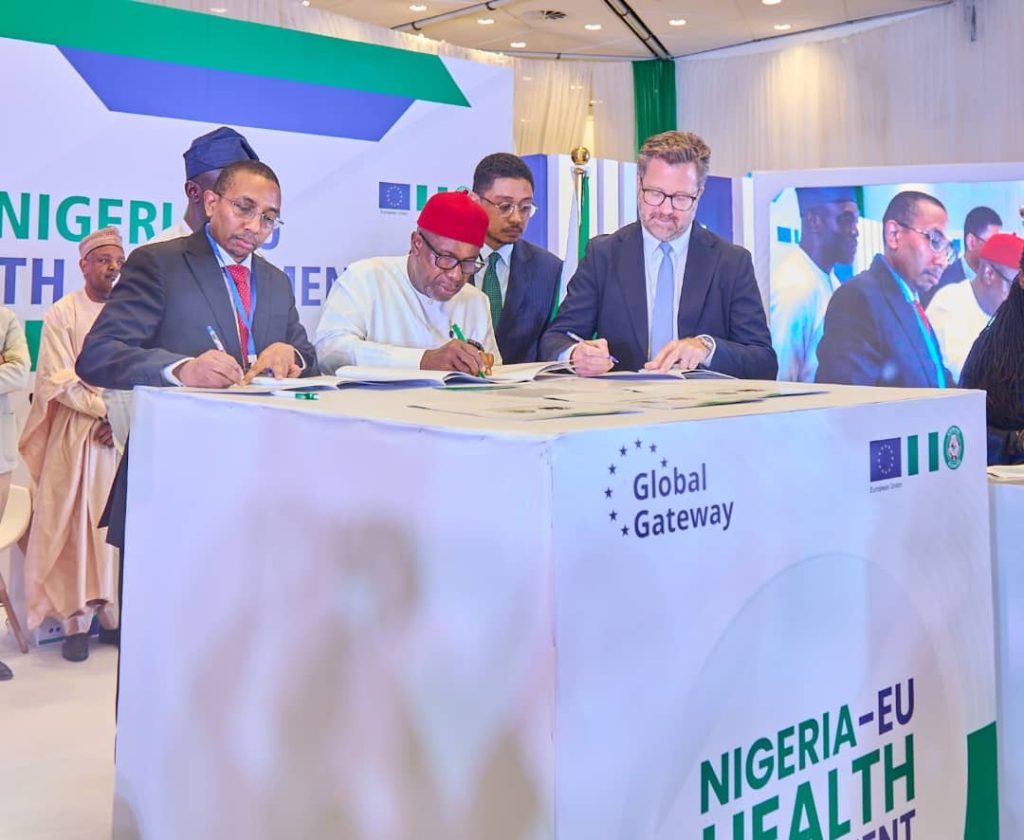
The Federal Government, in partnership with the European Union and France, has signed a €10.2 million agreement to boost local pharmaceutical production and strengthen Nigeria’s health systems.
The initiative, launched under the EU’s Global Gateway’s Manufacturing and Access to Vaccines, Medicines, and Health Technologies (MAV+) programme, aims to expand Nigeria’s capacity to produce quality-assured medicines and improve access to essential health technologies.
According to a statement issued by the EU on Sunday, the project; titled Quality Uplift for Advancing Local Industry in Medicine Standards (QUALIMED), will also enhance research-driven innovation and reinforce the National Institute for Pharmaceutical Research and Development (NIPRD) as a regional reference centre for quality control, bioequivalence, and stability studies. The centre will collaborate with similar institutions in Rwanda and Senegal.
EU Ambassador to Nigeria and ECOWAS, Gautier Mignot, described the deal as a reflection of the strong partnership between the EU, France, and Nigeria.
“Let’s combine the strength of our EU-Nigeria and EU-ECOWAS partnerships with the dynamism of our companies on both sides to achieve a common goal: making Nigerian healthcare life-saving and sustainable, diversified, accessible, and affordable for all Nigerians,” he said.
He added that the initiative is designed to build “robust, resilient, and efficient” health systems that create jobs and opportunities across West Africa.
France’s Ambassador to Nigeria, Marc Fonbaustier, reaffirmed his country’s commitment to the collaboration, highlighting France’s Global Health Strategy built on the principles of “equity, solidarity, and human dignity.”
The Director-General of NIPRD, Dr Obi Adigwe, said the partnership would help Nigeria achieve greater self-sufficiency in healthcare while driving economic growth.
“We want to ensure that our people not only get the highest level of access to healthcare but also catalyse socioeconomic development, job creation, capacity building, technology transfer, and revenue generation,” he said.
Through laboratory upgrades, technology transfer, and workforce training, the QUALIMED project is expected to enhance regulatory compliance, boost clinical research, and promote gender equity in biomanufacturing.
Once completed, the initiative will leave Nigeria with modernised laboratories meeting international standards, improved Good Manufacturing Practice (GMP) compliance, and deeper integration of the local pharmaceutical sector into global supply and innovation networks.



