

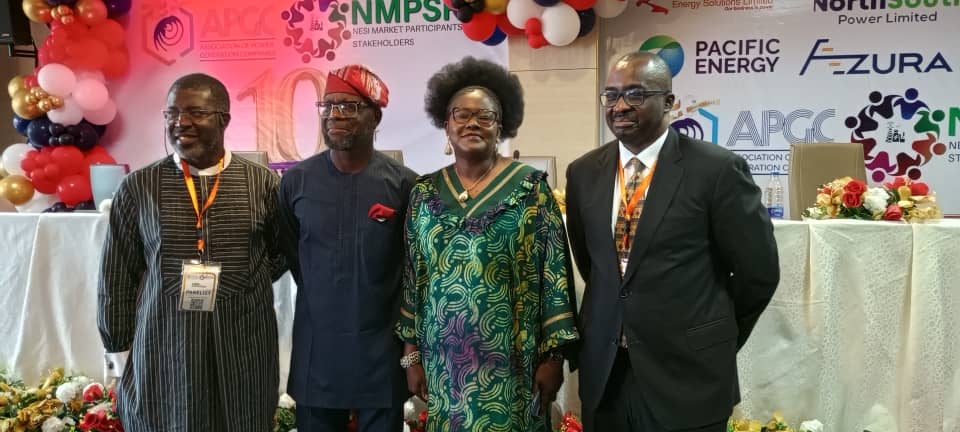
BY GLORIA AKUDORO
Electricity professionals have highlighted the need for a sustainable market model that addresses revenue collection, investment and commercial viability of the Nigerian power industry.
They are exploring different approaches such as: virtual, integrated, vertical models, state-level markets, commercial entities and homebase innovative solutions aimed at identifying a framework that can drive sustainability and growth in the sector.
At the panel sessions organised by the Association of Power Generation Companies (APGC) to mark 10th anniversary, Engr. Belije Madu, a Technical/Engineering Professional, highlighted federal government interventions and funding mechanisms that included $730 million funding aimed to support the power market, pay generation companies (GenCos) costs and ensure liquidity.
“The government has given Nigeria $730 million, Nigeria has what I call it autism counterpart funding, and the aim of that counterpart funding is to make sure that we keep the market moving, make sure we pay GenCos costs and we pay disbursements. And it’s not as if everybody goes to sleep. At the beginning of every year, the Minister of Finance has to write up a document called the financial plan, and the Minister of Finance has to sign it.
“And what the financial plan simply says is that the federal government has credible and clear transparent plans of financing the Nigerian power sector. And it was the financing plan of 2024 that resulted in the 4 trillion Naira conversation. So, the President didn’t just wake up one day and decide to give the power sector 4 trillion.
“It came out when we wrote the prepared 2024 financing plan, and the World Bank insisted that there has to be a transparent funding mechanism for GenCos costs and gas costs. And that is how some calculation was done, and we arrived at 4 trillion, and we said if we put 4 trillion on the table and get into the decisions, we’re going to clear the backlog,” he said.
While criticizing the devolving responsibilities to states, without adequate analysis and further complicating the sector challenges, Engr. Madu advocated addressing market structure and liquidity issues separately, emphasizing the need for innovative and home-made solutions rather than relying on foreign models.
During the discussion session, he argued that the distribution companies (DisCos) have failed, citing widespread inefficiencies that stemmed from lack of investment, likening it to a contagious effect where the entire system is flawed. He added that the DisCos failure accrued to significant liabilities, unpaid GenCos bills and market shortfalls.
“I want to mention Nigerian distribution companies have failed and I’m saying it’s because there’s the “contagion effect”. The state discos have failed, and there are liabilities that have accrued from that failure, including the Genco bills, market shortfall, where do we go from here? The fact is that somebody has to put money on the table because failure comes at a cost, there has to be a clean-up period. When we politically and economically agree that, at the moment we are still living in denial, we have not agreed that discos have failed, so there is no solution of what to do with the discos at the moment. And I’m not saying that the solution cannot be states or municipal markets, you have to come to an acceptance that this thing is not working and is never going to work no matter how we slice and dice it,” he stated.
On the way forward, Engr. Madu recommended that, “Gencos must begin to look at virtual, integrated, vertical models, and to look at taking investments in State-Cos, municipal markets, and begin to radiate your energy and collect your money at that level.”
Also speaking, Engr. Ebipere Clark, a seasoned Consultant in Capital Market, Energy/Infrastructure Sector’s, attributed power sector fundamental issues to commercial, with insufficient revenue collection hindering growth. “Essentially, there is not enough money being returned for the power being produced. So, any idea of going above 4,500 megawatts doesn’t make sense because if you’re only paying for 2,000 megawatts, who are you going to convince to bring the next 500 megawatts? So, we really have to understand that any ideas about super grids or growing or more power doesn’t work if the power you’re being paid for isn’t paid for.
Engr. Clark also emphasized on the need for clear separation and defined responsibilities in the wholesale market. He questioned the state’s ability to resolve commercial problems and called for 37 commercial entities and not regulators to manage distribution and collection.
He argued that the Electricity Act added complexity to the system, without addressing core commercial issues. He continued, “I think there needs to be a separation of the wholesale market, very cleanly, very clearly. And needs to be clear who are those people that are attached to it and who are those people that are attached to it, how are they responsible to meet their obligations to that.
“Now Nigerian Bulk Electricity Trading Plc (NBET) is a child of the federal government and it is pretty clear that the federal government does not want anything to do with the market and when the federal government does come in it comes in late and in part. So, the concept of the subsidy doesn’t really work with the federal government because it never pays in full and it never pays on time. So, it’s not a subsidy, it’s a debt. I would say, we have to look at the market that involves market participants who aren’t NBET, not because NBET doesn’t work but because NBET hasn’t had the support of the federal government behind it.”
On his part, Engr. Odion Omofonma, former Investment Banker/Energy Expert, recommended the need for GenCos to diversify their market-base by going beyond selling the DisCos to selling to new licensees and industrial areas. “My opening comment is that I think that GenCos are dinosaurs in this market as we currently are structured. I mean, at the end of the day, you’ve got 13,000 megawatts installed capacity over 10 years, you’ve not been able to go past 4,000, 5,000 megawatts.
“Meanwhile, you have a couple of heavy industrial areas coming up, and none of them use your power. You also have a situation where you have state electricity licensees looking at interstate generation. So you find that GenCos at this rate are dinosaurs unless and until they figure out how to sell their power beyond the level-stranded and bankrupt discos that currently enjoy their power and sell to new licensees.”
He criticized NBET for lacking innovation and proposed it should facilitate trading and selling power beyond Discos, creating frameworks for state entities and licensees to buy, sell, or export power. He also emphasized the need for the Nigerian Independent System Operator (NISO) to develop technical, regulatory, and commercial frameworks to enable state-licensed Discos to participate in the market, ensuring GenCos’ survival.



