

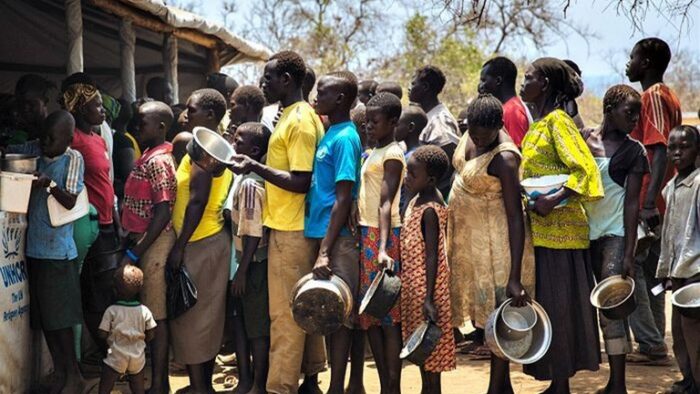
…Says millions could face famine between November 2025 and May 2026
…Only 44% of social benefits reach poor Nigerians
…Nigeria spends just 0.14% GDP on social protection, far below global average
By TEDDY NWANUNOBI
The United Nations has sounded a grim warning that Nigeria is heading toward a deepening food crisis, with millions of citizens at risk of famine between November 2025 and May 2026.
In its latest joint report, “Hunger Hotspots: FAO/WFP Early Warnings on Acute Food Insecurity,” the Food and Agriculture Organisation (FAO) and the World Food Programme (WFP) named Nigeria among 16 countries facing “very high concern” levels of food insecurity. Others include Afghanistan, the Democratic Republic of the Congo, Myanmar, Somalia, and Syria.
According to the report, countries such as Haiti, Mali, Palestine, South Sudan, Sudan, and Yemen are already teetering on the brink of catastrophic hunger, the most severe classification (IPC/CH Phase 5).
The UN attributed the crisis to ongoing conflicts, economic shocks, and extreme weather events, warning that a decline in humanitarian aid could push millions toward starvation. Only $10.5 billion of the $29 billion required for emergency food assistance has been received as of October 2025, forcing the UN to cut rations and suspend critical nutrition and school feeding programmes.
FAO Director-General, Qu Dongyu, cautioned that without urgent funding, agricultural lifelines such as seeds and livestock support will not reach affected communities in time for the next planting season.
“We must move from reacting to crises to preventing them,” he said. “Famine prevention is not just a moral duty; it’s an investment in peace and stability.”
Similarly, WFP Executive Director, Cindy McCain, warned that millions are already skipping meals as resources dry up.
“Mothers are starving so their children can eat,” she said. “Without swift funding and access, instability and conflict will worsen.”
The UN agencies called for global solidarity, urging governments and donors to invest in resilience and ensure unrestricted humanitarian access to conflict zones.
Meanwhile, a World Bank report has revealed that Nigeria’s social safety-net programmes are failing to reach the poor, despite billions spent annually. In its new study, “The State of Social Safety Nets in Nigeria,” the Bank found that only 44 percent of the country’s total social benefit payouts actually reach poor Nigerians.
The report said the nation’s fragmented, underfunded safety nets have had “almost no impact” on poverty reduction. Nigeria spends just 0.14 percent of its GDP on social protection, far below the global average of 1.5 percent and the Sub-Saharan African average of 1.1 percent.
According to the report, this negligible spending has reduced the poverty headcount by a mere 0.4 percentage points nationwide. It blamed poor targeting, low benefit levels, and inadequate coverage for the minimal impact.
Even well-intentioned programmes such as the National Home-Grown School Feeding Programme (NHGSFP) and the National Social Safety Nets Project (NASSP), the Bank said, fail to provide sufficient relief due to limited reach and small payouts.
The Bank noted that poorer households, typically larger in size, end up dividing small benefits among more members, further diluting the impact.
“At current spending levels, social protection has virtually no effect on poverty or inequality,” the report stated.
The findings come despite government claims of progress. Finance Minister Wale Edun recently announced that 8.5 million of the targeted 15 million households had received at least one tranche of the N25,000 cash-grant scheme, with more expected before year-end.
But analysts warn that without stronger targeting, funding, and transparency, Nigeria’s anti-poverty programmes risk becoming token gestures in the face of a deepening humanitarian crisis.



