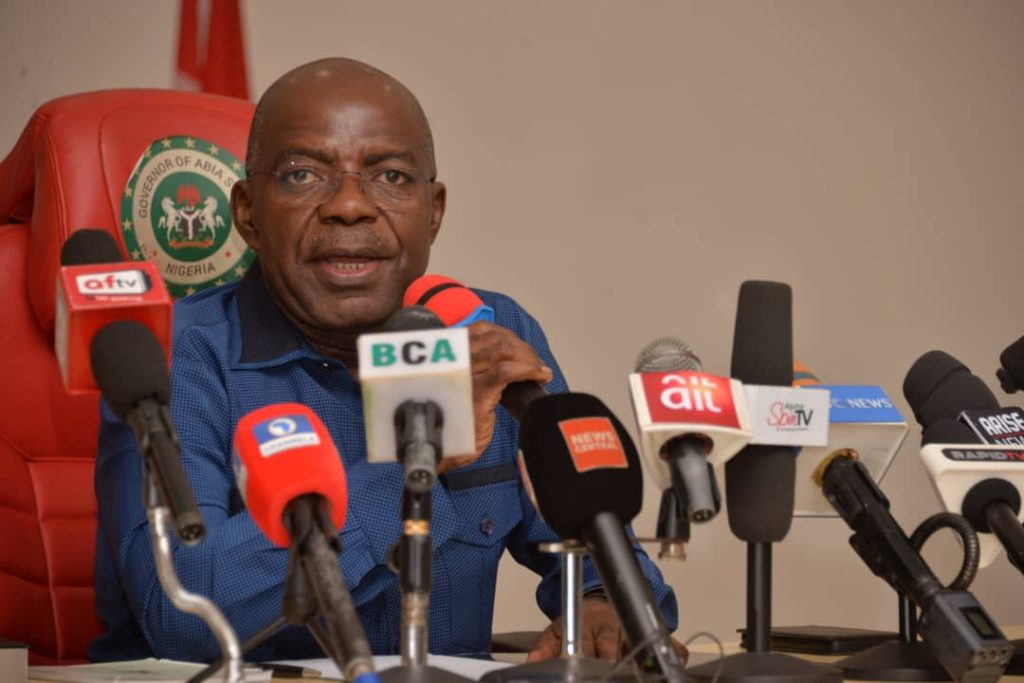
As Governor Alex Otti prepares to meet President Bola Tinubu at the Presidential Villa, an influential faction in Abia’s ruling All Progressives Congress (APC) urged him to use the visit to strengthen ties with the federal government and clarify contentious issues within his administration.
The Abia APC Renaissance Group, speaking through Comrade Udeagha Agbayi, framed the meeting as a critical opportunity for the governor — a former banker who won office under the Labour Party and later defected — to “align Abia State with the ruling party” and to secure federal support for state projects. The group said it expects Otti to address allegations that his administration operates from private residences rather than the government house, and to explain the status of large foreign loans and capital projects, including N54 billion allegedly allocated for school renovations.
“Governor Otti should use the meeting to align Abia with the centre and ensure developmental resources reach the people,” the statement read. It accused the governor of administrative opacity in certain sectors and of failing to adequately implement the approved minimum wage for some health workers.
The demand for alignment comes amid a wider pattern of defections and shifting alliances in the state; the Abia political landscape has seen the state assembly speaker and multiple lawmakers cross to the APC recently — moves that party insiders say reflect a strategic bid to “align with the centre” for developmental and political advantage.
Critics of the Renaissance Group say its posture is partisan and that a governor seeking independence from centre-party dictates should not be compelled to fully integrate with the ruling party to do what is right for Abia. Supporters counter that political alignment with the federal centre often accelerates project approvals and funding flows — a pragmatic argument that resonates with voters weary of delayed infrastructure.
Notably, the group has previously petitioned federal security agencies in October 2025, urging investigations into what it described as alleged incitement by Governor Otti. The move drew condemnation from civil society actors who warned against weaponising security instruments for partisan battles.
As the meeting approaches, Abia watchers expect Otti to seek a careful balance: to maintain the independence that defined his electoral appeal while smoothing relations with Abuja enough to unlock federal assistance for roads, healthcare and education. The outcome could recalibrate Abia’s political trajectory ahead of 2027, particularly if tangible federal commitments emerge from the meeting.
Maikaya builds alliances, stakes Nasarawa claim ahead 2027 guber
Musa Muhammad Maikaya, known in political circles as Chiroman Toto, is intensifying outreach as he pursues the All Progressives Congress (APC) ticket for the 2027 Nasarawa State governorship, holding a strategic meeting in Abuja with former House Speaker Ibrahim Balarabe Abdullahi (Walin Opanda).
After a sit-down at the former speaker’s residence, Maikaya presented his campaign narrative as one anchored in unity, inclusion, and pragmatic development.
“We are engaging leaders across the State because the future of Nasarawa requires collective effort,” he told journalists, underlining his plan to build a broad-based coalition focused on security, job creation, poverty reduction and infrastructural renewal.
The meeting is part of a broader pattern of pre-primary coalition building. Maikaya’s approach hinges on forging bridges with traditional gatekeepers, party stalwarts, and influential legislators who can sway grassroots sentiment across Nasarawa’s diverse local government areas. By meeting the respected elder Balarabe, Maikaya aims to demonstrate deference to institutional experience and to signal seriousness about governance beyond electoral theatrics.
Balarabe praised the outreach as evidence of political maturity. “Politics should be about cooperation and service. When leaders interact in this manner, it strengthens peace and our democracy,” he said, urging competitors to prioritise state interest over personal ambition.
Analysts note the tactical value of Maikaya’s strategy. Nasarawa’s politics have historically been shaped by intricate local alliances and religious and ethnic balances. Pre-emptive coalition building — particularly with respected elders and former lawmakers — helps candidates avoid last-minute fracturing and enhances chances of unifying warring party blocs.
Maikaya insists his platform, “Fresh Vision, Real Impact”, is more than a slogan. He says he intends to prioritise practical policy interventions — from improved revenue generation and fiscal prudence to agricultural revitalisation and youth employment — and to chart an agenda that resists the rent-seeking tendencies that have hampered state progress.
With 2027 approaching, Maikaya’s outreach will likely escalate into a larger programme of town halls, stakeholder dialogues, and targeted development promises aimed at solidifying core support. Whether this strategy yields dominance in APC primaries will depend on his ability to translate elite endorsements into grassroots enthusiasm, a familiar hurdle for many would-be governors in Nigeria’s complex local contexts.