

By Joy Onu
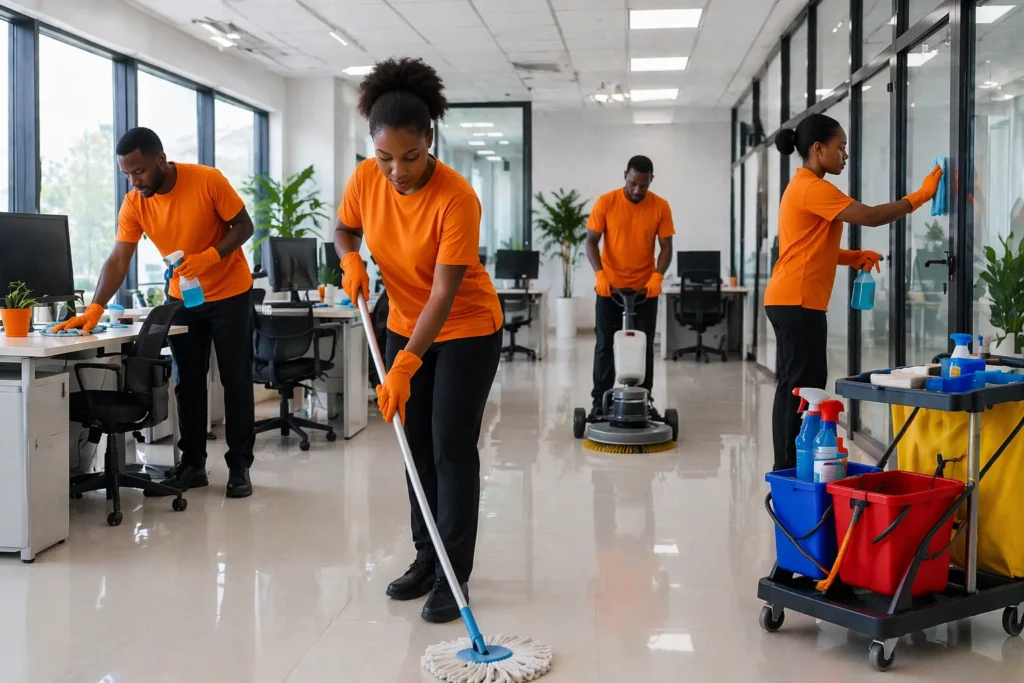
In the face of rising unemployment and economic pressure in Abuja, analysts
and economic observers are increasingly pointing to the professional cleaning
industry as a practical entry point for job creation and poverty reduction,
especially among young people struggling to secure formal employment.
According to economic analysts, the sector presents a low-cost business
opportunity that requires relatively minimal startup capital compared to many
urban enterprises, making it accessible to unemployed youths seeking
sustainable income sources.
They further argue that if properly structured and harnessed, the cleaning
industry could evolve into a significant driver of grassroots employment in
Abuja, providing structured work opportunities for thousands of residents in
both residential and commercial spaces.
With the city’s rapid urbanization, expanding estate developments, and growing
corporate presence, observers note that demand for professional cleaning
services continues to rise, even as formal job openings remain limited.
Industry practitioners say the business remains one of the most underrated
sectors in the capital city, largely because many job seekers overlook it due to
social perceptions and cultural attitudes that label cleaning work as inferior.
According to several professional cleaners interviewed by New National Star
Newspaper, this mindset has slowed youth participation in a sector that is
already experiencing steady demand across homes, offices, estates, and
construction sites.
One of the cleaners, Lucky Osakwe, lamented that many unemployed youths
underestimate the opportunity, linking it to cultural beliefs that discourage
engagement in what is often wrongly perceived as “dirty work.”
“Many unemployed people underestimate this business. They see it as a dirty
job because of cultural beliefs. I pray that unemployed youths will key into this
business. We are not enough in Abuja,” he said.
Another cleaning operator and founder of ZP Cleaning Services, Umar
Akowe, described the business as a survival pathway for many educated but
unemployed Nigerians trying to cope with harsh economic realities.
“I am a graduate with a family. If I keep waiting for white-collar jobs, I will be
here blaming people unnecessarily. I encourage young unemployed people to
take advantage of this cleaning business,” Akowe said.
“I am just starting. I am not there yet, but I am grateful to God. You can start
small,” he added.
Akowe explained that Abuja’s growing real estate and property development
boom has significantly increased demand for industrial and office cleaning
services across the city.
According to him, many wealthy individuals, politicians, and business owners
are now investing heavily in landed properties and housing developments,
creating fresh opportunities for cleaning businesses.
“In Abuja today, a lot of big men are no longer keeping their money in the bank.
Many of them are investing in properties because the property business is very
lucrative,” he said.
He noted that after construction projects are completed, professional cleaners
are often required to prepare buildings for handover to clients and occupants.
“After the finishing of houses, estates need professionals to wash and clean the
buildings before handing them over to owners or tenants. You cannot hand over
a dirty building after construction,” he added.
Akowe further stated that the increasing number of working-class families in
Abuja is reshaping the domestic cleaning segment of the industry, as many
households now rely on scheduled professional cleaning services to maintain
their homes.
“In Abuja, both parents are mostly working-class people and the children are in
school. Many families no longer want to leave all domestic work to house helps,
while some do not even keep house helps anymore,” he explained.
He added that office and industrial cleaning contracts remain among the most
profitable segments of the business, especially for companies that secure long-
term agreements with corporate organisations.
“In office cleaning, if you secure contracts with organisations, they pay
monthly. From that payment, you handle staff salaries and sustain the business,”
he said.
Akowe also recounted how a recent cleaning job handled for a high-profile
client in the Life Camp area of Abuja later generated referrals for additional
contracts.
“About two months ago, we handled a cleaning job for a high-profile individual
in Life Camp, and he later referred us to another client we are preparing to
meet,” he disclosed.
When asked how much cleaning companies make monthly, both Osakwe and
Akowe said earnings largely depended on the size and nature of contracts
secured.
“At times you can get a job as little as Five Hundred Thousand Naira, while you
can also get jobs worth millions, depending on the size of the facility you are
cleaning,” Akowe said.
He explained that many workers in the sector operate on daily pay
arrangements, earning at least N10,000 per day, except in cases where
companies secure long-term contracts lasting between six months and one year.
According to him, workers attached to long-term contracts are usually placed on
salaries, which also vary depending on the value of the contract involved.
As Abuja continues its rapid urban expansion, stakeholders believe the cleaning
industry is quietly positioning itself as an important part of the city’s service
economy. They argue that beyond aesthetics and hygiene, the sector holds
strong potential for youth employment, small business growth, and poverty
reduction if more attention is given to its development.
For now, analysts insist that rethinking the cleaning industry could open up one
of the most accessible economic lifelines for unemployed youths in Nigeria’s
capital city.



