

By Ogana Cyril Jr
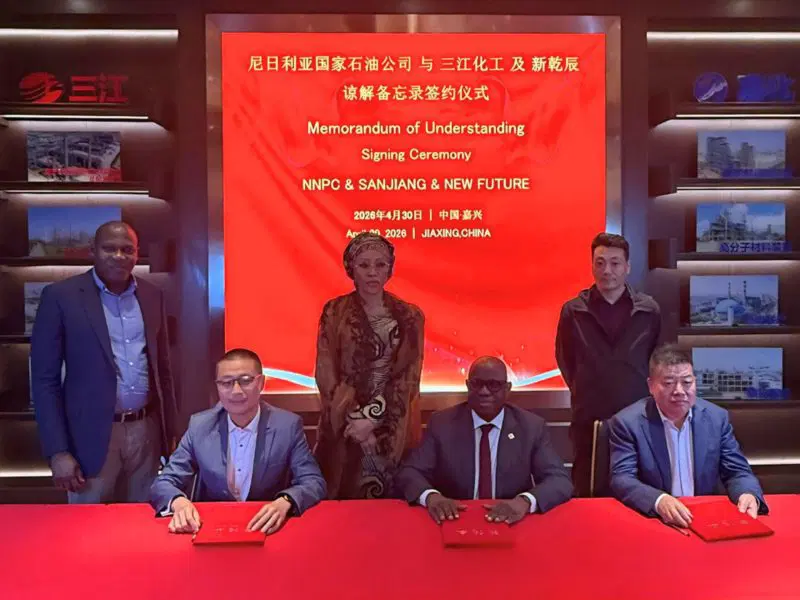
The recent Memorandum of Understanding (MoU) signed by the Nigerian
National Petroleum Company Limited (NNPC) with two Chinese firms:
Sanjiang Chemical Company Limited and Xingcheng (Fuzhou) Industrial Park
Operation and Management Co. Ltd, has stirred the hornet’s nest.
The MoU was signed for the rehabilitation and operation of the moribund Warri
and Port Harcourt refineries, amid growing calls for the federal government to
explore the competence of indigenous energy companies with proven
operational track records across the oil and gas sector.
The NNPC had announced that it signed the MoUs with the Chinese companies
as part of plans for a technical equity partnership aimed at completing
outstanding rehabilitation works and operating the two refineries which has
again stirred cautious optimism across the oil and gas sector.
But unlike previous announcements, this latest move is arriving amid
widespread public distrust, rising fuel costs, and growing questions over how
successive governments spent billions of dollars on refinery rehabilitation
projects that delivered little or no results.
At the heart of the debate is whether the new “technical equity partnership”
model can finally succeed where previous turnaround maintenance programmes
failed.
But the development has generated criticism within sections of the oil and gas
industry, especially after former President of the Organised Private Sector of
Nigeria (OPSN), Dele Oye, questioned the technical and financial competence
of the Chinese firms during an interview on Arise Television recently.
Oye argued that neither Sanjiang Chemical nor Xinganchen had verifiable
global refinery rehabilitation or operational experience comparable to
established Engineering, Procurement and Construction (EPC) firms like
Saipem and Tecnimont, which previously handled rehabilitation contracts for
the Nigerian refineries.
Besides, industry analysts argued that Nigeria now has a stronger base of local
upstream and midstream operators with growing technical and financial
capabilities than it did a decade ago.
Many of local companies that took over assets divested by IOCs have not been
found wanting, they have filled the gap with demonstrable competence.
Companies such as Conoil Producing, Seplat Energy, First E&P and
Renaissance Africa Energy Holdings have emerged as major players in
Nigeria’s oil and gas industry, controlling strategic upstream assets and
executing complex production and infrastructure projects.
Oye, criticised the recent MoUs signed by the NNPC for the rehabilitation of
the Warri and Port Harcourt refineries, saying that the selected Chinese firms
lacked the financial and technical competence to execute such complex projects.
According to him, investigations conducted by the Alliance for Economic
Research and Ethics showed that the two companies linked to the refinery deals
had no proven record in refinery rehabilitation or operation anywhere in the
world.
According to Oye, one of the firms involved in the MoU, Sanjiang Chemical
Company, is not an EPC company, but operates mainly in the downstream
chemicals business.
Oye stated that although the company is publicly listed on the Hong Kong Stock
Exchange, its recent financial fundamentals indicated declining cash reserves
and increasing short-term borrowings.
“The first company, Sanjiang Chemicals, is not an EPC company. It’s not an
engineering company. Nigeria owns four refineries, two in Port Harcourt, one in
Warri, and one in Kaduna, with a combined installed refining capacity of
445,000 barrels per day.
“Yet, despite years of rehabilitation contracts and repeated government
assurances, the facilities have remained completely idle for long periods,” said
Oye.
It is estimated that more than $16 billion may have been spent on refinery
rehabilitation efforts over the past decade alone, including the controversial $1.5
billion approved for the Port Harcourt refinery rehabilitation under the
Muhammadu Buhari administration.
In 2021, the federal government approved a $1.5 billion EPC contract for the
rehabilitation of the 210,000 bpd Port Harcourt Refinery. The contract was
awarded to Italy’s Maire Tecnimont through its subsidiary, Tecnimont SpA, with
the project structured in phases lasting between 18 and 44 months.
A few months later, in August 2021, the government approved another $1.48
billion for the rehabilitation of the Warri and Kaduna refineries.
Of the amount, about $897.7 million was earmarked for the 125,000 barrels-per-
day Warri Refinery, while $586.9 million was approved for the 110,000 barrels-
per-day Kaduna Refinery.
The contracts were awarded to Italy’s Saipem and Saipem Contracting Nigeria
Limited, with the rehabilitation expected to be completed in three phases
spanning 21, 23 and 33 months.
However, despite repeated announcements of mechanical completion and partial
resumption of operations, the refineries have continued to face operational
setbacks, shutdowns and production challenges.
In fact, today, not a single barrel of oil is being refined from the facilities.
In the same, vein, in late 2024, Nigerians were briefly told that the Port
Harcourt refinery had resumed operations, sparking celebrations. But the
optimism quickly faded as fuel supply realities failed to match official claims.]
For many stakeholders, the latest Chinese-backed deal represents yet another
test of government credibility.
Comrade Azubuike Azubuike, former zonal chairman of PENGASSAN in Port
Harcourt, said Nigerians have become deeply skeptical because previous
refinery revival announcements ended without measurable impact.
“Unfortunately, Nigerians are no longer interested in stories. Nigerians want to
see action rather than words,” he said.
According to him, repeated government pronouncements without visible results
have weakened public confidence in the refinery rehabilitation process.
“There have been a lot of discussions, engagements, and pronouncements about
similar agreements before now. We were told in 2024 that the refineries were
working. Unfortunately, we are still where we are today,” he stated.
According to Azubuike, the core problem goes beyond technical failures and
points directly to governance and corruption.
“Huge amounts have been put into the refineries, yet we cannot see products
coming out. It goes to show the monumental fraud and corruption embedded in
the whole refinery project.
“It is insane to put such money into a project without any result and then move
on like nothing happened. People need to answer questions.
“People need to bear the consequences of billions of dollars spent on
rehabilitation of the refineries without any result,” said Azubuike.
Civil society organisations say reviving the refineries alone will not be enough
unless transparency and environmental accountability are prioritize, warning
that secrecy surrounding the MoU could undermine public trust.
Meanwhile, a coalition of oil sector reform and Accountability advocates has
called on the NNPC to account for more than $3.5 billion reportedly spent on
refinery rehabilitation projects before proceeding with fresh agreements
involving Chinese firms.
The coalition criticized what it described as a recurring cycle of waste, opacity,
and failed promises surrounding Nigeria’s state-owned refineries.
The group said the latest agreement raises major accountability concerns,
particularly given previous billions of dollars committed to refinery
rehabilitation projects without corresponding operational results.
“It is unacceptable that public institutions continue to announce new agreements
without first accounting for previous investments. Nigerians deserve to know
what happened to the billions already spent on refinery rehabilitation,” the
coalition stated.
For ordinary Nigerians battling rising fuel prices and economic hardship, the
debate is no longer about agreements or MoUs. It is about results.
The latest agreement with Chinese firms may represent a fresh opportunity, but
analysts say public confidence will depend entirely on whether fuel begins
flowing consistently from the rehabilitated plants.


