

By Joy Onu
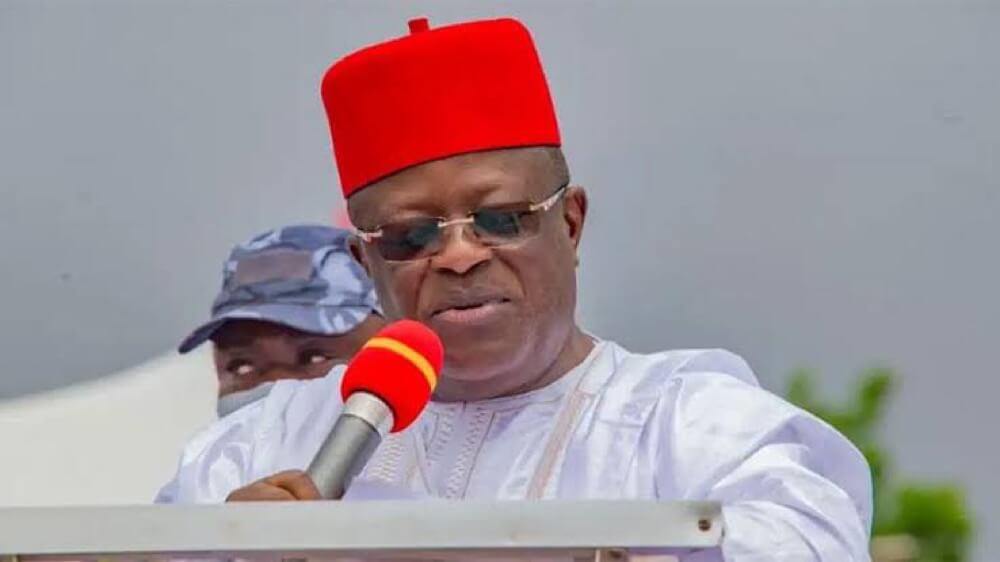
The Federal Government has intensified its oversight of major road infrastructure projects across the country, with the Minister of Works, Engr. David Umahi, stepping up a nationwide review of all ongoing federal road contracts and warning that underperforming contractors risk delisting from government programmes.
Umahi said the decision followed concerns over inefficiency among firms handling multiple projects without matching execution capacity, stressing that government would no longer tolerate abandonment, slow delivery, or non-performance on critical national highways.
“From next week, we are going to weed out contractors who are not committed. Some of them have up to 25 jobs awarded before we came on board. If you are not ready to invest while awaiting Federal Government payments, then you are not part of the progress of this country,” he said.
He also warned that supervising officials within the Ministry of Works would be held accountable for lapses in enforcement. “Whenever I issue directives and return to find them not implemented, I will remove the directors and controllers from the project,” the Minister added.
Umahi issued the directive during an extensive inspection tour of key federal highway corridors, including the Maraba–Keffi axis and sections of the Abuja–Kaduna–Zaria–Kano expressway, where he assessed ongoing rehabilitation and reconstruction works valued at several hundred billion naira.
The inspection brought together members of the National Assembly Committees on Works, senior officials of the Ministry of Works, engineers, contractors, presidential aides, and community representatives along the project corridors.
During the inspection, the Minister expressed satisfaction with the pace and quality of work on the 43.65-kilometre Mararaba–Keffi Road reconstruction and expansion project, being handled by China Harbour Engineering Company (CHEC) Ltd on the Keffi-bound carriageway, describing it as a key corridor in the FCT–Nasarawa infrastructure axis.
He also commended Messrs JRB Construction Company for the standard of work on the full emergency rehabilitation of the Abuja-bound carriageway of the same corridor, expressing confidence that the project would be delivered within its scheduled 1st March 2028 completion timeline, including ancillary components such as solar-powered street lighting.
“This is highly commendable. The quality of work is evident, and I encourage you to sustain this standard through to completion.
“I declare JRB as one of the best indigenous contractors because of the quality of work, the equipment deployed, and the commitment shown. Even with funding delays, they continue working because they understand this is their country,” Umahi said during the inspection, urging strict adherence to approved specifications and designs.
Reaffirming government’s position, the Minister stressed that the era of abandoned or substandard federal projects would not be tolerated, insisting that contractors must remain faithful to contractual obligations and ministry directives, while maintaining open communication where challenges arise.
“If you encounter any difficulty, inform us immediately. The Federal Government remains committed to meeting its obligations, including timely payments. However, quality must never be compromised,” he cautioned.
He further directed contractors to prioritize completion of all outstanding sections before commencing additional asphalt works, noting that unfinished stretches often undermine durability and overall project integrity.
At the Maraba–Keffi corridor, officials had earlier briefed the Minister that emergency rehabilitation works on about 40 kilometres of the Abuja-bound carriageway, awarded at over ₦75.6 billion to JRB Construction Company, had reached over 41 per cent completion, with works ongoing on asphalt pulverisation, drainage rehabilitation, culvert reconstruction, shoulder formation, and pavement strengthening.
The corridor remains one of the busiest entry points into Abuja, with rising traffic pressure driven by urban expansion and growing commercial activity along the axis.
Attention also shifted to the Abuja–Kaduna–Zaria–Kano expressway, particularly Section II of the Kaduna–Zaria corridor being executed by Infiouest International Limited at a contract sum exceeding ₦507.1 billion. The project, awarded in March 2025, involves 72.08 kilometres of continuously reinforced concrete pavement (CRCP) and wearing course overlays, with completion scheduled for November 2026.
Officials reported that about 40 per cent of the works have been completed, including asphalt pulverisation, cement-stabilised base construction, reinforced concrete pavement installation, and shoulder formation across key segments.
A second package covering Sections I and III of the same corridor, valued at about ₦252.8 billion, was also inspected, with officials confirming significant progress, including completion of the airport road axis, now fitted with solar-powered lighting and road markings, while drainage and safety works continue elsewhere.
According to project documentation from the Federal Ministry of Works, Section II comprises dual continuously reinforced concrete pavement lanes and wearing course overlays designed for long-term durability under heavy traffic loads, while Sections I and III combine CRCP works, asphalt sections, and overlays aimed at improving traffic flow across the corridor.
Also speaking during the tour, the Senior Special Assistant to the President on Community Engagement for the North Central region, Dr. Abiodun Essiet, called for stronger coordination among implementing agencies and contractors, stressing that infrastructure delivery must translate into measurable socio-economic impact beyond contractual completion.
She commended the Minister’s hands-on supervision style, describing it as a key factor improving discipline and accountability across project sites.
The Federal Controller of Works in the FCT, Engr. Mohammed Usman, also commended the level of commitment demonstrated across project sites, praising both the Minister’s supervision approach and contractors’ adherence to quality standards.
Similarly, the Managing Director of JRB Construction Company, Mr. Jamilu Ogunbola, noted that indigenous firms are increasingly demonstrating the technical capacity to handle complex federal infrastructure projects in line with global benchmarks.
Among those present were the Chairman of the Senate Committee on Works, Sen. Allwell Onyesoh, and the Chairman of the House of Representatives Committee on Works, Hon. Akin Alabi, alongside the Member representing Akwanga/Wamba/Nasarawa Eggon Federal Constituency, Hon. Jeremiah Sa’idu. They commended the Federal Government’s renewed infrastructure drive under President Bola Ahmed Tinubu, GCFR, describing the projects as strategic investments capable of stimulating economic growth, improving connectivity, and strengthening national integration.
Umahi also directed a shift in construction methodology, insisting that full asphalt removal should be avoided except where structurally necessary, recommending partial milling combined with cement stabilization and stone base reinforcement to improve durability and reduce costs.
He ordered accelerated completion of drainage systems, concrete shoulders, and New Jersey barriers along key corridors, describing them as critical to long-term safety and performance of federal highways.
The Minister further disclosed plans for solar-powered street lighting and CCTV surveillance systems on selected highways as part of a pilot initiative aimed at improving real-time monitoring and rapid response to incidents, to be implemented in collaboration with security and telecom agencies.
He assured that government was working to ensure timely release of funds to contractors while tightening enforcement mechanisms to guarantee compliance with project specifications and delivery timelines across all federal highway projects.
The inspection tour, he added, reflects the Federal Government’s broader commitment to accelerated infrastructure delivery under the Renewed Hope Agenda, with emphasis on durability, accountability, and national connectivity.



