

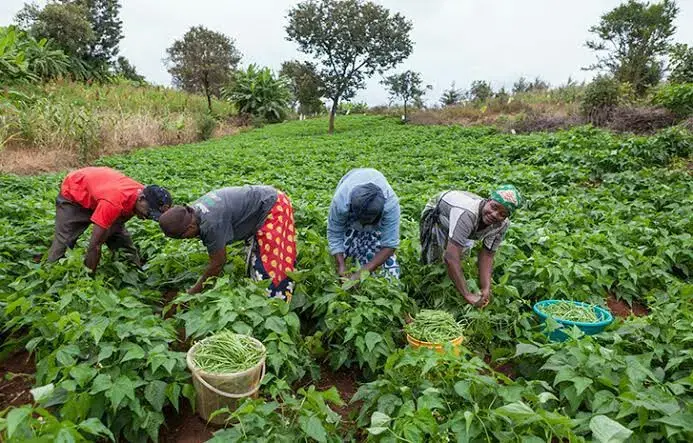
Recently, the Federal Government adjusted its policy of encouraging Nigerians to patronise and eat what they produce. The past administration of late President Muhammadu Buhari, history will remember him, encouraged local production of food for Nigerians by introducing programmes that supported various small and medium scale industries to thrive. Funds were made available through the CBN’s NIRSAL Micro Finance Bank, Bank of Agriculture. Borders were shut; embargos were imposed on farm produce imports to encourage the local farmers. The programme as at that time could be described as fantastic because a nation that cannot produce what her citizens eat, will always be controlled by another that produces it. Truth be told, the programme was grossly abused by politicians and the managers were culpable and couldn’t handle it objectively. Some genuine farmers couldn’t benefit.
However, it was not a grant but a soft loan, repayable after seven years. Some of the farmers that were opportune to access the loan, went into production but met unforeseen circumstances of insecurity apart from biting inflation and some managed to produce.
However, from the happenings nowadays, it seems Nigerian farmers are trapped in a painful financial squeeze. While the prices of farm produce have drastically dropped due to government waivers and massive food imports, the costs of essential production inputs like pesticides, fertilisers, and fuel remain stubbornly high, forcing many farmers to operate at a significant loss. The situation creates a severe disconnect between what farmers spent and what they gained.
Prices for agrochemicals and pesticides remain heavily inflated. Meanwhile, a single bag of fertiliser ranges between ₦45,000 and ₦55,000, and basic herbicides cost upwards of ₦8,000 to ₦10,000 per liter, all driven by currency fluctuations and global energy prices.
Following the federal government’s food importation windows and waivers, the market-glut of staples has driven farm-gate prices down significantly. For example, the price of a 100kg bag of maize has fallen from ₦70,000 in previous seasons to between ₦30,000 and ₦35,000 in some instances, while rice and beans have seen similar sharp reductions.
The All-Farmers Association of Nigeria (AFAN) and lawmakers have warned that this margin squeeze threatens domestic food security, as many smallholder farmers are scaling back cultivation or abandoning agriculture entirely to avoid bankruptcy.
In trying to survive high inflation on the price of farm inputs and transportation cost, President Tinubu’s government in order to salvage Nigerians from acute hunger made a quick adjustment by implementing a duty-free food import policy alongside seasonal influxes of foreign commodities. These imports rapidly flooded the market, causing dramatic price crashes. This, we understand, was done in good faith to cushion the impact of high cost of food and as well as assuage the suffering poor masses.
This sudden change in policy has cut farmers off guard because of the traditional practice of storage where farmers store food produced during harvest and sell later at a higher margin. But this policy change to serve the mass of Nigerians has created a catastrophic profit wipe, rendering farmers and hoarders bankrupt as they could not compete with cheaper imported goods.
The sudden availability of imported items (such as rice, wheat, and maize) sharply reduced commodity prices. Hoarders and speculators who purchased local grain at peak harvest period during the previous harvest season were forced to sell at a significant loss to avoid complete spoilage.
The high cost of farm inputs (fertilizer, seed) and the expensive logistics of storage meant that producers had already invested high capital into their hoarded stock. When market prices crashed, returns plummeted below production and storage costs. While import policies targeted short-term consumer relief, they exacerbated an already fragile supply chain. The country already suffers from massive post-harvest losses, with up to $3.6 billion to $10 billion in food wasted annually due to poor storage, bad roads, and inefficient logistics.
Many farmers and merchants who took bank loans to finance agricultural production and storage faced non-performing loans when they could not liquidate their stored stock at profitable prices.
Agricultural stakeholders warned that the government’s dual push to encourage farming alongside duty-free import windows creates policy sabotage. The influx of cheap alternatives discourages domestic investment in large-scale agriculture and long-term storage.
Amidst the outcry from local farmers and storage operators over price distortions, the Federal Ministry of Agriculture and Food Security has pivoted to investing in community-level silos and household storage technologies. These initiatives aim to protect farmers’ incomes by improving local preservation and curbing post-harvest wastage.
The Federal Government’s shift toward direct food importation and temporary tariff suspensions has sparked concern among local agricultural experts. While providing short-term relief for consumers, flooding the market with cheaper foreign goods threatens the livelihoods of Nigerian farmers. Experts advocate for prioritizing domestic production. Agricultural groups and economists strongly argue that import-dependent measures undermine long-term food security and economic resilience. To strike a balance between easing immediate food inflation and protecting local agriculture, advocates propose shifting the focus to a more localized, farmer-first approach.
Establishing a framework to purchase key crops (like maize, rice, and millet) directly from farmers at a fixed rate. This shields them from devastating financial losses during harvest-time price crashes.
Instead of subsidising foreign producers through import waivers, the government can supply farmers directly with high-yield seeds, fertilisers, and modern equipment at affordable rates.
We believe that addressing the root causes of supply-chain failures by securing farmlands in regions like the North West and North Central, so farmers can cultivate and harvest safely will go a long way in ameliorating the breeding concern.
New National Star applauds the Federal Government in making staple foods available and cheap through importation. However, we appeal to the FG to prioritise acting as the off taker to the local farmers, revamp the public silos, thereby reducing the loss of investments and minimising post-harvest losses to create a balance



