

By Joy Onu
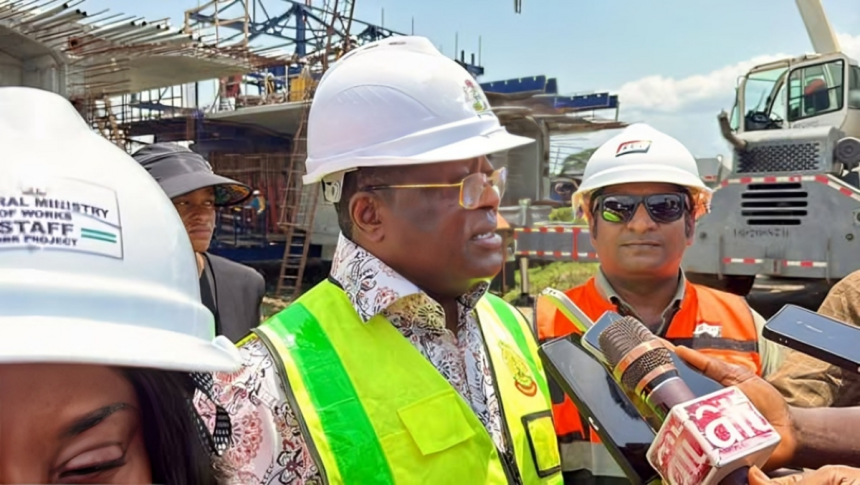
The Minister of Works, Senator David Umahi, has said President Bola Ahmed Tinubu’s four legacy road projects are designed as an interconnected national transport network that will link all six geopolitical zones, stimulate economic growth, strengthen food security, and deepen regional integration.
Francis Nwaze, the Senior Special Assistant to the Minister of Works (Media), in a statement, said Umahi made the remark on Monday in Abuja during a meeting with a delegation from the ECOWAS Bank for Investment and Development (EBID), led by Maimouna Sidibe, Head of the Basic Infrastructure Division in the Department of Public Sector Corporations.
The delegation is currently carrying out an appraisal ahead of the proposed financing approval for Section One of the Trans-Sahara Super Highway, a flagship component of the Tinubu administration’s legacy infrastructure programme.
Speaking during the engagement, Umahi said the four legacy projects were deliberately conceptualised to operate as a unified loop connecting the country’s key economic corridors.
He explained that the 750-kilometre Lagos–Calabar Coastal Highway links directly with the Trans-Sahara Super Highway through Ndibe Beach in Cross River State, forming part of a broader national grid of strategic road infrastructure.
According to him, Section One of the Trans-Sahara Super Highway stretches 123.64 kilometres from Ndibe Beach to the Benue border, with additional sections already awarded across Benue, Kogi and Nasarawa States.
Umahi noted that the route, which dates back to the colonial era, remains a critical agricultural and trade corridor that supports food distribution across the country.
He added that the highway would significantly reduce travel time between Calabar and Abuja to about four hours, while also opening up major agricultural belts in Ebonyi, Benue and Cross River States.
Beyond road connectivity, the Minister said there were plans to integrate dams along the corridor for irrigation and renewable energy generation, describing the project as a catalyst for industrialisation, job creation and investment expansion.
He further explained how the Trans-Sahara Super Highway connects with the Abuja–Akwanga corridor, extending through Jos, Bauchi, Gombe, Biu and Maiduguri, thereby linking key northern economic zones.
Umahi also said procurement had commenced for the Bauchi–Gombe section, while the recently flagged-off Gombe–Biu stretch covers 125 kilometres and is being constructed as a six-lane carriageway, as he further revealed plans to connect the Lagos–Calabar Coastal Highway to the Sokoto–Badagry Super Highway via a new corridor beginning at Victoria Island, passing through a 3.5-kilometre tunnel, Ogogoro Island and Snake Island before reaching Badagry.
“When you look at all of this on a map, you see a loop. All the geopolitical zones are included,” he said, adding that the network would enable movement across the country within two days.
The Minister commended the contractor handling Section One of the Trans-Sahara Super Highway, Infioues, noting that work had reached over 20 per cent completion, and stressed the need to fast-track financing as the project advances.
Earlier, Sidibe said the project had already passed the bank’s first credit committee and was now undergoing detailed appraisal ahead of further approvals.
She confirmed that the proposal would proceed to the second credit committee next week before being presented to the Board of Executive Directors in early July for final approval.
Sidibe also commended the Federal Government’s commitment to counterpart funding, noting that about 30 per cent had already been paid, and praised the quality and durability of the ongoing works, which she said were expected to last up to 50 years.
The delegation included officials from EBID, environmental and sustainability experts, financial analysts, and representatives of the project contractor.
The meeting ended on a positive note, with both parties expressing confidence in the successful completion of the appraisal process and the timely approval of funding for the project. Umahi reiterated the Federal Government’s commitment to delivering transformative infrastructure under President Tinubu’s administration, while the EBID delegation assured continued technical and financial support towards the realisation of the Trans-Sahara Super Highway and other legacy road projects.



