

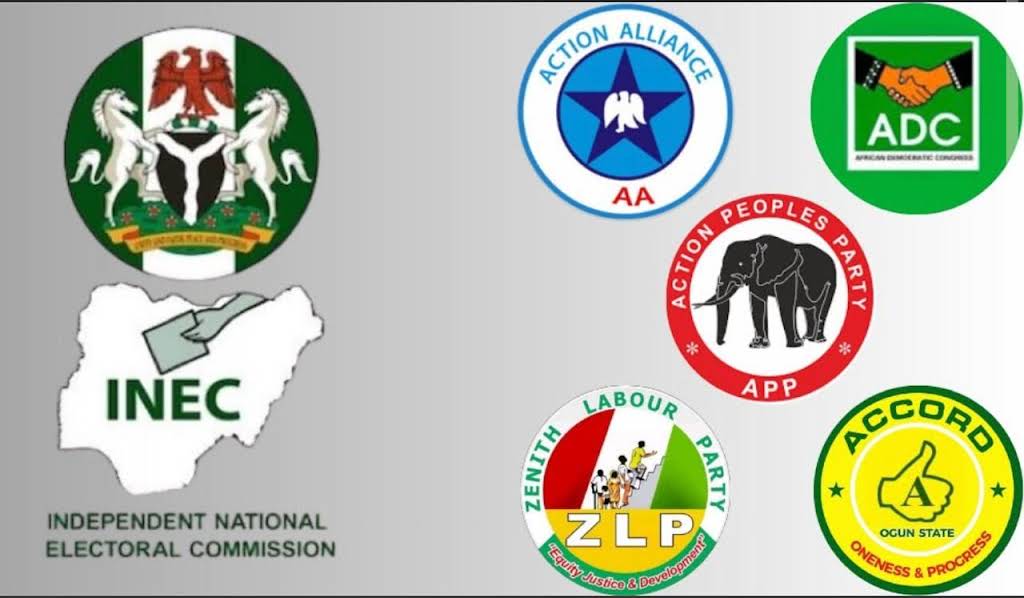
… ADC spokesman describes ruling as bid to undermine opposition, entrench one-party state
… ZLP says deregistration is an attempt to shrink political competition
By George Ameh
The Federal High Court sitting in Abuja on Monday ordered the Independent National Electoral Commission (INEC) to deregister five political parties, mainly opposition political parties, and barred them from participating in any further elections. The affected parties are the African Democratic Congress (ADC), Action Peoples Party (APP), Action Alliance, (AA), Accord Party (AP) and Zenith Labour Party (ZLP) for persistently failing to meet constitutional performance thresholds.
Justice Peter Lifu delivered the ruling in a suit filed by the National Forum of Former Legislators, marked FHC/ABJ/CS/2637/2026.
The plaintiff asked the court to determine whether INEC was constitutionally obligated to deregister political parties that fail to meet the thresholds set out in Section 225A of the 1999 Constitution.
The suit further relied on provisions of the Electoral Act 2022 and INEC’s regulations, which were cited as reinforcing the constitutional requirements for party registration and continued existence.
The plaintiff argued that the five parties had persistently failed to meet the constitutional benchmarks required to retain their registration, which include winning at least 25 per cent of votes in a state during a presidential election or securing at least one elective seat at the national, state or local government level.
The former legislators told the court that the ADC and the four other parties performed poorly in both the 2023 general elections and subsequent by-elections, failing to win seats across key tiers of government, and insisted that their continued existence as recognised political parties were unlawful and undermined the integrity of the electoral system.
Among the reliefs sought, the plaintiff urged the court to declare that INEC is duty-bound to deregister such parties and to compel the commission to do so before preparations for the 2027 elections advance further.
The plaintiff also asked the court to restrain the five parties from participating in elections or engaging in political activities such as campaigns, rallies and primaries, and to bar INEC from recognising or dealing with them unless they strictly comply with constitutional provisions.
The ruling could have implications for the prospects of candidates from the affected political parties, including former Vice President Atiku Abubakar, who has been linked with the ADC ahead of the 2027 presidential election, as well as Governor Ademola Adeleke of the Accord Party and House of Reps member, Ikenga Ugochinyere of the APP.
Meanwhile, the camp of Atiku has reacted to the Federal High Court judgment ordering INEC to deregister the party. The reaction was contained in a statement posted on X by Paul Ibe, the Media Aide to Atiku.
Describing the ruling as a bid to entrench a one-party state, Ibe said that a pending appeal and an active stay-of-action order already exist to counter the High Court’s decision.
The media aide labelled the judgement as; “height of judicial rascality” and a desperate attempt by the ruling party to undermine the opposition ahead of the 2027 elections.
Ibe stated that the High Court ruling directly violated a subsisting order from a higher court, explaining that the Court of Appeal had already intervened to halt the proceedings.
“The so-called deregistration of the African Democratic Congress (ADC) @ADCNig along with other parties by Justice Peter Lifu may yet be the biggest manifestation of Tinubu’s hell-bent bid to undermine the opposition and entrench a defacto one-party state. The judgment is the height of judicial rascality,” he said.
In the same vein, Osun State Governor, Ademola Adeleke, has condemned Monday’s judgement of the Federal High Court ordering the deregistering the five parties.
Adeleke described the decision as an abuse of court process and a direct violation of a subsisting order of the Court of Appeal. He expressed surprise that the lower court proceeded to deliver judgment despite an order by the appellate court staying proceedings on the matter.
According to Adeleke, the Court of Appeal had already made a pronouncement on the issue and directed that all proceedings, including the delivery of judgment, be halted pending the determination of the appeal. The Court of Appeal presided over by Justices Mohammed A. Danjuma, Adebunkunola A. Banjoko, Oyejoju O. Oyewumi had in Appeal CA/ABJ/CV/569/2026 and suit No. FHC/ABJ/CS/2637/2025 ordered Justice Lifu to stay further action on the matter until the hearing and determination of the Appeal before it. The hearing the appeal was scheduled for the 27th of October 2026. That order was dated 22nd of May 2026.
“Nigerians and the international community can see the level of desperation of the government of the ruling party to either have their way in the 2027 elections or destroy our democracy that was purchased at a huge cost,” he said.
Similarly, the Zenith Labour Party (ZLP) and its National Leadership have rejected the Federal High Court judgment, dismissing the ruling as politically motivated and stating that it won’t pass the Court of Appeal test. ZLP National Chairman, Chief Dan Nwuanyanwu, has been at the forefront of this push back.
The party insists it met all constitutional requirements for continued registration and has maintained that the deregistration suit is an attempt by opposing forces to shrink political competition.
Contrary to reports arising from the judgment delivered by Justice Lifu, available legal records indicate that the Action People’s Party, APP, is not affected by the ruling and remains a legally recognised political party entitled to participate in Nigeria’s electoral process.
Legal analysts and party stakeholders have pointed to a series of existing judgments delivered by courts of competent jurisdiction, including the Federal High Court, the Court of Appeal, and the Supreme Court, which have consistently affirmed the legal status and continued existence of the APP.
According to available court records, no fewer than three Federal High Court judgments had previously held that the APP satisfied all constitutional and statutory requirements for registration as a political party. These decisions were subsequently affirmed by the Court of Appeal and ultimately reinforced by the Supreme Court, effectively settling questions surrounding the party’s legal status.
Also, Omoyele Sowore, a politician and human rights activist, has joined the fray, condemning the Justice Lifu ruling. On his X account, Sowore rejected the deregistration, labelling it undemocratic and unjustifiable in a multi-party democracy. He criticised the move because the affected parties had already concluded their primary elections and were preparing for future general elections. He insisted that the court’s action “shall not stand.”
The New National Star reports that all the affected political parties including the AA have rejected the Justice Lifu judgement describing it as politically motivated and a travesty of justice that cannot stand the test of time. The affected parties have advised their members and supporters to remain calm as the matter would be challenged at the court of appeal.



