

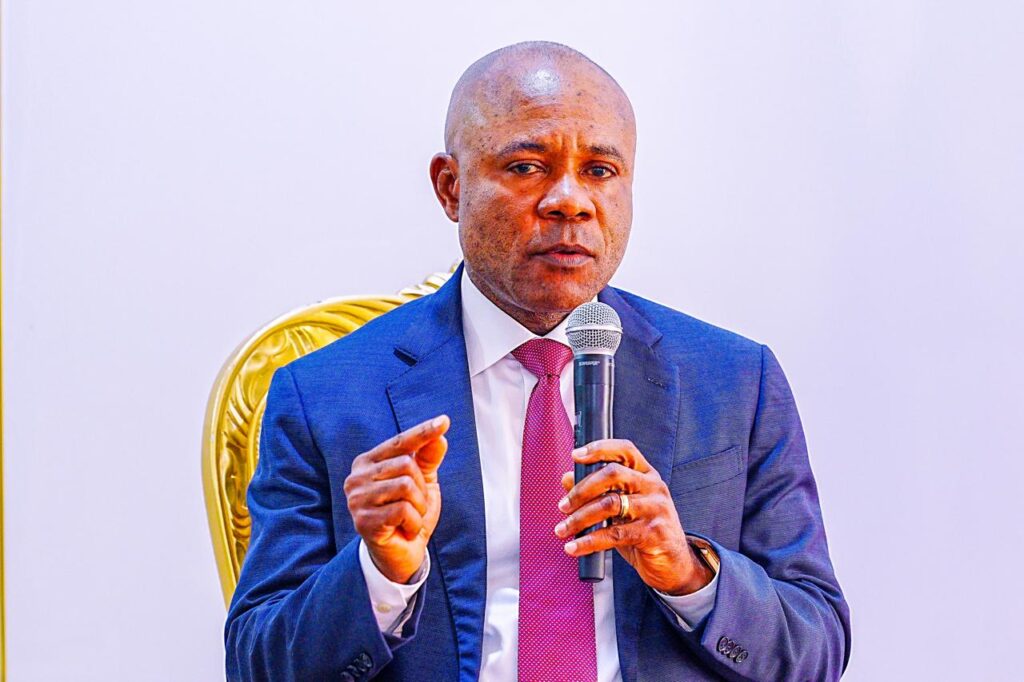
…. Removal of fuel subsidy ought to have taken effect decades ago – Gov. Mba
…….Increased federal support is already producing visible results across states – Onanuga
…….. Experts highlight disconnect between rising allocations and worsening economic hardship
By Joy Onu
When President Bola Tinubu announced the removal of fuel subsidy in May 2023, it triggered one of the most intense national debates in Nigeria. For many citizens, the immediate effect was painful, rising transport costs, inflationary pressure, and uncertainty about the future. For others within government and fiscal policy circles, it marked the beginning of a structural reset in Nigeria’s public finance architecture.
Today, more than a year into the reform cycle, a clearer picture is beginning to emerge into a country where subnational governments are receiving unprecedented inflows from the Federation Account Allocation Committee (FAAC), and infrastructure development at the state level is increasingly being tied to expanded fiscal space created by federal reforms.
Governor Peter Mbah of Enugu State, without mincing words, said the removal of fuel subsidy is working and ought to have taken effect decades ago.
Mba has attributed the state’s ongoing infrastructural transformation to increased financial allocations to subnational governments under the administration of President Tinubu, saying the enhanced fiscal environment has enabled the state to execute development projects on an unprecedented scale.
Mbah spoke while receiving members of the Renewed Hope Ambassadors and the Presidential Communications Team on a media tour of projects across the South-East geopolitical zone.
The delegation was jointly led by the Special Adviser to the President on Information and Strategy, Bayo Onanuga, and the Special Adviser on Media and Public Communications, Sunday Dare.
The media tour, an initiative of the National Coordinator of the Renewed Hope Ambassadors and Governor of Imo State, Hope Uzodimma, is designed to showcase major federal and state government projects across the South-East.
Speaking during the visit, Mbah said President Tinubu’s economic reforms and support for subnational governments had freed up resources, allowing states to undertake critical infrastructure projects and development programmes.
In a statement issued on Wednesday by the Renewed Hope Ambassadors’ Director of Media and Publicity, Tunde Rahman, the governor said “it would have been impossible, to say the least, for us as a state to have done things at the scale we did without some of the bold and courageous policies of Mr President.”
According to him, the Federal Government’s policies have significantly strengthened the financial capacity of states by increasing allocations from the Federation Account.
He noted that previous administrations often struggled to meet recurrent obligations, leaving little or no funds for capital projects.
“What we are seeing in Enugu today and at the scale these things are happening is only possible because we now have more funds coming from the Federation Account and there is quite a lot of support from the centre to the subnationals and for us is to make good use of that opportunity and that’s essentially what we’re doing,” he said.
Onanuga believes that increased federal support is already producing visible results across states. “President Bola Ahmed Tinubu has not ignored any section of Nigeria. People are going to feel the impact of road works and infrastructure projects going on across the country,” he said during a project inspection in Enugu State.
“Today, Enugu State presents one of the most visible infrastructure portfolios in the country. These include the ongoing 38.6-kilometre Enugu–Onitsha–Port Harcourt dual carriageway reconstruction, the 21.5-kilometre Enugu International Airport Road expansion, and multiple inter-city road dualisation projects aimed at improving regional connectivity.
“In the health sector, the Enugu International Specialist Hospital stands out as a flagship project, featuring modern diagnostic equipment such as MRI machines, cancer treatment units, and advanced surgical theatres designed to reduce outbound medical tourism.
“The state’s Smart Green Schools initiative is also being developed to provide digitally equipped learning environments across communities, while a tractor assembly plant is being established to support agricultural mechanisation and improve food production capacity,” he stated.
Onanuga, after inspecting several of these projects, described them as evidence that federal-state collaboration is beginning to yield visible outcomes. “Everywhere has been taken care of. The impact of ongoing infrastructure projects will be felt across the country,” he said.
While government officials and beneficiaries of the reforms insist that the fiscal expansion is unlocking long-delayed infrastructure delivery, critics and civil society actors argue that increased allocations have not sufficiently translated into improved living conditions for ordinary Nigerians.
For Okechukwu Nwanguma, Executive Director of the Rule of Law Accountability and Advocacy Centre (RULAAC), the issue is not the absence of resources but governance priorities. “Governors must work towards delivering on infrastructure projects,” he argued, stressing that failure to translate increased FAAC inflows into measurable results reflects a lack of vision and moral leadership rather than shortage of funds.
Similarly, fiscal transparency advocate, Victor Agi, has repeatedly questioned the disconnect between rising allocations and worsening economic hardship. “Mr Governors, for the umpteenth time, how has FAAC impacted lives in your states?” he asked, noting that rising inflation, transport costs, and electricity tariffs have eroded whatever fiscal gains states may be receiving.
Following subsidy removal and foreign exchange reforms, FAAC disbursements surged significantly. Monthly allocations, which previously hovered around ₦1 trillion, have in recent periods crossed ₦2 trillion. In 2024 alone, total FAAC disbursement stood at over ₦15 trillion, with states and local governments receiving unprecedented shares.
Yet, economist Muhammad Akanji, author of Counting Trillions, Measuring Nothing, warns that the surge in revenue has not translated into proportional improvements in outcomes. “Across much of the country, infrastructure remains broken, hospitals under-equipped, and workers unpaid. FAAC has evolved into a survival lifeline for states, not a performance lever for development,” he said.
He further noted that many states still execute barely 50-60 per cent of their capital budgets annually, with recurrent expenditure, especially salaries and overheads, crowding out investment in physical infrastructure.
From the perspective of Eze Onyekpere, Lead Director of the Centre for Social Justice (CSJ), the core issue remains accountability. “Nigeria receives huge allocations from FAAC every month, but how much of these funds truly translates into real development for citizens?” he asked, calling for stronger alignment between public spending and measurable development outcomes.
Chief economist Ayokunle Olubunmi of Agusto & Co. offers a complementary view, arguing that despite increased revenue inflows, “development has not improved when compared to the surge in state revenues,” largely due to weak transparency and inefficient allocation of resources.
Civil society leader Auwal Musa Rafsanjani of CISLAC is even more direct. “There is no physical, verifiable, tangible evidence to show that the monies governments are receiving are touching lives in healthcare, electricity, infrastructure, or agriculture.”
Across social media platforms, many Nigerians continue to question the disconnect between rising allocations and persistent hardship. Ordinary citizens cite rising food prices, transport costs, unemployment, and deteriorating public services as evidence that increased FAAC inflows are not yet translating into meaningful relief. One Lagos-based trader captured the sentiment bluntly: “We hear trillions are coming to the states every month, but nothing is changing for us. Everything is still expensive.”
Dr Ayodeji Ebo of Afrinvest explains that while revenues have increased, states remain highly dependent on oil-linked allocations. “These revenues are volatile and largely outside state control,” he noted, warning that without diversification, sustainability remains a concern.
At the heart of the debate is a fundamental question: is increased FAAC translating into development impact at the grassroots?
What is clear is that Nigeria’s fiscal federalism is undergoing a profound shift. The removal of fuel subsidy, foreign exchange reforms, and petroleum sector adjustments have significantly increased the resources flowing to states. The real test now lies in how effectively those resources are put into fruitful use.
As one governance analyst put it, “The money is no longer the problem. The question is impact.”



