

By Joy Onu
The call by the Minister of Information and National Orientation, Mohammed Idris, for stronger collaboration between the media and security agencies at the National Security Summit in Abuja goes beyond routine official remarks, as it speaks directly to one of Nigeria’s most persistent governance challenges, trust deficit in the information and security ecosystem.
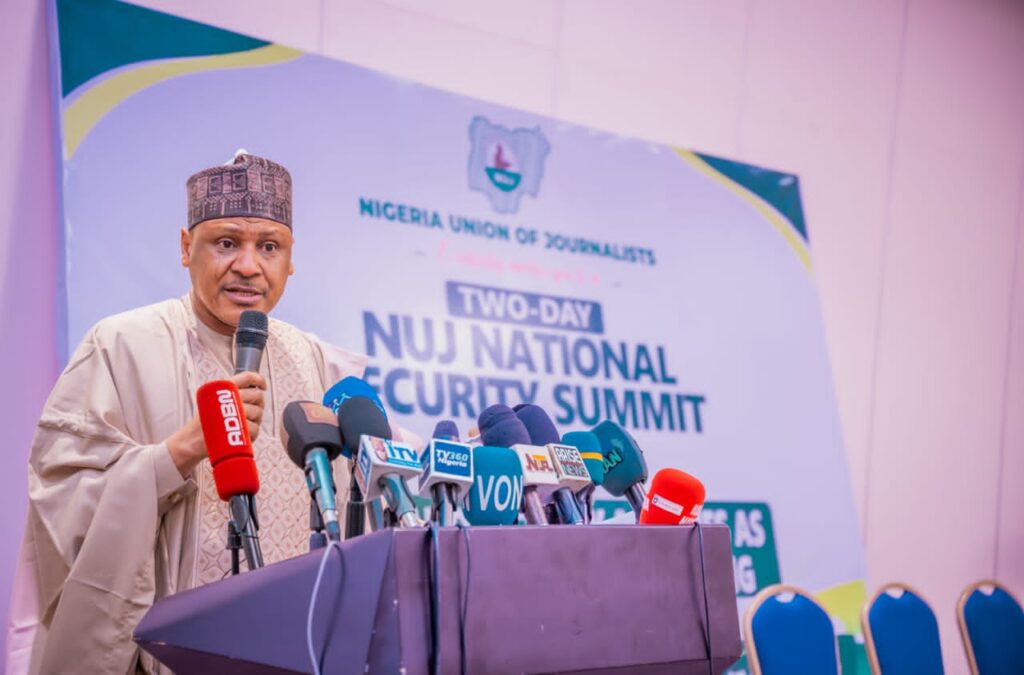
Speaking at the summit organised by the Nigeria Union of Journalists (NUJ) in partnership with the Department of State Services (DSS) on Thursday, Idris described the relationship between both institutions as a strategic necessity for national stability rather than a ceremonial partnership.
At the centre of his message was a clear argument on security agencies and the media, though different in function, are bound by a shared responsibility to safeguard national interest. While security institutions are tasked with protecting lives, property, and territorial integrity, the media serves as a watchdog and communication bridge between government and citizens.
However, the Minister also pointed to a growing tension in the information space particularly the rise of misinformation and disinformation which he said poses a direct threat to national stability if not managed responsibly.
In an era where digital platforms amplify both facts and falsehoods at unprecedented speed, Idris stressed that journalism must now balance the public’s right to know with the imperative of protecting national security. This balance, he suggested, is where the greatest challenge lies.
His remarks also highlighted the Tinubu administration’s ongoing security strategy under the Renewed Hope Agenda, which combines kinetic military operations with intelligence-driven interventions, inter-agency coordination, technology deployment, and community engagement.
While the government continues to report gains such as the arrest and neutralisation of terrorists, bandits, and kidnappers, as well as the dismantling of criminal networks, the broader security picture remains complex, with threats still evolving across regions.
The Minister also highlighted federal investments in modern security infrastructure, including surveillance systems, intelligence platforms, and training programmes designed to enhance operational effectiveness. He, however, maintained that security cannot be achieved through force alone.
According to him, long-term stability also depends on addressing structural drivers of insecurity such as unemployment, weak infrastructure, limited access to education, and socio-economic inequality areas where government reforms and social interventions are currently being pursued.
From a media perspective, his message placed renewed responsibility on journalists to uphold professionalism, accuracy, and ethical standards, particularly in a climate where unverified information can escalate tensions or undermine public confidence in institutions. At the same time, he called on security agencies to improve transparency and communication with the media, suggesting that secrecy without explanation can be as damaging as misinformation itself.
The summit, which brought together senior government officials, security chiefs, media executives, and communication experts, reflected a growing recognition of the need for coordinated messaging in national security discourse.
Among those in attendance were the Director-General of the Voice of Nigeria (VON), Mallam Jibrin Baba Ndace; the Chairman/Chief Executive Officer of the National Drug Law Enforcement Agency (NDLEA), represented by Assistant Commander-General of Narcotics, Dankolo Shehu Mohammed; and the President and Chairman of Council of the Nigerian Institute of Public Relations (NIPR), Dr. Ike Neliaku, alongside other senior government officials, security chiefs, and communication professionals.
Ultimately, Idris’ intervention underscores a broader policy reality as Nigeria’s security challenges are no longer purely operational but also informational, and how effectively the media and security institutions manage that information space may increasingly shape public perception, trust, and ultimately, national stability.



