

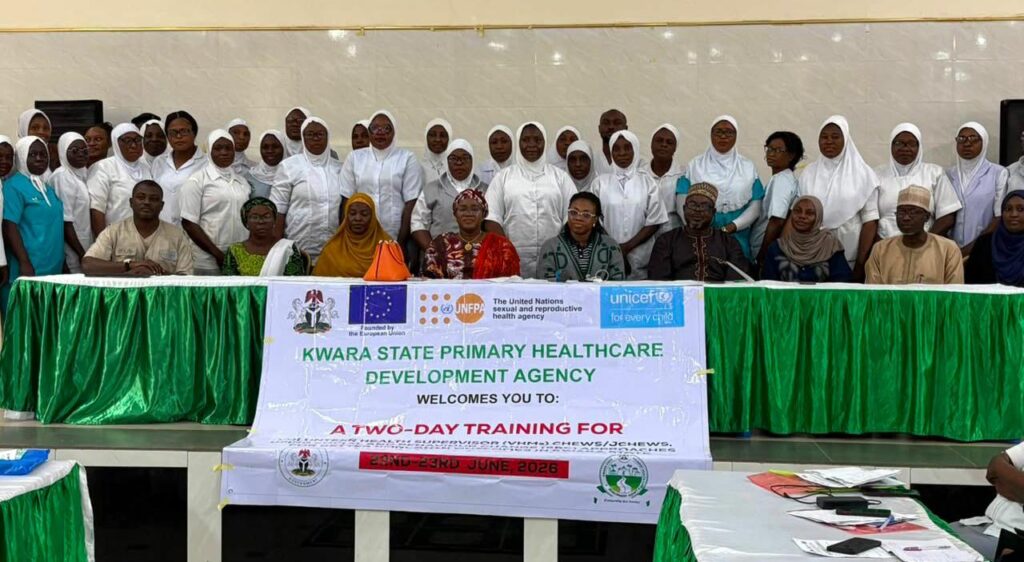
The Kwara State Primary Health Care Development Agency (KWSPHCDA), with support from the United Nations Children’s Fund (UNICEF), has commenced capacity-building training for volunteer health supervisors to strengthen primary healthcare service delivery statewide.
The two-day training, which began on June 22 in Omu-Aran, Irepodun Local Government Area, brought together Community Health Extension Workers (CHEWs) from the state’s 193 wards serving as supervisors.
This is contained in a statement issued by the agency’s Press Secretary, Mrs Bukola Abdulganiyu, on Wednesday in Ilorin, highlighting efforts to improve supportive supervision and healthcare outcomes across communities.
The statement quoted the Executive Secretary of the agency, Prof. Nusirat Elelu, as saying continuous capacity building remained critical to improving healthcare service delivery and achieving better health outcomes statewide.
Elelu urged participants to maximise the opportunity provided by the training, emphasising that effective supervision was essential for strengthening community health workers’ capacity, ensuring accountability and improving healthcare quality.
She said the training would equip supervisors with the skills and tools needed to support frontline health workers, improve service delivery, enhance data quality and strengthen evidence-based decision-making processes.
The executive secretary added that the agency would continue supporting Maternal, Perinatal and Child Death Surveillance and Response (MPCDSR) activities, alongside nutrition outreach programmes targeting preventable child deaths.
According to her, improved supportive supervision will enhance data accuracy, strengthen monitoring mechanisms and contribute significantly to building a more responsive and efficient health system across communities.
In his goodwill message, the State Health Educator and representative of the Kwara Ministry of Health, Mr Jibril Abdulkareem, emphasised supervisors’ role in driving positive health outcomes statewide.
Abdulkareem described demand generation as critical to the success of health programmes, noting that the initiative was designed to stimulate demand for healthcare services at community level.
He said Volunteer Health Mobilisers served as a bridge between communities and health facilities by encouraging individuals and families to access available healthcare services and interventions.
The health educator urged participants to take their supervisory responsibilities seriously, saying effective supervision would enhance volunteers’ performance and contribute significantly to achieving the programme’s objectives statewide.



