

….. IMF said about ₦8.83 trillion spent in 2025 not reflected in the budget
……₦8.8 trillion “shadow treasury” outside the national budget amassed as war chest for 2027 general elections – Atiku
….. FG Rejects claims, says IMF report misrepresented
By Ameh George and Theodora Obayojie.
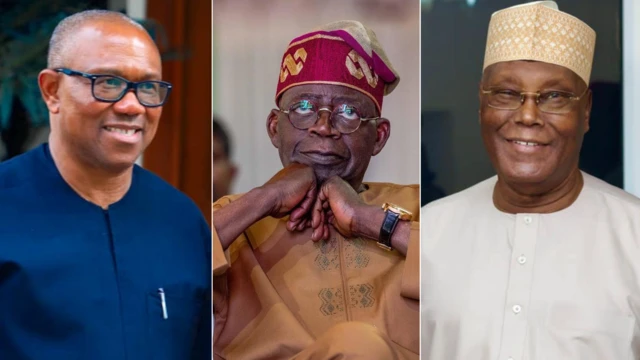
The presidential candidate of the Nigeria Democratic Congress (NDC) Peter Obi, has renewed his call for President Bola Tinubu to resign, alleging that the reported ₦8.83 trillion spent outside the 2025 budget is further proof of poor governance and weak financial accountability.
Obi made the demand in a statement on Sunday while reacting to findings in a recent consultation report by the International Monetary Fund (IMF), which reportedly indicated that 2 per cent amounting to ₦8.83 trillion in government expenditure for 2025 was not reflected in the approved national budget.
According to him, the expenditure was outside legislative oversight and administrative scrutiny, raising fresh concerns about transparency in the management of public funds.
“The IMF now reveals that about ₦8.83 trillion in expenditure undertaken in 2025 is not reflected in the budget. This expenditure is not budgeted and is therefore not under legislative oversight or administrative scrutiny,” he said.
Obi said the amount represents about two per cent of Nigeria’s Gross Domestic Product (GDP), exceeds 35 per cent of the 2025 capital budget of ₦23.96 trillion, and is higher than the combined federal allocations to the education and health sectors.
He argued that if properly managed, the funds could have improved healthcare, education, infrastructure and employment opportunities, instead of becoming the subject of accountability concerns.
The former Anambra State governor described the reported expenditure as part of what he called a pattern of financial mismanagement, warning that continued disregard for due process could weaken public institutions, deepen poverty and threaten national stability.
Obi said the latest development strengthens his earlier position that President Tinubu should step down over what he described as incompetence, lack of compassion and failure to deliver on promises made to Nigerians during the 2023 election campaign.
He also called on Nigerians to demand greater accountability through lawful means, insisting that public resources must be managed openly and in line with established financial regulations.
On his part, former Vice President Atiku Abubakar accused the Bola Tinubu-led administration of operating a ₦8.8 trillion “shadow treasury” outside the national budget, alleging that the funds are being amassed as a war chest for the 2027 general elections while Nigerians face worsening economic hardship.
Atiku, the 2027 presidential candidate of the African Democratic Congress (ADC), raised the alarm on Friday in a statement, citing a July 1, 2026, IMF Article IV report published by Reuters.
The ADC leader said the IMF report revealed that about two per cent of GDP, estimated at ₦8.8 trillion based on a ₦441.5 trillion economy, was spent in recent budgets without statutory recording, audit or legislative oversight.
“I view this revelation with the gravest alarm. The Tinubu administration is awarding multi-trillion-naira contracts, moving massive public capital, and commissioning infrastructure projects entirely beyond the reach of the Auditor-General, the nation’s procurement laws, and the legitimate oversight of the National Assembly. It is a parallel fiscal universe, one governed by executive whim,” Atiku said.
He added that the IMF’s resident representative in Nigeria, Christian Ebeke, confirmed the discrepancy arose from “large-scale government projects executed off-budget entirely.”
The former vice president also alleged that ₦800 billion was “illegally deducted” from statutory allocations due to state governments under the Progressives Governors Forum, without National Assembly approval or court order.
“We state clearly and without equivocation that this ₦800 billion, combined with the ₦8.8 trillion in unrecorded federal expenditures, points unmistakably to the construction of a massive, multi-source political war chest being assembled ahead of the 2027 general elections,” Atiku said.
Atiku linked the alleged secret spending to the current economic pain, including fuel subsidy removal, naira devaluation, and high interest rates.
He asked the National Assembly to convene emergency investigative hearings on the IMF findings.
He equally said the Auditor-General should conduct a full, independent audit of all off-budget expenditures and publish findings without redaction.
Atiku insisted the Federal Government should provide a full public account of every Naira spent outside the official budget, including projects, contractors and authorising officials.
He also said the Federal Government should refund to the states immediately and restore the ₦800 billion deducted from state allocations for the prosecution of Tinubu’s re-election.
The former Vice President further said EFCC and ICPC should open formal investigations independent of the Presidency.
“A government that governs in secret spends in secret. A government that spends in secret does not govern; it plunders,” Atiku said.
However, the Federal Government has defended its management of public finances, insisting that no part of its expenditure has been carried out outside the law, following claims that more than ₦8 trillion was spent outside the 2025 budget.
The clarification came on Sunday after reports cited the IMF 2026 Article IV Consultation Report as indicating that government spending equivalent to about two per cent of Nigeria’s GDP was not captured in the approved budget.
Responding to the reports, Minister of Finance and coordinating Minister of the Economy, Mr. Taiwo Oyedele, said the interpretation was inaccurate and did not reflect the IMF’s actual findings. He maintained that all federal spending is backed by constitutional provisions and approvals granted by the National Assembly.
According to the Minister, Nigeria’s public finance framework does not permit the operation of a parallel or undisclosed budget. He explained that government spending is carried out through annual appropriation laws, supplementary budgets where necessary, and other statutory approvals provided under the Constitution.
Oyedele noted that some capital projects extend beyond a single fiscal year and are financed through legally approved rollovers. Such arrangements, he said, should not be mistaken for expenditures made outside the budgetary process.
He also explained that several government financial obligations, including statutory transfers to agencies, first-line charges, debt servicing, security interventions, and allocations to the Federal Capital Territory, are established by law and may be presented differently in fiscal reports prepared under international accounting standards.
The Minister argued that these expenditures are publicly disclosed and remain subject to legislative oversight and audit, stressing that differences in reporting formats should not be interpreted as evidence of hidden spending.
He challenged those alleging that trillions of Naira had been spent illegally to identify the affected projects and provide credible evidence to support the claims, describing speculation without facts as misleading.
The government further dismissed suggestions that the reported figure reflected a widening fiscal deficit, explaining that budget deficits are determined by the gap between government revenue and expenditure rather than the financing arrangements adopted for approved projects.
Oyedele said the IMF’s observations were directed at improving the scope and presentation of Nigeria’s fiscal reporting and did not suggest that public funds had been spent unlawfully.
He added that the Tinubu administration had already initiated reforms to consolidate overlapping government budgets into a more unified framework, alongside measures to strengthen budget credibility, improve revenue administration, digitise public financial management and enhance transparency.
The Minister urged Nigerians to interpret fiscal reports within their proper context and avoid drawing conclusions that are not supported by the IMF’s findings or Nigeria’s legal framework.
The New National Star reports that according to an IMF report, Nigeria has left about N8.83 trillion (about $6.15 billion) in public spending out of its recent official budgets.
The IMF’s resident representative in Nigeria, Christian Ebeke, said last Wednesday that the unreported spending has created a gap between the country’s reported fiscal deficit and its actual financing needs.
The New National Star reports that the N8.83 trillion is calculated based on the National Bureau of Statistics’ (NBS) latest full-year nominal GDP figure of N441.5 trillion for 2025.
According to the NBS, Nigeria’s nominal GDP rose to N441.5 trillion in 2025 from N372.8 trillion in 2024, driven by improved performance across the oil and non-oil sectors.
Applying the IMF’s two per cent estimate to this figure puts the value of the unrecorded expenditure at approximately N8.83 trillion, or about $6.15 billion at the Central Bank of Nigeria’s average 2025 exchange rate of N1,436 to the dollar.
Ebeke further explained that the discrepancy arose because some capital spending was not captured in budget documents or implementation reports, making Nigeria’s fiscal deficit appear smaller than the actual level of government borrowing.
He linked the unreported expenditure partly to large government projects executed outside the formal budget process, saying this had distorted assessments of the country’s fiscal position and public investment levels.
The report comes months after the NBS rebased the economy, changing its GDP base year from 2010 to 2019, a move that significantly widened the size of the reported economy and, by extension, the naira value tied to any percentage-based fiscal estimate.



