

By Joy Onu
For a city created to represent Nigeria’s unity, identity and aspirations, the Abuja City Gate has always carried a meaning beyond its physical structure. Standing as one of the first major landmarks visitors encounter on arrival in the nation’s capital, the gateway has long served as a symbol of Abuja’s image.
But over the years, the landmark gradually lost the elegance associated with its original purpose, creating a visible gap between the vision of Abuja as a modern capital and the appearance of one of its most recognisable entrances.
That gap in the city’s aesthetics was what First Lady Senator Oluremi Tinubu drew attention to, according to FCT Minister Nyesom Wike, leading to the transformation of the ageing structure into a renewed landmark.
The remodelled City Gate is part of the Federal Capital Territory Administration’s broader urban renewal efforts aimed at repositioning Abuja to meet global standards, the FCT noted in a statement by Rabi Musa Umar, Deputy Director, Press, Office of the FCT Minister.
Unveiled by President Bola Ahmed Tinubu, the landmark has now become one of the most visible symbols of the FCTA’s urban renewal drive, sparking conversations about beauty, public spaces, national identity and the priorities of government.
President Tinubu, represented by the First Lady at the commissioning ceremony, described the facility as more than a transit point, saying it reflects Nigeria’s unity, diversity and shared aspirations.
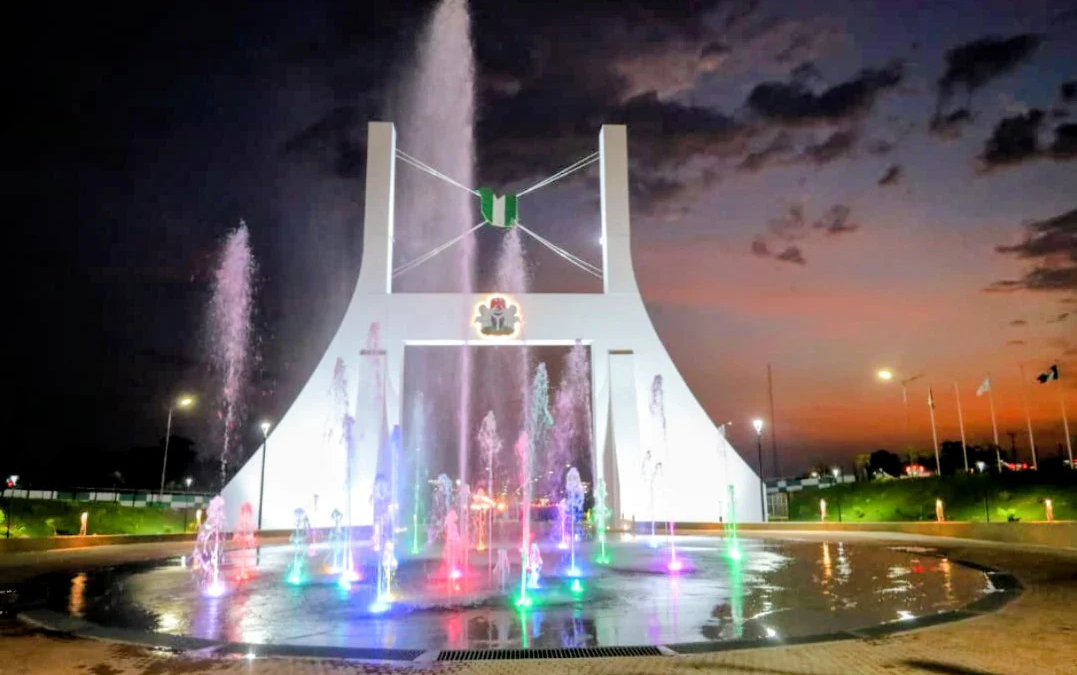
“This newly remodelled Abuja City Gate, with its beautiful water fountain representing the 36 states and the FCT, tells every visitor and Nigerians arriving from the airport that they have entered a city built on unity, diversity, and shared aspirations,” the President said.
He added that the quality of the project enables the landmark to stand alongside globally recognised public monuments, while urging residents to take ownership of public infrastructure.
The renewed landmark now features a Unity Fountain with 37 nozzles representing Nigeria’s 36 states and the Federal Capital Territory, improved lighting systems, landscaping, irrigation facilities, recreational areas, a 60-car parking facility, toilet facilities and enhanced security arrangements.
For Wike, the transformation was driven by the need to restore the dignity expected of a gateway into Nigeria’s capital.
“The First Lady challenged us to look at the gate and ensure it befits a nation’s capital. She didn’t seek personal gain; she sought to fill a gap in our national aesthetics. Today, thanks to the President’s backing and the efficiency of the FCDA and Julius Berger, we have a world-class monument,” the minister said.
The Minister of State for the FCT, Dr. Mariya Mahmoud, described the project as part of a new era of infrastructural renewal in Abuja, noting that the remodelling represents the administration’s determination to reposition the capital city to meet global standards.
She said the renewed landmark demonstrates how public spaces can contribute to the overall character of a city, while encouraging residents to protect and take ownership of government infrastructure.
Beyond the official symbolism, the transformation has also renewed discussions about the role of aesthetics in urban development. Supporters argue that a modern capital cannot be defined only by roads and buildings but also by landmarks, recreational spaces and structures that communicate confidence and identity.
The Executive Secretary of the Federal Capital Development Authority (FCDA), Engr. Richard Yunana Dauda, provided the historical context, explaining that the Abuja City Gate was originally constructed in 1991 to symbolise the relocation of Nigeria’s capital from Lagos to Abuja.
He said the rehabilitation became necessary after years of deterioration, adding that the renewed facility was designed not only as an entrance point but also as a sightseeing and recreational destination for residents and visitors.
For people in the creative industry, the transformation offers a new visual identity for Abuja.
Ahmed Mohammed, a photographer based in Wuse, said the renewed landmark provides opportunities beyond aesthetics.
“The remodelled gate is beautiful. For us in the creative space, it’s a new backdrop, a new symbol of Abuja we can use in our work. People underestimate how image and aesthetics also matter for a city’s identity,” he said.
Other residents also welcomed the new look. Ibrahim Musa, a taxi driver in Lugbe, said the improved features had changed the experience of entering the capital.
“Honestly, I like what they have done with the gate. When I drive in at night, the lights and the fountain make Abuja look like a serious capital, not just one big construction site. At least people can now see something that shows the government is trying,” he said.
Chioma Okafor, a youth corps member in Kubwa, said the project gives young Nigerians a landmark they can identify with.
“As a young person, I’m happy to see Abuja looking more modern. The new City Gate gives us a proper landmark, somewhere you feel proud to show friends who are visiting for the first time. It may not solve every problem, but it changes how the city feels,” she said.
However, some residents believe aesthetic projects must be balanced with investments that directly address citizens’ daily challenges.
Maryam Danladi, a petty trader in Karu, questioned whether the project should take priority amid economic pressures.
“The gate is fine, but you cannot eat City Gate. My rent is going up, food is expensive, transport is a struggle. When I hear how much they spent on that place, I just ask myself: if they used that money on markets, schools, or hospitals, would it not touch more lives?” she said.
John Eze, a civil servant in Garki, said the project does not address some of the problems commuters face.
“I pass that road almost every day. The gate is new, yes, but the traffic and bad planning are still there. It feels like they polished the entrance for cameras while leaving the real problems of ordinary commuters and residents unsolved,” he said.
For Halima Sani, a teacher in Nyanya, government priorities remain an important consideration.
“I don’t hate beauty, but priorities matter. Our classrooms are overcrowded, children sit on the floor, and we are talking about fountains and landscaping at the City Gate. It sends a message that image is more important than people,” she said.
The intervention by the First Lady has, therefore, become a significant part of the conversation around the project, highlighting how attention to public aesthetics can shape the identity of a city.
The contrasting reactions around the remodelled City Gate reflect a wider debate about what defines a modern capital.
While supporters see the landmark as an investment in Abuja’s identity, tourism potential and global image, critics believe such projects must move alongside improvements in areas that directly affect citizens.
Ultimately, the renewed City Gate has become more than an entrance into Abuja. It now represents a continuing conversation about how Nigeria’s capital can balance beauty, symbolism and the everyday needs of the people who call the city home.



