

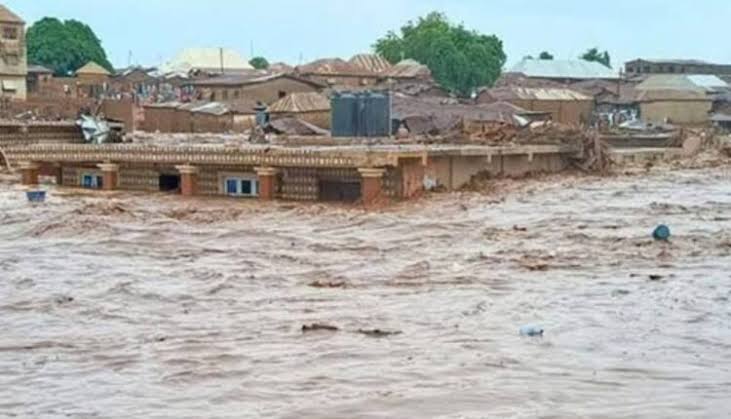
Flooding has become a recurring decimal in Nigeria’s littoral areas, sacking communities, destroying properties, wreaking havoc in the magnitude never imagined. This natural disaster occurs during the rainy season, cutting across the Northern and Southern parts of Nigeria.
As it has become the culture, the Federal Government, through its weather watch agencies, issues alerts to the general public to warn of a looming disaster caused by flooding.
Usually, when the Federal Government issues flood alerts, the various media outlets publish very frightening headlines, which put the citizens, already traumatised by the menace of banditry, kidnapping, and extreme poverty, on the edge.
No doubt, the Nigeria Hydrological Services Agency (NHSA) and the Nigerian Meteorological Agency (NiMet) are equipped with up-to-date weather forecast tools to provide real-time flood risk monitoring and near-accurate weather forecasts, access to comprehensive hydrological data, risk assessments, and early warning systems to support disaster preparedness and water resource management. Armed with the appropriate data, the Federal Government and the sub-nationals inform residents of the flood prone states and communities to get prepared for the impending floods.
There have been numerous flood alerts in the months of May, June and July. The announcements and early warning signs have always been accompanied by flood relief funds, shared among the affected states. For instance, on June 22, the Federal Ministry of Environment warned that at least 26 states and the Federal Capital Territory may experience flooding between June 22 and July 5, 2026, following forecasts of heavy rainfall across several parts of the country. This flood prediction emanated through the National Flood Early Warning Centre under the Erosion, Flood and Coastal Zone Management Department, and it identified hundreds of communities tagged either critical-risk or high-risk flood zones. States listed under the critical-risk category include; Abia, Adamawa, Akwa Ibom, Anambra, Bayelsa, Benue, Cross River, Delta, Ebonyi, Edo, Ekiti, Enugu, Imo, Kogi, Kwara, Lagos, Niger, Ogun, Ondo, Osun, Oyo and Rivers.
Other communities identified as highly vulnerable include; Aba, Arochukwu and Umuahia in Abia State; Jimeta and Numan in Adamawa State; Eket, Oron and Uyo in Akwa Ibom State; Onitsha Inland Town and Awka Urban Drainage Corridors in Anambra State; and Yenagoa, Brass and Nembe Town in Bayelsa State. Makurdi, Gboko and Katsina-Ala in Benue State; Calabar Metropolis and Creek Town in Cross River State; Asaba, Warri City and Sapele in Delta State; as well as Abakaliki, Afikpo and Onueke in Ebonyi State. Benin City Urban Core and Auchi in Edo State; Ado-Ekiti and Ikere-Ekiti in Ekiti State; Enugu, Nsukka and Oji River Town in Enugu State; Owerri, Orlu and Okigwe in Imo State; Lokoja and Ajaokuta in Kogi State; Ilorin, Jebba and Pategi in Kwara State; and several communities in Lagos State, including Agege, Alimosho, Apapa, Badagry, Ikeja, Ikorodu, Lagos Island, Lekki and Surulere. The list is unending and the alert only left three States safe out of 36 states and the FCT.
Flooding has already occurred in States like Lagos, Ogun, Rivers in Nigeria and across West Africa in countries such as Ghana and Ivory Coast. Residents are bearing the brunt alone – houses are submerged, vehicles swept away – the victims have resorted to begging the government for what could have been either averted or mitigated.
The government at various levels appear ill-prepared to handle flood disasters, merely maintaining two duties: announcing looming flood and sending ecological funds across affected states for relief materials. The government should go beyond announcing flood alerts. More often than not, the government at both federal and state levels only compel the affected citizens to evacuate flood impacted areas, without making adequate efforts to mitigate the disaster or provide a buffer. Rather, the residents of the affected communities are shipped to displaced persons’ camps, mostly schools located in the upland areas, thereby disrupting learning and academic calendars.
In other disaster-prone countries, especially Southeast Asia, governments provide low-cost houses for the affected communities until they are all resettled.
There are instances where some affected people refused to be relocated owing to cultural or traditional reasons. Yes, their reasons could be germane but safety of lives must be prioritised; besides, if the government commits to building befitting houses, many will be willing to relocate.
If governments at various levels are committed to mitigating the catastrophic effects of flooding, they must muster the political will and planning to prioritise the relocation of residents of flood prone communities, or redesign the building patterns in those areas. A typical example is Venice, Italy, the iconic Italian city built on water centuries ago. Even the houses in most of the Ijaw communities are floating or built on water. We believe, what is lacking is proper planning beyond annual relief materials. In the end, who benefits? All of us!
It is appropriate that concerned Nigerians are urging the government at all levels to do more than announcing flood alerts, providing mattresses and blankets to the affected citizens. The Federal government should review the objectives of the ecological fund to include collaboration with the state and local government counterparts, to deliberately resettle citizens living along flood prone areas to avert recurring yearly flood disasters.
Also, urban planning should be properly designed, strategically, religiously implemented without fear or favour. Canals, drainages and water channels should be regularly desilted as well as expanded to accommodate free flow of water. Those who build on water ways should be appropriately sanctioned and where necessary denied building approvals. Changing building designs in flood prone areas by adopting the Sicily model of raising building pillars high could salvage the yearly disaster.



