

… INEC says voters that died 15 years ago still in the register
… Partners NIMC for cleaning of register, UK for security, technology
By Ameh George
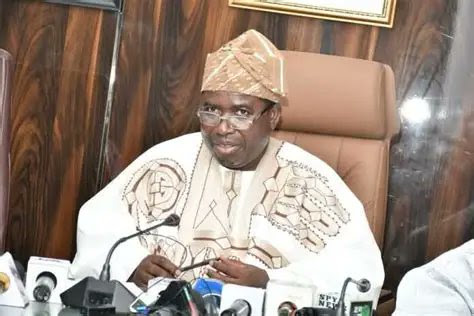
The Chairman of the Independent National Electoral Commission (INEC), Prof. Joash Amupitan, has reiterated the Commission’s resolve to conduct a transparent and credible elections in 2027 by making sure that the voters’ register is cleaned to reflect the actual figures of voters alive.
Amupitan said this when he received the Director-General/Chief Executive Officer of the National Identity Management Commission (NIMC) Abisoye Coker-Odusote and her management team who visited him in Abuja recently.
According to Amupitan, names of voters who had died as far back as 15 years ago were still in the country’s voters’ register which may impact on the credibility of the 2027 elections and even cause unnecessary financial waste in terms of printing ballot papers and providing other logistics for the exercise.
He declared that the newly signed NIMC Act 2026 lays the foundation for a new electoral system in Nigeria built on verified identity and stronger data integrity.
Amupitan expressed confidence that with NIMC’s database now covering more than 136 million enrolled Nigerians, deeper cross-platform integration between the two commissions would allow for continuous auditing, verification and elimination of duplicate or underage entries on the voter register.
Explaining how the partnership will authenticate voter registration, the INEC boss said that it would significantly reduce the overall cost of conducting elections.
“Entries belonging to Nigerians who died as far back as 2011 remain on INEC’s records, alongside cases of duplication. The commission looks forward to leveraging NIMC’s data architecture to progressively clean up the register.
“A credible, well-quantified voter register would significantly reduce the overall cost of conducting elections. INEC currently has to print materials in excess of the more than 100 million entries on its register to accommodate discrepancies,” he said, adding; “a comprehensive quantification exercise is planned for after the general election.”
He expressed confidence that the new legal framework and the technology behind it, would make such infractions far easier to detect and address.
He recalled that he had personally raised the need for stronger identity safeguards during an appearance before the Senate and commended the National Assembly for providing what he described as the legislative leeway now serving as the foundation for a more credible electoral system.
The NIMC boss, Coker-Odusote, also assured that identity remains the foundation of effective governance and credible election planning, pledging NIMC’s full support to INEC in delivering a fair and transparent 2027 general elections.
The INEC chairman’s revelation was just a confirmation of the fear being expressed by many Nigerians. A university lecturer, Dr Samuel Adegboye, believes that having dead persons’ names on the voters’ register aids election manipulations.
He also believes that sometimes, it is deliberate, noting that, “some corrupt INEC officials are working in cahoots with some dubious politicians to ensure that election manipulation is made possible. With the names of dead persons in the voter register, it becomes very easy for politicians to inflate figures at the end of the day. And as I said, such politicians work in cahoots with some INEC officials.
“However, the INEC chairman did not tell us the number of dead persons in the register. The numbers could be in the hundreds of thousands considering the number of unnatural deaths that had occurred in Nigeria over the past 10 years as a result of insecurity across the country.”
He commended Amupitan for being honest to accept that there are dead persons whose names are still in the voters’ register. “Let it not just end in rhetoric, let him back it up with action as he has promised. Such dead persons’ names should be weeded out of the register.
“That way, rigging will be maximally reduced and we can expect an improved election outcome.”
He advocated that apart from dead names, the issue of ghost voters must also be tackled. He noted that there are hundreds of thousands of non-existent names in the voter register, stressing that since the INEC chairman has started with the dead voters, he should also go a step further to tackle the issue of ghost voters.
“You know, it has become a popular cliche that anything is possible in Nigeria. This is a country where the absurd has become the norm. It started with ghost workers in the civil service where some dubious officials collect salaries for non-existent personnel. And this went on for so many years before it was discovered and since its discovery, that problem has kept recurring in the civil service.
“Recently, we are talking about a ghost agency that has existed for over three years. Can you imagine that? An agency that has been submitting budgets and getting approval for three is what they are telling us doesn’t exist?
“If that can happen, what makes you think that we can’t have ghost voters? So, since the INEC chairman has decided to be honest enough to admit that there are dead persons’ names in the voter register, I want him to also know that there are ghost voter names in that register. Let him address both issues at the same time so that we can have fair and credible election results in 2027,” he added.
Also, speaking on the matter, a retired civil servant, Johnson Adewale stressed that apart from curtailing rigging and restoring credibility to the electoral process, such a clean-up will save enough funds.
For a former local government counsellor in Amuwo Odofin Local Government Area of Lagos State, Kolade Adegboyega, “Nigerians are tired of rhetoric; they want action.”
He agrees with the INEC chairman that such a move would reduce the overall cost of election in Nigeria. He commended his openness and resolve to tackle the menace once and for all by seeking collaboration with NIMC. He, however, advised the INEC boss to do everything within his power to ensure that Nigerians have credible elections in 2027.
Also, a lawyer and public affairs commentator, Jason Osazuwa decried the development, saying, “if not that the entire system is already corrupt, how can such a thing happen?
“We all know that Nigeria has a big problem with keeping data and that’s why we have ghost workers in the civil service everywhere.
“It is shameful that at this age and time, we are talking about having names of dead persons in our voter register. I only want the INEC boss to live up to his words. Let him partner with NIMC to clean the register. We want to have fair, credible elections in 2027 and beyond,” Osazuwa said.
To ensure the actualisation of a credible election in 2027, the Commission stated that it has appealed to the United Kingdom on the need for deeper collaboration on security, technology, cybersecurity and voter education as it intensifies preparations for next year’s general elections.
Amupitan made the appeal when he received the British High Commissioner to Nigeria, Dr. Richard Montgomery, at the commission’s headquarters. He described the UK as a longstanding partner in Nigeria’s democratic journey, reflecting that the relationship had evolved beyond election observation and technical assistance into broader institutional support for strengthening democratic governance.
Amupitan explained that the commission had made significant progress in preparing for the 2027 polls despite a compressed electoral timetable, including the rollout of enhanced technology, improved cybersecurity architecture and expanded voter registration.
The New National Star reports that INEC earlier dismissed viral social media claims that its officials were distributing death certificates to citizens during the ongoing Continuous Voter Registration CVR, describing the incident as a procedural error by a registration officer that was easily misinterpreted in a politically charged climate.
An INEC official, who spoke to journalists, on the condition of anonymity said the form at the centre of the controversy, INEC Form EC 3A, officially titled ‘Notification of Death of a Person Named on the Register,’ was not a voter registration form and was never intended to be given to fresh registrants at the point of registration but only during claims and objections.
The commission said it has so far removed 7,746 deceased persons’ names from the voter register through the claims and objections process, including 2,500 in Yobe State alone, as part of efforts to ensure the integrity of the register ahead of the 2027 general elections.



