

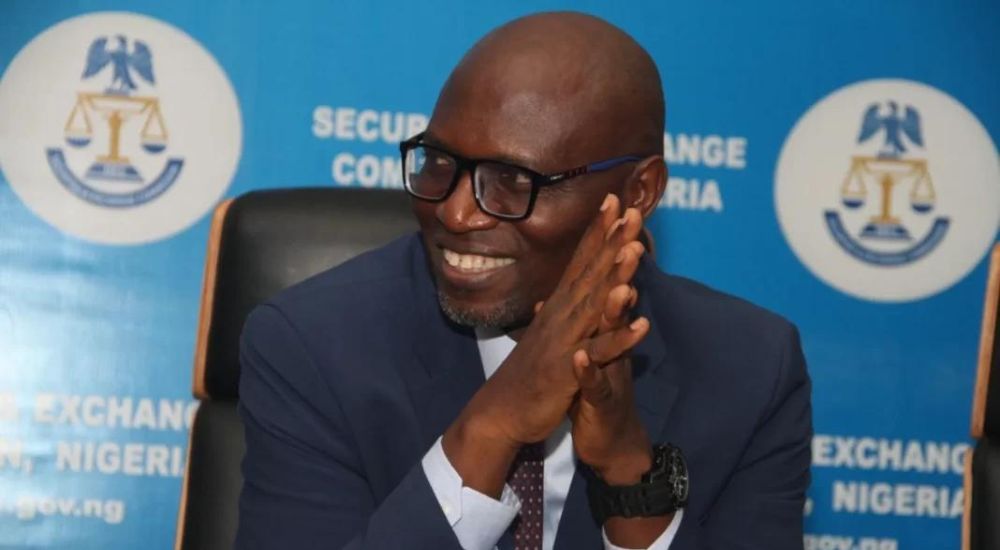
The Securities and Exchange Commission (SEC) has secured a grant from the African Development Bank (AfDB) to deploy a state-of-the-art market surveillance system aimed at strengthening oversight of Nigeria’s capital market, while also retaining a 20 per cent revenue waiver approved by the Federal Government to sustain its regulatory operations
.
Director-General of the SEC, Dr. Emomotimi Agama, disclosed this on Tuesday during the 2026 Revenue Monitoring Exercise conducted by the House of Representatives Committee on Finance in Abuja, where he also reaffirmed the Commission’s commitment to maintaining an efficient, transparent, and globally competitive capital market.
Agama said the new surveillance system, funded through the AfDB grant, is expected to become operational this year and will significantly enhance the Commission’s ability to monitor trading activities, detect market abuses, and strengthen investor protection in line with international best practices.
According to him, the initiative forms part of the SEC’s broader strategy to modernize market regulation and align Nigeria’s capital market with global standards.
“The Commission has secured a grant from the African Development Bank to acquire a modern market surveillance system, which will be deployed this year.
This will strengthen oversight of the capital market and ensure that our regulatory framework meets international standards,” Agama said.
The SEC boss also revealed that the Commission continues to operate without any budgetary allocation from the Federal Government, relying entirely on internally generated revenue from activities within the capital market to fund its operations while still making statutory remittances to the government.
He explained that although the International Organization of Securities Commissions (IOSCO) recommends that securities regulators operate independently with governments providing financial support where necessary, Nigeria’s SEC currently finances its activities from market-generated income.
“Going by IOSCO principles, the SEC is expected to be financially independent. The government is supposed to provide support for the running of the Commission.
However, due to the paucity of funds, all the money used to fund the Commission comes from the market.
The SEC does not receive any funding from the government; rather, it pays money to the government,” Agama stated.
He further explained that once the Commission’s revenues are lodged into its account with the Central Bank of Nigeria (CBN) statutory deductions are automatically effected before the SEC can access the remaining balance.
According to Agama, the arrangement has made it necessary for the Commission to adopt prudent financial management measures while ensuring that regulatory activities are not compromised.
To cushion the impact of the deductions, he disclosed that the SEC obtained approval from the Minister of Finance to retain 20 per cent of its internally generated revenue through a waiver.
He noted that the waiver has become critical to sustaining the Commission’s operations without imposing additional financial burdens on capital market operators through increased regulatory fees.
“We are regulators and are not expected to ask the market for money.
With the kind permission of the Honourable Minister of Finance, we obtained a 20 per cent waiver on deductions to ensure our operations are not hindered,” he said



