

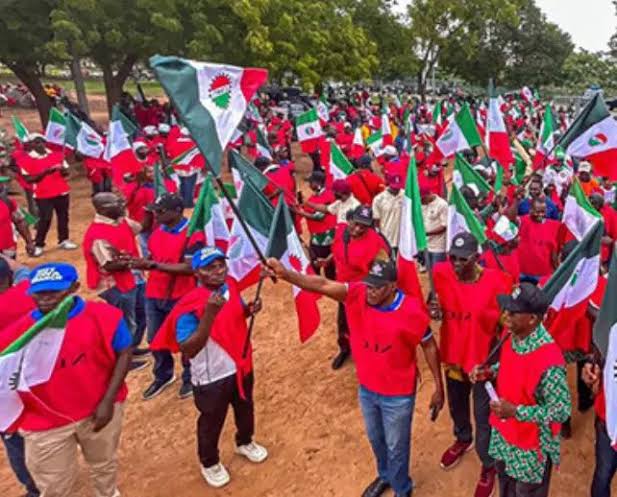
Nigeria’s current ₦70,000 national minimum wage requires an urgent upward review to a realistic living wage as soaring inflation continues to erode workers’ purchasing power.
The Nigeria Labour Congress (NLC) is actively pushing for a nationwide campaign to review the ₦70,000 national minimum wage up to a sustainable living wage.
This push is fuelled by skyrocketing inflation, which has effectively reduced the ₦70,000 benchmark originally established under the Minimum Wage Act in July 2024 to what the labour leaders nicknamed the “poverty wage.”
The current ₦70,000 monthly wage no longer covers basic expenses like food, healthcare, public transit, and housing. The inflation also affected the people’s purchasing power. Owing to the economic realities, different figures of expected minimum wage are being debated.
However, the debate extends beyond how much workers should earn. Unless Nigeria tackles inflation, improves productivity and addresses the reality that over 90 per cent of its workforce is employed informally, a higher minimum wage may have only a limited impact on the country’s widening cost-of-living crisis.
The renewed conversation reflects an uncomfortable reality. The 133 per cent increase approved in 2024, after months of negotiations between the Federal Government, labour unions and the organised private sector, has been overtaken by present day realities.
In Lagos, housing costs rank among the highest in Africa, the state government acknowledged this reality by fixing its minimum wage at N85,000, arguing that the national benchmark could hardly meet the cost of basic survival.
Rivers and Imo also pay above the national minimum, while several states, particularly in northern Nigeria, are yet to fully implement even the existing N70,000 wage, citing revenue constraints.
Labour unions, however, argue that N100,000 would still leave workers struggling. The NLC insists that even the proposed increase “falls far below the realistic figure,” with labour leaders floating a minimum wage of N1million.
The minimum wage debate often assumes that most Nigerians are salary earners whose incomes are determined by government policy. In reality, the overwhelming majority of workers fall outside that framework.
Nigeria operates two parallel labour markets. One is the formal economy, where salaries are regulated, taxes are deducted, pensions are paid and labour laws, including minimum wage legislation, can be enforced.
The second is the informal economy, where millions survive through petty trading, farming, transport services, artisan work, domestic services and countless small businesses. Earnings fluctuate daily and government wage policies rarely have any direct effect.
The National Bureau of Statistics’ Labour Force Survey found that 92.93 per cent of employed Nigerians worked in the informal economy in 2023.
For a workforce that is 93 per cent informal, any increase in the national minimum wage directly benefits relatively a small fraction of the workforce.
For workers, a higher minimum wage promises immediate relief. For employers, especially small and medium-sized businesses already struggling with high energy costs, foreign exchange pressures and weak consumer demand, it represents another increase in operating expenses.
In comparison with other third world countries especially in Africa, Nigeria, in spite of having enormous mineral resources such as crude oil, is ranked below Egypt, South Africa, Cabon, Equatorial Guinea in minimum wage payment. The N70, 000 is around $44, whereas Egypt pays over $130 – $170 and South Africa pays $231 -$280.
To address economic problems in a high inflationary environment, the government should address the cost of living through the supply-side of the economy instead of hiking minimum wage. Agriculture, logistics, and core aspects of inflation should be addressed. Thea government should set its sight on the purchasing power of workers by increasing production, productivity and growing the economy.
The NLC’s proposal of a N1 million minimum wage may sound ambitious, but some analysts argue that even such a dramatic increase would not automatically solve Nigeria’s cost-of-living crisis.
If production remains weak while wages rise sharply, businesses would likely increase prices to stay afloat. Inflation would accelerate, weakening the purchasing power of the higher salary earners.
For workers outside the formal sector, who make up more than nine out of every 10 employed Nigerians, there would be no wage increase at all. They would simply face higher prices without earning more.
This means that raising the minimum wage alone cannot address widespread poverty in an economy where most workers are self-employed or employed informally.
Complementary policies like formalisation of the informal sector, access to credit irrespective of status of businesses, social safety nets, improved infrastructure would all help lift all Nigerians from despair to a state of hope.
Infrastructure improvements, particularly electricity, roads and digital connectivity, could reduce production costs while boosting productivity.
To strike a balance between improving workers’ welfare on one hand and causing inflation and job losses among MSMEs would require that increased minimum wage be attached to performance, productivity and results.
Such an approach, economists argue, could allow wages to rise alongside productivity, making higher pay more sustainable for businesses while limiting inflationary pressures.
The New National Star strongly recommends that rather than negotiating for a minimum wage, the NLC and the government at all levels should focus on a living wage backed with a productive economy that encompasses workers in the formal and informal sector. A living wage, if implemented can go a long way in solving most social and economic challenges, therefore, placing workers in the right frame of mind to help build the economy through increase productivity which would lower food prices, improve logistics and transport networks to reduce distribution costs.
The Federal Government should also sustain crude oil sales to the Dangote Refinery in naira to moderate fuel prices, and expand its compressed natural gas (CNG) public transportation programmes already introduced in some cities.



