By Theodora Obayojie
The closed-door meeting between former President Olusegun Obasanjo and the presidential candidate of the Nigeria Democratic Congress (NDC Peter Obi, may have lasted only a few hours, but it has injected fresh momentum into the political calculations already shaping the 2027 presidential election.
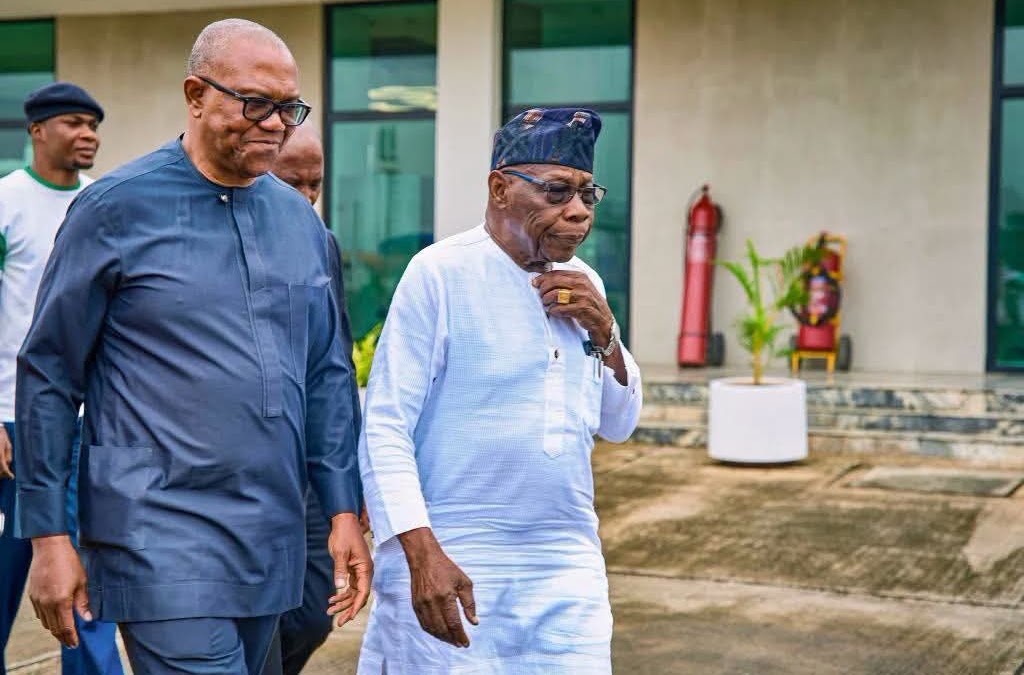
Contents released on Wednesday by the Obi Media team showed Obi visiting Obasanjo at his Abeokuta residence in Ogun State. Also present at the meeting was a Catholic bishop. Neither Obi nor the former president disclosed what transpired behind closed doors, but the timing of the meeting has fuelled speculation that consultations among opposition leaders are entering a more strategic phase.
The visit comes against the backdrop of ongoing efforts to forge a broad opposition coalition capable of mounting a formidable challenge to President Bola Tinubu and the ruling All Progressives Congress (APC) in 2027.
Unlike previous election cycles where opposition parties entered the race on separate platforms, leading figures are increasingly emphasising unity as the pathway to electoral success. The emergence of the NDC as a rallying platform for several opposition politicians has further strengthened discussions around coalition politics.
The meeting also followed recent comments by Akin Osuntokun, former Director-General of the Obi-Datti Presidential Campaign Council and a former political adviser to Obasanjo. Dismissing reports that the former president was working for President Tinubu’s re-election, Osuntokun said Obasanjo was instead committed to building a stronger opposition alliance.
According to him, “If you can say that Obasanjo is supporting any ticket, it is the Peter Obi-Kwankwaso ticket. As a matter of fact, he is the principal sponsor of that ticket.”
He further argued that “Obi and Kwankwaso is a much more realistic, more compelling ticket than the 2023 one,” describing Kwankwaso’s political influence in Kano and parts of northern Nigeria as “a big bonus” for the proposed alliance.
Although Obasanjo has not publicly confirmed those remarks, his latest meeting with Obi has reinforced the perception that he remains actively engaged in consultations capable of shaping Nigeria’s political landscape.
The significance of the Abeokuta meeting lies not only in the personalities involved but also in the timing.
With less than seven months until the 2027 general election, political alignments are gathering pace across the country. Several opposition figures have continued discussions aimed at avoiding the fragmentation that many analysts believe weakened their chances during the 2023 presidential election.
Obi, who left the Labour Party to join the NDC coalition, has continued consultations with former Kano State governor Rabiu Kwankwaso and other political stakeholders as efforts intensify to build a national platform with broader regional appeal.
Those efforts, however, have not been without challenges.
According to media reports, the OK Movement, established to mobilise grassroots support for the proposed Obi-Kwankwaso alliance, has recently been engulfed in an internal leadership dispute. The disagreement has generated concern among supporters over the direction of the movement and the possibility of avoidable divisions.
Kwankwaso’s spokesman, Ladipo Johnson, recently acknowledged the disagreement, describing it as a distraction rather than a major crisis. He disclosed that Obi had already been briefed on the situation and was dissatisfied with the internal wrangling.
Johnson said, “Yes, we have, may I call it a distraction at the moment. It is not such, in my own humble opinion, that would lead you to take unilateral actions that could possibly scuttle or bring bad blood within the support base of the person you purportedly want to become the president of the country.”
He added: “I saw the presidential candidate last night along with the DG. He’s not happy about the whole situation.”
The comments have reinforced concerns within the coalition that internal disputes, if left unresolved, could undermine efforts to build a united opposition platform ahead of the 2027 election.
Analysts say Obasanjo’s continued relevance in Nigeria’s political equation also explains why every meeting involving the former president attracts national attention.
Since leaving office in 2007, the former president has remained one of the country’s most influential political figures. He played significant roles in the emergence of successive administrations and has repeatedly intervened in national debates through public letters, policy interventions, and consultations with political leaders across party lines.
His endorsement of Peter Obi before the 2023 presidential election demonstrated his willingness to back candidates outside the traditional political establishment.
Whether that support will evolve into a more active role ahead of 2027 remains one of the questions political analysts will be watching closely.
For Obi, maintaining regular engagement with Obasanjo could offer more than symbolic value.
While the former Anambra State governor enjoys considerable popularity among young voters and urban professionals, analysts have often argued that translating electoral support into electoral victory requires a wider political network, stronger grassroots structures and broader acceptance among Nigeria’s traditional political class.
Obasanjo’s extensive relationships across the South-West, the North, and the wider political establishment could prove valuable if the opposition coalition succeeds in remaining united.
The meeting also comes at a period when governance issues are increasingly dominating national discourse. The implementation of the 2026 budget, persistent inflation, rising cost of living, and lingering security challenges have continued to shape public opinion and are expected to dominate political campaigns as the election approaches.
Despite the political significance attached to the Abeokuta meeting, many questions remain unanswered. Neither Obi nor Obasanjo has issued an official statement explaining the purpose of the talks, while there has been no indication that formal agreements were reached regarding the proposed coalition.
Nevertheless, in politics, symbolism often carries as much weight as official declarations. A private meeting between two influential political figures at a time when opposition negotiations are gathering momentum inevitably sends a message. It suggests that consultations are continuing, alliances are being explored, and political calculations for 2027 are accelerating.
Attention will now shift to whether Obasanjo eventually speaks publicly on the coalition efforts, whether the NDC succeeds in consolidating support from other opposition blocs, how internal disagreements within the OK Movement are resolved and how the APC responds to the emerging political realignments.
The ruling party has often dismissed coalition talks, however at the moment, the Abeokuta meeting has achieved one immediate outcome, it has reignited national conversation about the future of the opposition and underscored that, although formal campaigns remain some distance away, the battle for the 2027 presidency is already taking shape behind closed doors.