

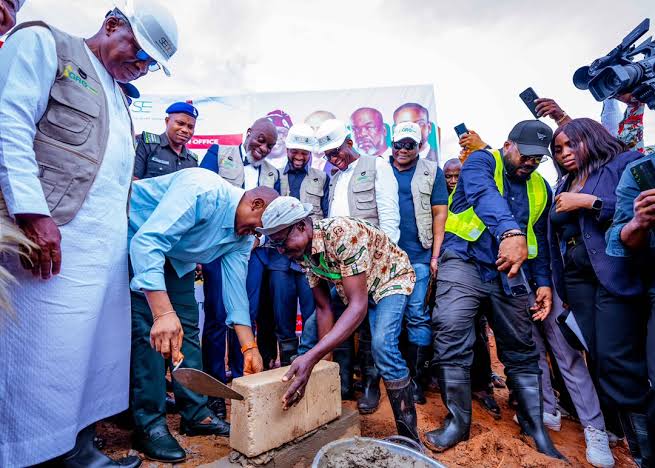
The South East Development Commission has commenced work on a 200-hectare integrated agricultural project in Nomeh Unataeze, Nkanu East Local Government Area of Enugu State, with the facility projected to generate more than 1,000 direct jobs when fully operational.
The project, being developed under the Commission’s South East Agro-Development Programme, is designed to combine large-scale agricultural production with mechanisation, processing, skills development and market access.
SEDC said the initiative is intended not only to boost food production but also to demonstrate an agricultural model that can be adapted and replicated across the five South East states.
The pilot project is being implemented in partnership with the Enugu State Government and will incorporate dairy farming, poultry, fisheries, greenhouse cultivation, fodder production, agro-processing, renewable energy, mechanisation and practical agricultural training.
The flag-off ceremony, which was held on Wednesday, was attended by Enugu State Governor, Dr Peter Mbah, represented by his deputy, Barr. Ifeanyi Ossai; Minister of Regional Development, Engr Abubakar Momoh; Chairman of SEDC, Dr Emeka Wogu; Managing Director/Chief Executive Officer of SEDC, Mr Mark Okoye; traditional rulers, community leaders and other stakeholders.
Ossai described the project as evidence of the benefits that could arise from cooperation among government institutions, particularly at a time when food security, job creation and economic diversification remain major development priorities.
“The development of this agricultural facility in Nomeh demonstrates what is possible when government institutions work together around a clear development objective. Enugu State is committed to creating the conditions for productive investment, and we are pleased to partner with SEDC on a project that will not only produce food, but also create jobs, develop skills, support farmers and strengthen the agricultural value chain. We believe this project can become an important part of the economic development of Nkanu East, Enugu State and the entire South East region within the context of Nigeria.”
Unlike conventional agricultural projects built around a single commodity, the Nomeh facility is structured as an integrated production system in which the various components are expected to complement one another.
The project includes provision for a 200-head dairy herd, poultry production of up to 20,000 birds per cycle, fisheries infrastructure, fodder cultivation, silage production, processing and demonstration facilities.
The integrated approach is expected to allow the different enterprises to share infrastructure and services while reducing waste. Fodder produced on the farm will support livestock production, while animal manure and poultry litter could be utilised for energy generation and soil improvement.
Surplus fodder will also be converted into silage for use within the facility and for supply to participating farmers.
The project will equally provide shared facilities for feed production, water supply, farm machinery and processing, creating an agricultural ecosystem intended to link production with value addition and markets.
According to Okoye, the initiative was conceived to demonstrate how agriculture could be transformed from largely fragmented production into a coordinated economic activity driven by technology, mechanisation, skills and market linkages.
“The South East Agro-Development Programme is about building the productive capacity of the region. We want to demonstrate what agriculture can look like when land, technology, mechanisation, production, processing, training and markets are brought together in one system.”
He said the ultimate measure of the project’s success would be its ability to stimulate economic activity beyond the physical boundaries of the 200-hectare farm.
“The real impact is what happens around the farm and beyond the farm. It is the young person who acquires a practical skill here and starts a farm elsewhere, the farmer who supplies maize or soya to the feed mill, the dairy farmer who gets technical support and access to a reliable market, and the smallholder farmer who is able to increase production because the ecosystem around them has improved.”
A training and out-grower programme is expected to extend the benefits of the project to surrounding communities.
The training centre will accommodate between 100 and 120 trainees at a time, with practical instruction covering dairy husbandry, fodder and silage production, poultry, fisheries and agricultural mechanisation.



