

By Joy Onu
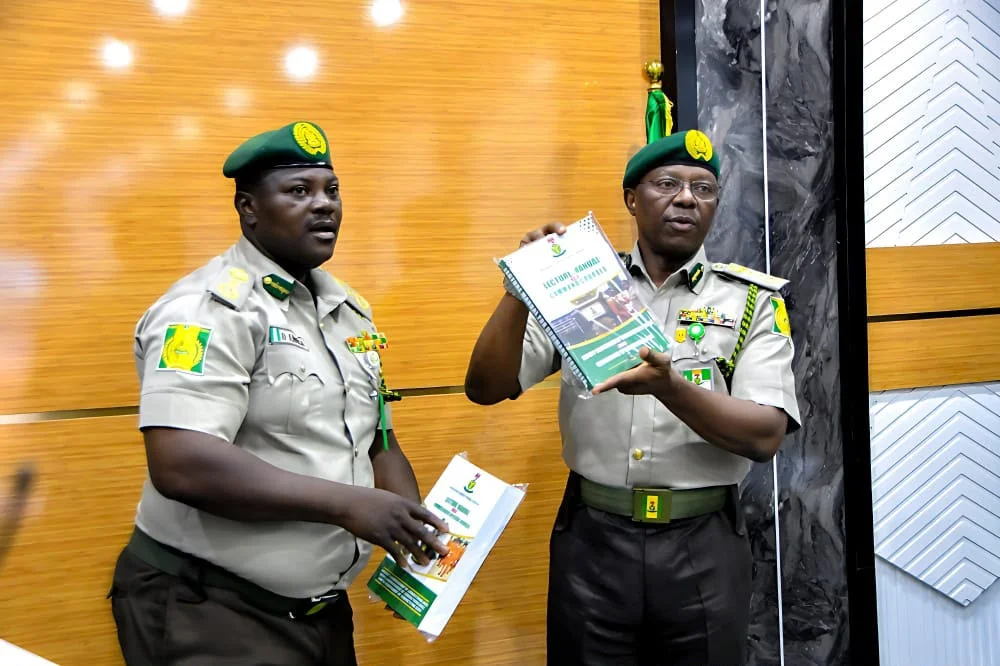
The Controller-General of Corrections, Sylvester Ndidi Nwakuche, has described the Nigerian Correctional Service’s (NCoS) first-ever Unified Training Manual and standardised Course Badges as a landmark achievement that will strengthen professionalism, institutional identity and uniformity in personnel training.
In a statement issued on Wednesday by the Service Public Relations Officer, Chief Superintendent of Corrections (CSC) JN Osuji, Nwakuche said the unveiling of the new Training Manual and Course Badges introduced a common training framework for all NCoS training institutions nationwide.
The new manual replaces the 2019 edition and has been reviewed to reflect contemporary realities, evolving correctional practices and emerging professional demands across the Service.
The Controller-General commended members of the Manual Review Committee and other personnel who contributed to the development of the curriculum, stressing the importance of the initiative to professional development within the Service.
The internally developed manual marks a shift from the previous practice in which much of the Service’s training materials were produced by external bodies.
According to the NCoS, the new approach will strengthen institutional ownership, preserve professional knowledge within the Service and ensure that training content remains relevant to operational realities and professional requirements.
The unified framework covers Command Courses, Commissioned Officers Courses, Basic Recruit and Chief Corrections Assistants Courses, as well as specialised and refresher programmes.
The Service also introduced standardised badges for various professional courses, including the Advanced Command Course Badge for Controllers of Corrections (CC), Command Course Badge for Deputy Controllers of Corrections (DCC), Chief Superintendent of Corrections (CSC) Course Badge and Assistant Superintendent of Corrections (ASC) Course Badge.
Nwakuche, who was decorated with one of the newly unveiled badges, described the insignia as a symbol of professional identity and accomplishment with enduring prestige.
He urged officers to appreciate the significance of the badges and uphold the discipline, values and professional excellence they represent.
In further recognition of professional advancement, the Controller-General decorated the Deputy Controllers-General with the Advanced Command Course Badge.
The Deputy Controller-General in charge of Training and Staff Development, DCG Olanrewaju Amoran, said the manual was conceived to provide a single, contemporary training resource capable of addressing the changing demands of correctional administration and practice.
Amoran said experienced personnel from relevant professional areas contributed to the development, ensuring that the content was grounded in institutional experience, operational realities and emerging trends in corrections.
He said the manual would provide a common reference point for instructors and trainees, promote consistency in the interpretation and delivery of course content, and improve the quality of professional training across NCoS institutions.
Amoran added that the framework would support continuous professional development by providing officers with standardised learning materials throughout their career progression, thereby reinforcing competence, excellence and lifelong learning.
Earlier, the Chairman of the Manual Review Committee and Deputy Controller-General in charge of the Human Resources Directorate, DCG Ado Sale, said the manual and course badges were important to the professional development of officers.
Sale stressed that the badges were not ceremonial accessories or items to be purchased from open markets, but professional distinctions earned through prescribed training and formally conferred by commandants of the Service’s training institutions.
The ceremony also featured the presentation of an Award of Excellence to Nwakuche by the Review Committee in recognition of his leadership and support for the initiative.
In appreciation of their contributions, Nwakuche presented plaques and certificates of recognition to members of the committee for their work in developing the new curriculum and training manuals.
The NCoS said the initiative was part of its ongoing reforms to strengthen institutional capacity, promote training excellence and build a modern correctional workforce capable of responding effectively to emerging challenges.
The Service reaffirmed its commitment to continuous professional development and to building a competent, disciplined and forward-looking workforce in furtherance of its mandate to secure custodial centres and facilitate the reformation, rehabilitation and reintegration of offenders into society.



