

By SIMEON OGOEGBULEM
The Manufacturers Association of Nigeria (MAN) has again made a strong case for the urgent implementation of Nigeria’s industrial policies.
MAN insisted that the real sector must play a much bigger role in the economy if the country is to achieve its ambition of attaining a $1 trillion economy by the year 2030.
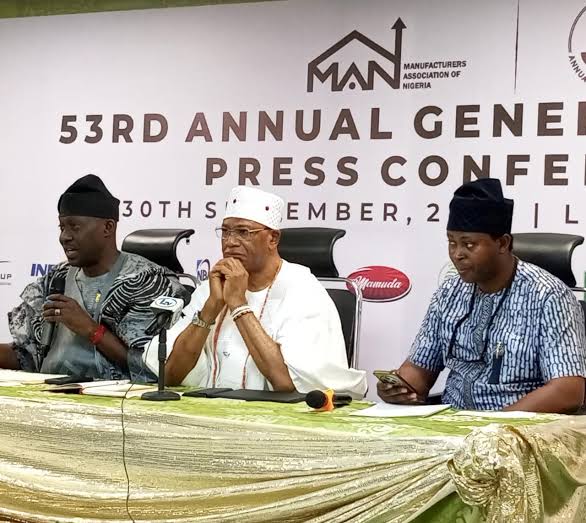
The Manufacturing body made the case at the opening of its 54th Annual General Meeting (AGM) of and the Made-in-Nigeria Products Exhibition in Lagos, with the theme, “Leveraging National Industrial Policy to Position Nigeria as Africa’s Industrial Hub.”
The President of MAN, Francis Meshioye regretted that the real sector is currently contributing about 3.3 per cent to Nigeria’s Gross Domestic Product (GDP).
Meshioye was emphatic that manufacturing has the capacity to account for as much as 25 per cent if the right policies are effectively implemented.
He stated the country’s heavy dependence on imported raw materials remained a major obstacle to achieving meaningful local value addition.
The President of MAN disclosed that Nigeria imported about N3.53 trillion worth of raw materials in the first half of 2025, with approximately N1.72 trillion sourced from Asia, underscoring the sector’s continued exposure to external supply chains.
Meshioye said the success of the Made-in-Nigeria agenda should be measured by tangible outcomes, including increased domestic value addition, lower production costs, higher capacity utilisation, stronger local supply chains, increased investment and greater access to regional and international markets.
He urged the Federal government to accelerate implementation of Executive Orders 003 and 005 and the Nigeria First Policy, particularly those aimed at increasing government patronage of locally manufactured goods.
According to him, government agencies that fail to comply with the directives should be sanctioned, stressing that “it is time for action.”
He also urged the Independent National Electoral Commission ,INEC, political parties and other agencies involved in the electoral process to prioritise locally manufactured products, particularly in the procurement of campaign and promotional materials.
Meshioye, however, warned that increasing output alone would not make Nigeria an industrial hub without addressing the high cost of production.
He identified energy costs, access to finance, industrial inputs, logistics, regulatory uncertainty, productivity and the ability of businesses to invest and expand as major determinants of industrial competitiveness.
Manufacturers, he said, spent approximately N1.35 trillion on alternative power in 2025, up from about N1.1 trillion in 2024.
While the expenditure helped businesses maintain operations, he said it diverted resources that could otherwise have been invested in capacity expansion, technology and productivity.
Meshioye further warned that efforts to increase local production of finished goods would have limited impact if Nigeria failed to develop domestic sources of raw materials and intermediate inputs.
He said the sector continued to face pressure from energy and financing costs, foreign exchange exposure, logistics, taxation, regulatory charges and weak consumer purchasing power.
The President of MAN said the association would continue to engage government and regulatory institutions on reforms that could support productive investment, strengthen local content and expand Nigeria’s export capacity.



