

By SIMEON OGOEGBULEM
The South East Development Commission (SEDC) has kicked off a $100 million gas distribution pipeline project to boost industrialisation, attract investments and create jobs in the South East.
The 400-kilometre pipeline, designed to connect gas resources to industrial and commercial centres across Enugu, Anambra, Imo, Abia and Ebonyi states, has about 150 potential customers identified, with projected demand of 254 million standard cubic feet of gas per day.
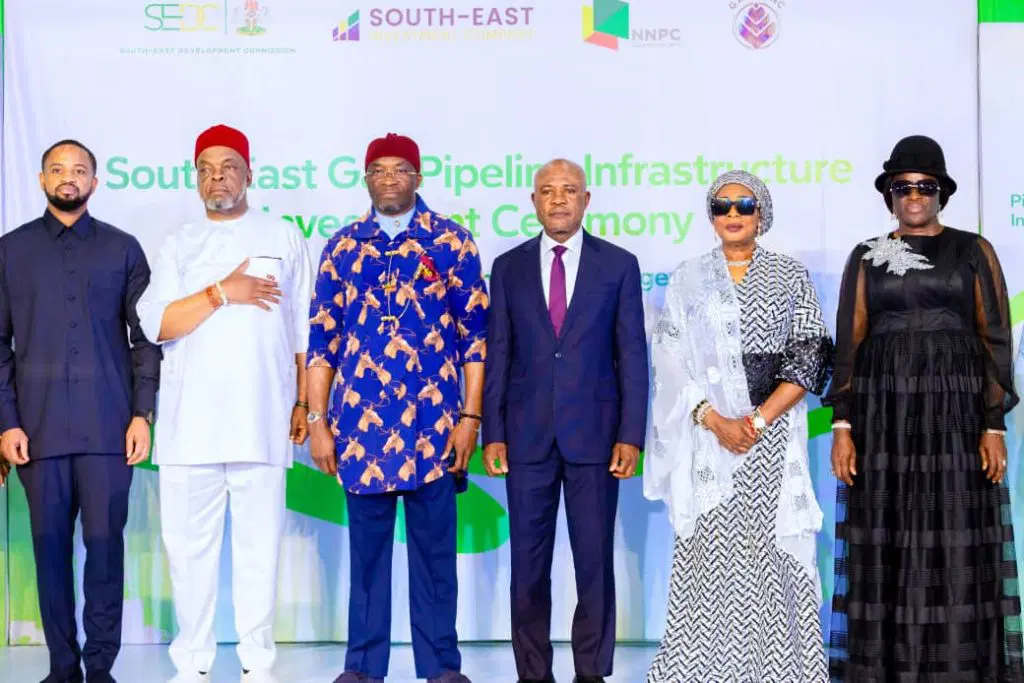
The investment agreement for the project was signed on Tuesday at the South-East Gas Infrastructure Investment and Project Development Ceremony held at Hotel Presidential, Enugu, marking a significant step towards establishing a regional gas distribution network.
President Ahmed Tinubu, represented by the Deputy Speaker of the House of Representatives, Benjamin Kalu, described the project as a strategic investment that would connect the region’s natural gas resources to industries, strengthen manufacturing and unlock economic opportunities across the five states.
Tinubu stated that the Southeast’s entrepreneurial spirit is one of Nigeria’s greatest economic assets and expressed strong conviction that the prosperity of the Southeast is inseparable from the prosperity of Nigeria.
The President noted that the gas pipeline project aligned with his administration’s commitment to building an integrated regional economy, stressing that gas infrastructure should support industrial development across state boundaries rather than serve isolated markets.
He said the pipeline would benefit manufacturers in Aba, strengthen industrial clusters in Nnewi and Onitsha, attract productive enterprises to Enugu, expand agro-processing and manufacturing in Ebonyi and connect Imo’s gas resources to the wider regional economy.
He, however, said the ambition extended beyond supplying existing factories to creating the conditions for new industries, industrial parks and investments that had stalled because of unreliable energy supply.
Tinubu commended the SEDC for committing $3 million to the gas project and establishing a framework to mobilise additional investments from state governments, institutions and private investors.
He said the project’s initial phase required approximately $100 million, describing the partnership between public institutions and private investors as essential to developing sustainable infrastructure.
“Our ambition is not simply to deliver gas to existing factories. It is to make possible factories that do not yet exist, industrial parks yet to be developed, and investments that have remained on the drawing board because reliable energy was unavailable,” Tinubu said.
He described SEDC as an institution established to deliver measurable development outcomes, urging it to assess its performance by the investments it mobilised, infrastructure it enabled, opportunities it created and lives it improved.
The President said the South-East Vision 2050 development framework, supported by Vice-President Kashim Shettima and the governors of the zone, provided a foundation for coordinated economic growth.
He also cited his approval of the South-East Investment Company as part of efforts to attract private capital into strategic development projects, noting that governments could not finance every development ambition from public funds.
“This is the model I expect from our development institutions: identify strategic economic opportunities, prepare credible projects, commit public resources responsibly and mobilise private capital at a scale government budgets alone cannot achieve,” he said.
Governor Peter Mbah of Enugu State, commended Tinubu for establishing the SEDC, describing the commission as the institutional vehicle needed to realise the Southeast’s longstanding industrialisation aspirations.
Mbah described the signing of the investment agreement as the commencement of the investment process, adding that the initiative would help realise the region’s aspiration for a common market and coordinated industrial development.
He expressed excitement that the project was advancing less than 13 months after he publicly advocated the idea, and praised the commission for adopting an innovative financing model that brings governments and private investors together.
He said the project would create opportunities for young people to build their futures in the Southeast rather than migrate to other parts of the country in search of jobs.
Managing Director and Chief Executive Officer of SEDC, Mark Okoye, said the commission had conducted technical, financial and legal due diligence before committing funds to the project, which received approval from its governing board.
Okoye said the commission was targeting aggregate regional investment participation of up to $30 million, including its initial $3 million commitment, as part of efforts to mobilise the private capital required to advance the project.
He said the initiative aligned with the commission’s industrialisation programme and its commitment to developing infrastructure that would benefit the entire region.
Representing GasSync, the project promoter, Callistus Mba said the pipeline would connect gas resources close to the Southeast to industrial users across the five states, reducing dependence on the expensive transportation of compressed natural gas (CNG) and liquefied natural gas (LNG) by road.
Mba said the proposed network would originate from the Ohaji area of Imo State, run through Owerri and branch towards Aba in Abia State and Onitsha in Anambra State, with extensions to Enugu and Ebonyi.
The governors of Imo, Anambra and Ebonyi States, Senator Hope Uzodimma, Professor Chukwuma Soludo and Francis Nwaifuru were represented by their Deputies, Lady Chinyere Ekomaru, Dr Onyekachukwu Ibezim and Mrs Patricia Obiala respectively.



