

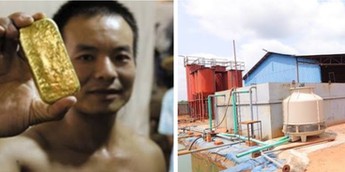
The Economic and Financial Crimes Commission (EFCC) has uncovered and taken custody of a massive, sprawling illegal industrial complex in Ogere, Ogun State, which was reportedly operated by Chinese nationals.
The enforcement raid, led by EFCC Executive Chairman Ola Olukoyede, revealed a highly sophisticated, unauthorized network of processing plants and mining hubs operating without government permits.
The chairman of Nigeria’s Economic and Financial Crimes Commission (EFCC), Ola Olukoyede, recently inspected an abandoned refinery in Ogere, Ogun State, where operatives discovered underground tanks and equipment believed to have been used for illegal oil processing.
Nigeria’s petroleum regulator confirmed that the facility occupied more than three hectares, operated without a permit and had underground storage capacity exceeding 90,000 litres.
Investigators also recovered waste materials and substances suspected to be diesel, while preliminary findings indicated that the operators sourced sludge oil, a petroleum residue, from Warri and Port Harcourt, two major centres of Nigeria’s oil industry.
According to local reports, the materials were allegedly transported to Ogun State, where they were heated and filtered to extract lighter petroleum products for sale in the Nigerian market.
However, those responsible remain unidentified, as security personnel reportedly told investigators that the Chinese operators had not disclosed their names or the company behind the facility.
The EFCC has secured the premises, while petroleum regulators warned that untested products from the refinery could damage vehicles and industrial equipment.
Earlier raid exposes four illegal lithium processing plants
The refinery discovery came after an October 23 operation in the same area, during which EFCC operatives arrested 14 Chinese nationals and one Nigerian over suspected illegal lithium processing activities at four plants.
Authorities recovered lithium-bearing rocks, electronic equipment and a truck, although investigators have yet to publicly identify the owners of the facilities or establish whether they were connected to the refinery.
The Nigerian investigation follows a separate crackdown in neighbouring Ghana, where authorities arrested two Chinese nationals in May 2026 after uncovering an illegal gold mining operation that had diverted part of a river for mineral extraction.
Ghana’s National Anti-Illegal Mining Operations Secretariat (NAIMOS) said the suspects were arrested on May 24 at Sanfo Adiam in the Ashanti Region, where mining equipment had been installed along the Dankai River.
Investigators found that sections of the river had been blocked and redirected into an artificial reservoir used for mining, raising concerns about environmental damage and the effects on nearby communities.
Nigeria considers licensed operators for seized facilities
Back in Nigeria, Olukoyede said the EFCC would seek court approval to preserve the equipment recovered from the suspected illegal operations and allow properly licensed businesses to take over the facilities where legally possible.
Rather than destroy the machinery, the commission intends to work with relevant regulators to identify qualified operators capable of putting the assets to legitimate commercial use.
“We are going to apply to court for all the necessary orders,” Olukoyede said, adding that regulatory agencies would help select professionals authorised to operate such facilities.
He explained that the approach would support economic activity and protect jobs while investigations into the suspected offences continued.
“One of the high points of the fight against financial crimes and economic crime is to use it to stimulate the economy. So all these things will not be destroyed. We are going to preserve them



