

… Raises concern over growing ethnic tensions
… Decries conflicting judicial pronouncements on political matters
… Technological improvements alone cannot guarantee credible elections – INEC
By George Ameh
Former President Goodluck Jonathan has warned presidential aspirants against acts capable of destabilising the country, cautioning that rising hate, political intolerance, thuggery and ethnic rivalry could threaten Nigeria’s peace and national unity.
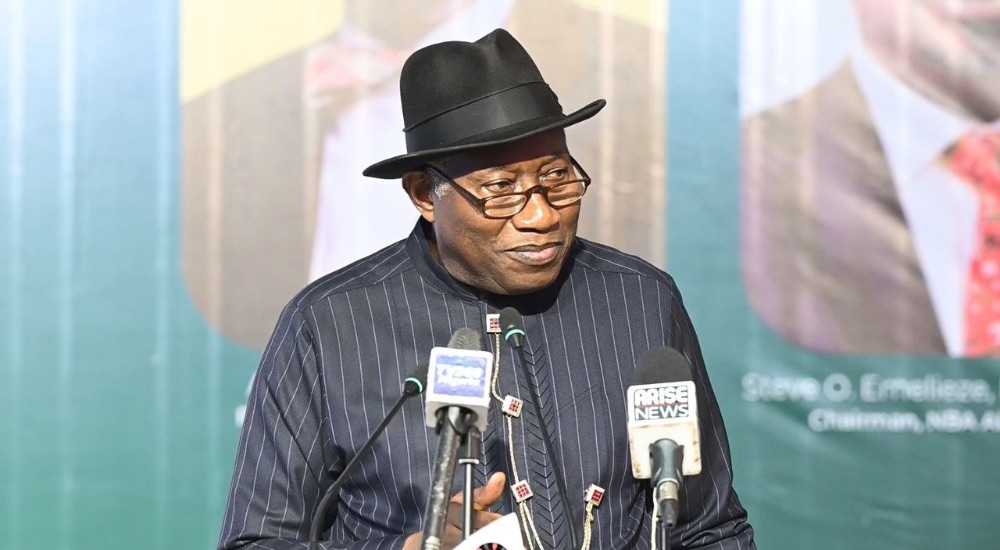
Jonathan raised the alarm on Tuesday in Abuja at the 2026 Goodluck Jonathan Foundation Peace Conference with the theme: ‘Safeguarding trust and strengthening social cohesion in a competitive political environment.’
He condemned the growing tendency among politicians to run political organisations and campaign teams like cult groups, where opponents are regarded as enemies to be attacked, killed or maimed.
The former President warned that Nigeria cannot afford to ignore the growing concerns about the direction of its political environment, particularly as the country approaches another general election.
He likened INEC to a referee in a football competition, the judiciary to video assistant referees and the general public to supporters, arguing that citizens must openly reject political excesses rather than limit their democratic responsibilities to voting.
He said: “Rather than the confidence and optimism we should be inspiring, there is growing apprehension about the likelihood of crises that may follow our elections. We must not ignore these concerns by the people, and we must do everything to prevent it as a nation and as people.”
Jonathan particularly condemned the exploitation of young Nigerians as instruments of political violence, warning that the growing unwillingness of politicians to accommodate opposing views was dangerous to democratic survival.
He also expressed concern over conflicting judicial pronouncements on political matters, warning that declining confidence in the courts could push citizens towards self-help and ultimately anarchy.
“Equally disturbing are controversies surrounding some judicial pronouncements. And I’m a bit careful whenever it comes to judicial pronouncements. What worries the most is courts of the same powers giving different pronouncements on the same matter, and sometimes lower courts sitting as an appellate court to even superior courts.
“So, when ordinary people observe this, people get worried. And a growing concern in Nigeria again is like I don’t know how to put it down, I wanted to say window shopping of courts, but that is not a correct description. People will go to courts that they think those who operate those courts are their friends, and they can carry something from Sokoto to Yenagoa, from Yenagoa to Kano, and they are making those of us who are not lawyers start asking what is happening in the country,” he said.
According to him, INEC needs to look into some of these and streamline approaches to litigations in Nigeria so that people will have confidence in the courts. “When citizens begin to lose faith in the courts and resort to self-help, the consequences can be very disastrous. Because if we don’t have confidence in our courts, the next step is self-help,. And that is a sign of anarchy, and we must not get to that point. The descent from a loss of confidence in institutions to anarchy is a danger we must collectively prevent, and we must not allow it to happen.
“There are growing concerns that our coming elections may degenerate into destructive ethnic rivalry at both the national and state levels, because the pattern of emerging issues could now ignite ethnic rivalry. And there’s nothing as bad as when ethnicity or religion is brought into the election and becomes confrontational; you can no longer solve the problem.
“Nothing could be more dangerous to our national existence than the deliberate encouragement of ethnic rivalry. We must never allow political ambition to undermine the bonds that hold us together as one nation and one country, both at the national level and at the state level.
These are precisely the concerns that inform this conference.”
On leadership recruitment, the former President urged Nigerians to prioritise competence, credibility and public service above ethnic, religious and other primordial considerations.
Jonathan also called for stronger preventive diplomacy, inclusive economic development and responsible use of digital platforms, warning that artificial intelligence-generated images, fabricated audio recordings and manipulated videos could inflame ethnic and religious tensions during the election period.
The former President recalled his decision to accept the outcome of the 2015 presidential election and facilitate a peaceful transfer of power, describing the experience as an enduring lesson in democratic statesmanship.
He maintained that political competition must never be allowed to destroy the country’s shared identity, declaring that no electoral victory was worth the sacrifice of national peace and no political ambition should outweigh the responsibility to preserve Nigeria.
In his remarks, the Chairman, Independent National Electoral Commission (INEC), Prof. Joash Amupitan, represented by National Commissioner, Mrs. May Agbamuche-Mbu, declared that the Commission had no preferred political party, favoured candidate or hidden agenda ahead of the 2027 general elections.
Amupitan stated that the number of verified voters had surpassed 100 million following the removal of more than 1.6 million invalid records through Continuous Voter Registration and Automated Biometric Identification System audits.
He said the Commission had also introduced operational and technological improvements under the Electoral Act 2026, including the procurement of 57,000 new Bimodal Voter Accreditation System devices and an upgraded IReV platform designed to reject polling unit results that fail arithmetic checks or indicate over-voting.
The INEC chairman announced that the Commission would conduct a nationwide mock accreditation and result transmission exercise on November 28, 2026, across the 36 states and the Federal Capital Territory to test its preparedness for the 2027 elections.
However, he warned that technological improvements alone could not guarantee credible elections without responsible conduct by political parties and their supporters, condemning recent incidents of political violence, intimidation and attacks on campaign convoys.
Issuing a stern warning to political actors, sponsors and their supporters, Amupitan said security agencies would work with INEC to identify and prosecute those responsible for violent campaigns, while stressing that attacks on election officials would attract decisive legal consequences.
He also cited Sections 96 and 97 of the Electoral Act 2026, which prohibit abusive and inflammatory campaign language, the deployment of thugs and private guards at political rallies, and the use of force to intimidate voters or political opponents.
He noted that the law provides for fines of up to N5 million or 12 months’ imprisonment for offending individuals, while political parties could face fines of up to N10 million for initial breaches. Under Section 148, he added, INEC is empowered to prosecute electoral offenders upon receiving investigative case files from the police.
On election security, INEC stated that the Commission is strengthening collaboration with security agencies through the Inter-Agency Consultative Committee on Election Security (ICCES), while establishing a dedicated Artificial Intelligence Division to monitor digital threats, verify online content and combat misinformation.
While declaring the conference open, former Vice-President, Namadi Sambo, described the theme as particularly relevant to Nigeria’s democratic development, stressing that political competition must not be allowed to undermine national identity, weaken institutions or threaten the country’s unity.
Sambo said, “Democracy thrives on trust, mutual respect, credible institutions, and the confidence of citizens as exercised in the political process. While competition is an essential feature of democratic governance, it must never be allowed to undermine our shared national identity, weaken our institutions, or threaten the unity and stability of our dear country.”
He urged political actors to regard differences as opportunities for constructive engagement rather than sources of division, insisting that national cohesion must transcend political affiliations and personal interests.
According to him, “We must deliberately build bridges across our ethnic, religious, and political differences and create an environment where we can all be together. Our democracy must be competitive, but our nation must remain united.”



