

By Joy Onu
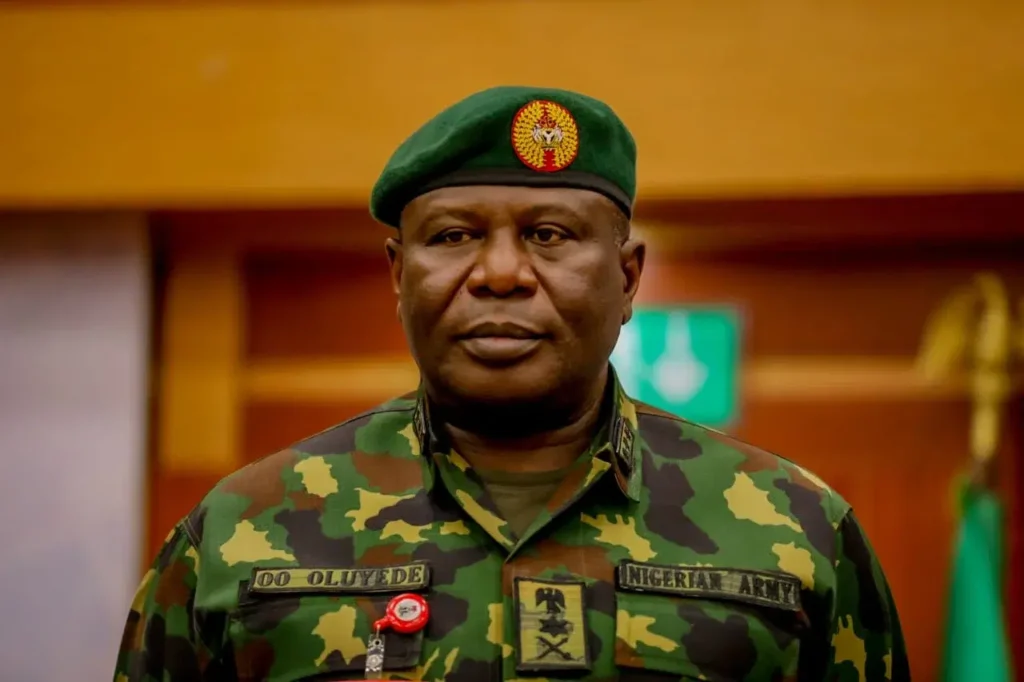
The Chief of Defence Staff (CDS), General Olufemi Oluyede, has urged media practitioners to verify information, protect sensitive operational details and strengthen public confidence in the Armed Forces through responsible reporting.
He said the growing threat of misinformation, disinformation and artificial intelligence-generated content had made strategic communication increasingly important to national security, stressing that accuracy must take precedence over speed and sensationalism.
Oluyede made the remark on Tuesday at the opening of the 2026 Defence Headquarters Strategic Communication Workshop at the National Defence College, Abuja, themed,
“Enhancing Strategic Collaboration Between Spokespersons of Security Agencies and Media Stakeholders for Accurate and Responsible Reportage Towards Improved National Security.”
The two-day workshop brought together serving and retired senior military officers, resource persons, journalists, spokespersons of security agencies and other media stakeholders to strengthen collaboration and promote accurate and responsible reportage in the interest of national security.
The CDS described the information domain as a critical component of modern warfare, noting that military success depended not only on combat capabilities but also on the ability to counter adversarial narratives and sustain public confidence.
He warned that old videos, misrepresented images and AI-generated audio-visual materials could create panic and undermine trust, urging journalists to adopt the principle of “verify before amplify.”
Oluyede said the Armed Forces regarded the media as a national security partner and did not expect journalists to abandon their watchdog responsibilities.
According to him, mutual respect, professionalism, sustained engagement and specialised training for defence correspondents would improve collaboration while ensuring that reports did not expose troop movements, locations or other sensitive information capable of compromising operations.
Represented by the Director-General of the Voice of Nigeria, Alhaji Baba Ndace, the Minister of Information and National Orientation, Mohammed Idris, said national security depended not only on operational capacity but also on the credibility and quality of information available to the public.
He said security agencies must provide timely and credible updates, while journalists should provide context and avoid reports capable of endangering lives or ongoing operations.
Idris stressed that responsible reporting was not a call for censorship, adding that the public’s right to information and the media’s constitutional responsibilities must be respected alongside legitimate security considerations.
He said the federal government was strengthening coordination among security institutions and promoting media and information literacy to equip citizens to identify false information.
The Minister cited the establishment of the International Media and Information Literacy Institute in Abuja, in partnership with UNESCO, as part of efforts to address misinformation in the digital environment.
The Special Adviser to the President on Media and Public Communication, Sunday Dare, said strategic communication must be planned before crises occur, warning that scrambling to counter negative narratives after they had gained traction indicated communication failure.
Dare said communication must be factual, timely and tailored to different audiences, adding that humanising security stories could help citizens understand military operations beyond statistics and official statements. He cautioned against confusing public relations with propaganda, noting that credible communication must be anchored on truth rather than manipulation or disinformation.
In a paper titled, “Framing Narratives and Messages to Enhance National Security,” Professor Abdullahi Saleh Bashir, Dean, Faculty of Communication and Media Studies, University of Abuja, urged the military to adopt people-centred storytelling to build public trust.
He identified protection, patriotism, partnership, peace-building, professionalism and human-interest perspectives as frames through which the military could communicate its activities.
Bashir illustrated the approach with the account of troops transported by helicopter from frontline locations to avoid dangerous routes reportedly mined by insurgents, explaining that highlighting the experiences of soldiers and their families could make military operations more relatable. He warned that failure to communicate stories effectively could allow adversaries to dominate public narratives.
Veteran journalist and TVC News Director, Babajide Kolade-Otitoju, in a presentation titled, “Understanding Military Operations and Their Sensitivity: A Guide for Effective and Responsible Defence Reporting,” urged journalists to avoid publishing information capable of compromising military operations.
He said the pressure to break news first must never override accuracy, stressing that it was better to miss a story than misinform the public. Otitoju cautioned against real-time reporting of troop movements, rescue operations and sensitive locations, noting that such disclosures could expose personnel to ambushes and jeopardise missions.
He urged journalists to treat social media content as leads requiring verification, authenticate videos through their sources, timestamps and geolocation, and understand military terminology to avoid misleading reports. He also stressed that casualty reporting must respect next-of-kin notification, while graphic images of fallen personnel should be handled with sensitivity.
He said defence reporting must balance accountability and the public’s right to know with operational security and the protection of lives.



