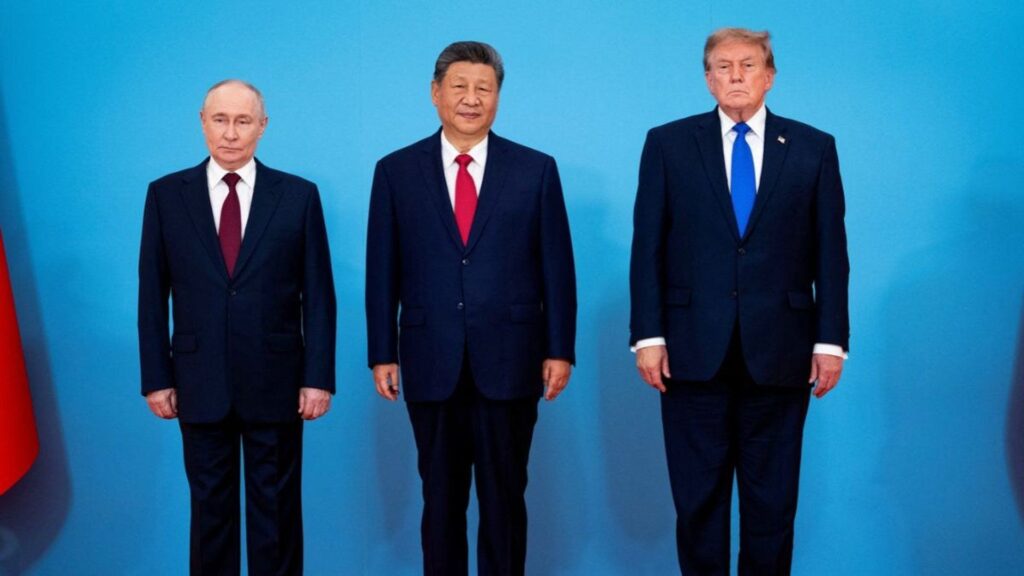
The November 19, 2026 trilateral summit in Shenzhen between U.S. President Donald Trump, Chinese President Xi Jinping, and Russian President Vladimir Putin highlighted sharp contrasts between their public calls for peace and their active geopolitical postures.
Foreign policy analysts and international observers widely noted this tension between the leaders’ rhetoric on global stability and their ongoing military conflicts and nuclear stockpiles.
While the three leaders signed a joint declaration stating that “a nuclear war cannot be won and must never be fought” and pledged to reduce nuclear risks, critics and observers point to several contradictions underlying the summit.There is an existing international pact against nuclear stockpiles and non-proliferation.
According to ABC7, the United States and Russia each hold more than 5,000 nuclear warheads, while China possesses over 600 and is rapidly expanding its arsenal. At the summit, Trump explicitly stated that the three powers would not allow Iran to acquire a nuclear weapon, even citing the difficulty of disarmament once weapons are acquired as a justification for the ongoing U.S. war with Iran, while the three nations themselves maintain massive arsenals without a binding arms treaty following the expiration of New START in February 2026.
The irony of a peace rhetoric alongside active conflicts is a point to note. As reported by El País, Putin invoked the Allied victory in World War II and the United Nations Charter to emphasise the trio’s shared duty to uphold international law and peace. Observers note this contrasts sharply with Russia’s ongoing war in Ukraine, the U.S. military conflict with Iran, and Beijing’s continued military and political pressure on Taiwan.
There has been a sustained criticism of international institutions such as the United Nations (UN). Despite framing themselves as guardians of the global order, the three leaders used the summit to agree on curbing the reach of the International Criminal Court (ICC), which has issued an arrest warrant for Putin over the war in Ukraine and faced intense U.S. pressure over its actions regarding Israel, while leaving the wars in Ukraine and Iran completely out of their final joint statement.
Analysts cited by outlets like Foreign Policy have characterised the summit less as a substantive breakthrough for global peace and more as a strategic photo opportunity that prioritised great-power optics and immediate economic interests, such as boosting refined fossil fuel supplies, over resolving active wars or making binding disarmament commitments.
According to international relations analysts and news reports, the meeting in China produced heavy diplomatic symbolism but few concrete agreements for world peace, leaving Africa largely on the sidelines of major power negotiations.
While the three leaders issued a four-point “joint declaration of peace” addressing nuclear risks, energy supplies, United Nations reform, and limits on international courts, observers note that the summit’s omission of active global conflicts raised new questions about how great-power politics will affect smaller nations.
Analysts at The Guardian note that in spite of the three leaders’ affirmation that a nuclear war “must never be fought” against the backdrop of the expired New START treaty. However, the fact that there was no announcement on binding arms-control agreements, timelines, or warhead limits smirks of a translucent hypocrisy.
Experts from the Council on Foreign Relations have pointed out that the joint statement completely left out the ongoing Russia-Ukraine war and the U.S.-led conflict with Iran, limiting the summit’s immediate impact on active global flashpoints.
Also, reports from the media highlight that the three powers agreed to curb the jurisdiction of the International Criminal Court (ICC) and protect state officials’ immunity, a step legal and diplomatic observers warn, weakens international accountability mechanisms for war crimes.
One of the criticisms against the summit is its potential shift towards a “G3” sphere of Influence. Researchers at the Observer Research Foundation suggest the summit signals a move toward managing crises through exclusive great-power deals rather than inclusive international bodies, which risks marginalising smaller nations.
Although specific African conflicts, such as those in Sudan, the Democratic Republic of Congo, and the Sahel, were not confirmed on the Shenzhen agenda, analysts identify several indirect effects on the continent.
The summit also portends to impact on energy costs and household budgets. According to Nigerian outlet MedCenter, the trio’s pledge to increase refined petroleum supplies and stabilise energy markets is the most immediate takeaway for African economies.
If implemented, the resolution of the summit will see to the easing of global fuel shortages, especially following disruptions in the Strait of Hormuz, and could relieve inflation, fuel prices, and fertilizer costs across countries like Nigeria.
Commentators on TRT Afrika note that while the three powers promised vague reforms to the United Nations where Africa holds the largest voting bloc in the UN General Assembly, African nations must remain critical to any formal UN restructuring, even as the U.S., China, and Russia retain Security Council veto power.
Security analysts warn that if the three powers operate through competing spheres of influence rather than unified multilateral frameworks, it could complicate UN peacekeeping mandates, sanctions enforcement, and conflict mediation in the Sahel and East Africa.
The trilateral meeting and the agreements signed provides a strategic positioning for African leaders. As reported by QuickNews Africa, regional analysts argue that the summit’s “great-power bargaining” serves as a reminder for African governments to strengthen continental unity and negotiate collectively with Washington, Beijing, and Moscow over lending, security, and resources rather than being treated as passive bystanders.