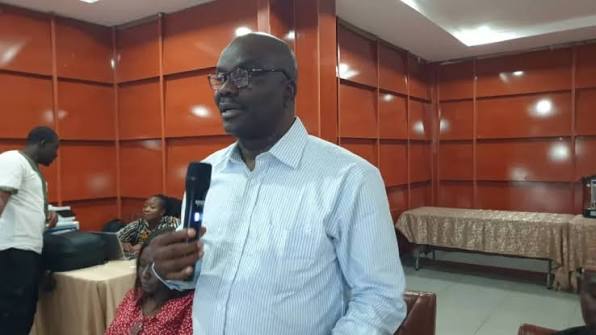
The Chief Executive Officer of Benignant Forte Nigeria Limited, Akor Philip Paul speaks about his company’s commitment to building generational wealth for Nigerians while striving to project a positive image of the country. In this interview with DEBORAH OLUSEGUN, he reveals his motivation, successes and vision for Benignant Forte Nigeria.
What is your background?
My name is Akor Philip Paul. I was born into a Roman Catholic family with five children. My dad was an administrator with Nigerian Post Authority and my mum was a trader, she did small and big trades. I was raised with a Catholic doctrine which was basically respected your elders, always be truthful and others. My family was a normal family and my dad is someone who is modest, he does not like showmanship. We didn’t lack anything as kids and what we needed per time was always there but we were taught to be ambitious. I am the third of five siblings, I have an elder sister, Vera and an elder brother, Stephen, who is an architect and a younger sister, Anastasia, who is a pharmacist and the last young man, Anthony, who is a student in the United Kingdom presently. I took two of my father’s name. I do not resemble him physically but we have same mannerisms. At every point in time, no matter how serious business is, he finds a way to crack jokes. And I look like my mother physically.
What did you study in school?
I studied at the Ahmadu Bello University, Zaria. And allow me to talk about ABU. It is always said that my alma matter is naturally ahead. That is because whatever you want to become, you become that excellently at ABU, Zaria. And it is the biggest university in Sub-Saharan Africa. I studied sociology and majored in Industrial Sociology.
Did your course impact on your business acumen and your decision to start Benignant?
Sociology broadened my scope of business. Sociology is the study of society and since business is built around people, Sociology helped me to understand the different dimensions of problems that exist in society. But, as far as I can remember, when my dad was working with the NPA, he was raising men and the reason for that was because a time was going to come when these men would raise us and he raised genuine men who were going to raise us. I was in SSS1 when I told him I did not like government job and the way it was done here in Nigeria, so I have always had that drive for business. And I never saw my mum lack money. I never saw my dad do too but there was this level of honour and respect I had for my mum especially when my dad was not around and if there was a need, she would get it done. So, she influenced my thirst for business. And I mostly associated with the Igbo. I am from Kogi State and I am Igala. But I have Igbo ancestry. My dad’s maternal family are Igbo from Enugu State and my mother’s maternal side are Igbo from Anambra State, so there was that fusion of Igbo mentality and I grew up mostly among Igbos which also influenced me. Sociology helped me to identify a problem and how to solve it.
What is the initial goal and objective of Benignant?
The initial goal of Benignant has always been and would always be number one, to pioneer a new generation of business-minded people who are not only interested in the profit but are also interested in the process that brings profit. If you must do business that transcends beyond one generation then you must think about the processes that bring the end. So Benignant is about generational wealth. It is an organisation that has come to educate by living out the right life for people to see. I, as a person, do not believe in pointing accusing fingers. I believe that the right way to correct an error is to set a proper example for the person to see. For us, the goal has always been to bring business in a peaceful, progressive, partnering and profiting way. A point would come where when Benignant is brought into a transaction, people will be more confident about it. When you travel around the world, the moment you bring out your Nigerian passport, there is an air of suspicion. Immigration officers are not so sure that there is something you are not trying to smuggle. This happens because the compromise of one generation became a culture and corruption became institutionalised which meant that there were not enough resources to go round to other people who were not in the civil service at some point. And young people were deprived of education which led to more corruption because people had to survive. Benignant alone cannot change this impression about Nigeria and that is why I am a lover of partnership and a lover of corroborative business dealings. Why? We are crying because the leaders are bad and we are clamouring for better leadership. But the fear is that those who are waiting to steal are more than those who are stealing.
So, why investments?
That is not the basic thing about Benignant. No, it is not, but the testimonials on the company’s website are from investors which spark curiosity… Awesome. There is a huge disparity between the bourgeoisie and the proletariat and there is no middle class anymore and we came to democratise this. Before I started Benignant, I worked in an investment organisation which is still functioning. I was the Pioneer Chief Investment Officer, the Pioneer Advisory General Manager, and the Group General Manager. When I was there, I noticed that investment was reserved for the rich. One of the reasons there is prevalence of scam in this nation is because those who are poor do not have the means to live according to the institutionalised standards of success in the country. Someone who was born in a slum in Adamawa State realizes that he has to go to school, he has to get a job, he has to earn a living, he has to send money back to those at home. When society judges, he won’t be judged kindly. Some might even call him careless and redundant. He begins to look for a quick means to cover the gap. Why we came into investment was to cover this gap. I had built my portfolio with men whom I could start a private investment with. But we saw the gap. It is the guy who has N20,000 that wants to earn N1 million in 30 seconds and it is so easy to dupe him. It is not attainable. So, we came up and said ‘let’s democratise investment. Let’s allow them to come and understand what investment is. We focus on the low-income earners. It is tedious, and without commitment, we would have backed out because these people abuse the most, they are scared the most but over the past sixteen months we have been able to gain a level of trust with them. We have people who get 4 per cent on N10,000 and even though it is not much, the goal is to change their mindset. We are the first that brought investment that low. Others don’t move below N300,000 or N1 million but it has changed a lot of things. I have seen guys that are no longer interested in the whole get-rich-quick scheme. Knowing the limit of those whose money we can handle at a particular period has helped us. When the money becomes too much, wastage comes in. You could fall victim to what I call ‘dormant money syndrome’. You might even run out of ideas of what to do with the money. Before I started Benignant, I had those who I had managed funds for who were confident of my abilities and a particular lady asked me to manage her funds for her. She insisted that I started managing her funds and others too.
What do you think Benignant has contributed to real estate in Nigeria?
Real estate for us is more like a store of value for us, a means by which we increase our liquidity. I might have a number of persons who would fight me for this but I have always said that if you want to do an investment for a very long time, buy properties. We cannot afford to keep our surplus funds in the bank because what the bank would do with those funds is what we do, so instead of keeping the funds idle, we develop properties with them. We build and we sell. At every point in time our liquidity is high since we build and we sell. You cannot run after every business idea that comes to your mind. You must find the business that fits you and stick with it. We have properties at Orozo and Lugbe and other places. So, when net profit comes down, we decide the amount we need to inject back into the business.
How did the pandemic affect your real estate business?
For us, the issues we faced and even now is the disparity between the naira and the dollar. If we have built sometime in 2013, the dollar was not as high as this. If we had sold at the time, we would have made more profit. Most of our clients stay abroad and they use lesser dollars to purchase more properties. Most of the things we use in our buildings we import.
What about the agricultural arm of Benignant?
Our agricultural arm covers snail, oil palm, maize breeding, and garri. The agro arm of the business excites me. When you build a stream of income around what people consume day in day out and people who consume are both from the micro and macro spheres of society, you’d have a daily cash flow. Agriculture is high-risk. Challenges are not really the problem but how you approach them. For us, before we take a step, we have consultants who are experienced. You can’t control flood and when it happens you cannot fault God. When the herdsmen go into your farm, you cannot sue them. But with an insurance company covering what you are doing there is a level of security. You cannot take away the level of uncertainty but one thing is sure that if anything goes wrong, there is something to fall back on. The least of our farms covers 5.7 acres. We also approach companies like Olam. When we approach Olam, they give us their preferred breed of maize and a specialist who would ensure we get it right. At the time of the initiation of the contract, payment has been made which saves us the battle we have to fight in a market that has already been established and also saves us from sabotage. We also do livestock and have a snail farm at Ugep in Cross River State with healthy massive snails. We have created a good market for ourselves because the name Benignant sells itself. Recently, we had to make a post that our garri is sold out and it took a period of one to two weeks to restock. We make sure that because we have built this name, we bring out quality. And so long as you consume something which did not harm you, it is sure that you’d come back for it. Management has helped us. It includes counsel, insurance and the management of communication. Agriculture for us is a win-win thing.
So, the haulage and logistics part of the business…
Haulage is the movement of heavy-duty goods from the port. We move goods that are about 25 tonnes and not exceeding 120 tonnes to any location within Nigeria and down to Benin Republic and Togo. To make sure we establish good quality, the trucks run for a 69-day period, on the 70th day they must be in Kano for inspection. We use the American standard of inspection. We check the driver’s sight and stature for defects. We check the truck’s seatbelt, brake pads, headlights, fluids. We make sure the truck is in good shape and often when we check we find out that there is a fault beginning to happen but it is cheaper to fix when we identify them on time before they escalate. We move goods every day and the God-factor comes in because we are so blessed to get the Lagos to Kano, Lagos to PortHarcourt, Port-Harcourt to Sokoto and we earn as net profit nothing less than N850,000 on a trip and a round trip earns N1.6 million naira on an average.
Is this good news extended to the logistic arm?
Yes, the branding sells itself.
Where would Benignant be in the next five to 10 years?
Benignant should become a tested investment bank in Nigeria. Chief of my role models is Tolu Elumelu and I am a member of his foundation (the Tony Elumelu Foundation). And I also have who has been termed the godfather of banking, Jim Ovia, the Chairman of Zenith Bank.